Nuclear physics
Elements
Aug 4th 2018

When you make a direct application from table of elements, iron converts to manganese, when corrosion consumes it.
Corrupted iron is weaker and lighter than fresh iron, but other qualities are almost unchanged.

Bohr's table defines atoms by the number of protons and neutrons in the core, wow.  Bohr's table of elements obviously used to define the atoms with their weight.

Bohr's table of elements cannot be correct. Qualities of atom must come from somewhere else. Weight is one typical quality of an atom. Since number of electrons can change, qualities come from the proton.  Proton is built from quantum particles, then it maintains gravitational and rotational fields. The qualities of an atom comes from construction material and the fields the proton maintains.

Most common elements were discovered long before electrons and protons.

- - - -

Currently it is impossible to research qualities of quantum particles. Not very easy to find a way to see electrons in solid material, either.

With projector microscope it is already possible to research proton's fields. You can get the rotation speeds, possibly also the sizes of the fields. Quantum particles are obviously too small for projector microscope : Estimation is that pressure threads are bigger than quantum particles. When so, threads ignore the quantum particles.

Table with field size

With atom weigh and density it is already possible to simply calculate estimation from atom's field sizes. With atom weigh, you get the number of atoms in volume. When you know the number of atoms in volume, you can calculate how much space each atom takes in the volume. Atoms' fields are balls. Vertical and horizontal diameters are almost the same. Magnetic drag field is different from drag and rotation fields. It is obviously created with atoms' rotation.

In the table field sizes are clamped with default density. Gases have 1000 times bigger fields than solid and liquid elements.
Atom weigh is 1.66 * 10-24 grams. One carbon atom weighs 12 units. It is needed when you calculate SI sizes for the fields. In the table Size pM is size in pica meters ( 10-12). Conversion and calculation of diameter flattens the numbers, in the conversion you remove the power of 3 effect.

- The table shows you very clearly, that element number and atom weigh does not have a connection to field size.
- Table shows also, that electric conductivity is not dependent on field size.

Number Symbol Gas Weigh  Density-g/L  Field Size  Size pM  Melts C   Boils C   Phase  Type Classification
17 Cl Chlorine 35.4530 3.2000 11.0791 2 639.59 -101.50 -34.04 Gas G Non-Metal, Toxic
9 F Fluorine 18.9984 1.7000 11.1755 2 647.23 -219.62 -188.12 Gas G Non-Metal, Toxic
8 O Oxygen 15.9994 1.4290 11.1962 2 648.87 -218.79 -182.95 Gas G Non-Metal
7 N Nitrogen 14.0067 1.2510 11.1964 2 648.88 -210.00 -195.79 Gas G Non-Metal
1 H Hydrogen 1.0079 0.0899 11.2143 2 650.30 -259.14 -252.87 Gas G Non-Metal
54 Xe Xenon 131.2930 5.8940 22.2757 3 331.55 -111.70 -108.12 Gas G Noble Gas
36 Kr Krypton 83.7980 3.7490 22.3521 3 335.36 -157.36 -153.22 Gas G Noble Gas
18 Ar Argon 39.9480 1.7840 22.3924 3 337.36 -189.35 -185.85 Gas G Noble Gas
2 He Helium 4.0026 0.1786 22.4110 3 338.28 -272.20 -268.93 Gas G Noble Gas
10 Ne Neon 20.1797 0.9002 22.4169 3 338.58 -248.59 -246.08 Gas G Noble Gas
86 Rn Radon 222.0000 9.7300 22.8160 3 358.27 -71.15 -61.85 Gas G Noble Gas, Radioactive, Toxic
Number Symbol Solid - Liquid Weigh  g/cm3   Field Size   Size pM   Melts C   Boils C   Phase  Type Classification
5 B Boron 10.8110 2.3400 4.6201 197.21 2 076.00 3 927.00 Solid S Semi-Metal, Toxic
4 Be Beryllium 9.0122 1.8500 4.8714 200.72 1 287.00 2 469.00 Solid S Alkaline Earth Metal, Toxic
6 C Carbon 12.0107 2.2670 5.2981 206.42 3 550.00 3 800.00 Solid S Non-Metal
28 Ni Nickel 58.6934 8.9080 6.5888 221.98 1 455.00 2 913.00 Solid S Metal, Toxic
27 Co Cobalt 58.9332 8.9000 6.6217 222.34 1 495.00 2 927.00 Solid S Metal, Toxic
29 Cu Copper - Cuprum 63.5460 8.9600 7.0922 227.49 1 084.62 2 562.00 Solid S Metal, Toxic
26 Fe Iron - Ferrum 55.8450 7.8600 7.1050 227.63 1 538.00 2 861.00 Solid S Metal
24 Cr Chromium 51.9961 7.1500 7.2722 229.40 1 907.00 2 671.00 Solid S Metal, Toxic
25 Mn Manganese 54.9380 7.4300 7.3941 230.67 1 246.00 2 061.00 Solid S Metal, Toxic
44 Ru Ruthenium 101.0700 12.4500 8.1181 237.97 2 334.00 4 150.00 Solid S Noble Metal
45 Rh Rhodium 102.9050 12.4100 8.2921 239.66 1 964.00 3 695.00 Solid S Noble Metal
76 Os Osmium 190.2300 22.6100 8.4135 240.82 3 033.00 5 012.00 Solid S Noble Metal
77 Ir Iridium 192.2170 22.6500 8.4864 241.51 2 446.00 4 428.00 Solid S Noble Metal
23 V Vanadium 50.9415 6.0000 8.4903 241.55 1 910.00 3 407.00 Solid S Metal, Toxic
46 Pd Palladium 106.4200 12.0230 8.8514 244.93 1 554.90 2 963.00 Solid S Noble Metal
75 Re Rhenium 186.2070 21.0200 8.8586 244.99 3 186.00 5 596.00 Solid S Noble Metal
43 Tc Technetium 98.0000 11.0000 8.9091 245.46 2 157.00 4 265.00 Solid X Metal, Radioactive, Synthetic
78 Pt Platinum 195.0840 21.4500 9.0948 247.15 1 768.30 3 825.00 Solid S Noble Metal
30 Zn Zinc 65.4090 7.1400 9.1609 247.75 419.53 907.00 Solid S Metal, Toxic
42 Mo Molybdenum 95.9400 10.2800 9.3327 249.29 2 623.00 4 639.00 Solid S Metal
74 W Tungsten - Wolfram 183.8400 19.2500 9.5501 251.21 3 422.00 5 555.00 Solid S Metal
13 Al Aluminum - Aluminium 26.9815 2.7000 9.9932 255.04 660.32 2 519.00 Solid S Metal, Toxic
79 Au Gold - Aurum 196.9666 19.3000 10.2055 256.83 1 064.18 2 856.00 Solid S Noble Metal
47 Ag Silver - Argentum 107.8682 10.4900 10.2830 257.48 961.78 2 162.00 Solid S Noble Metal, Toxic
22 Ti Titanium 47.8670 4.5060 10.6229 260.29 1 668.00 3 287.00 Solid S Metal
41 Nb Niobium 92.9060 8.5700 10.8408 262.05 2 477.00 4 744.00 Solid S Metal
73 Ta Tantalum 180.9479 16.6900 10.8417 262.06 3 017.00 5 458.00 Solid S Noble Metal
93 Np Neptunium 237.0000 20.2000 11.7327 269.05 637.00 4 000.00 Solid S Metal, Radioactive, Toxic
31 Ga Gallium 69.7230 5.9100 11.7975 269.55 29.76 2 204.00 Solid S Metal
14 Si Silicon 28.0855 2.3300 12.0539 271.48 1 414.00 3 265.00 Solid S Semi-Metal
94 Pu Plutonium 244.0000 19.8160 12.3133 273.42 639.40 3 228.00 Solid S Metal, Radioactive, Toxic
92 U Uranium 238.0289 19.1000 12.4622 274.52 1 132.20 4 131.00 Solid S Metal, Radioactive, Toxic
48 Cd Cadmium 112.4110 8.6500 12.9955 278.38 321.07 767.00 Solid S Metal, Toxic
3 Li Lithium 6.9410 0.5340 12.9981 278.40 180.54 1 342.00 Solid S Alkali Metal
33 As Arsenic 74.9216 5.7270 13.0822 278.99 817.00 614.00 Solid S Semi-Metal, Toxic
72 Hf Hafnium 178.4900 13.3100 13.4102 281.31 2 233.00 4 603.00 Solid S Metal
32 Ge Germanium 72.6400 5.3230 13.6464 282.95 938.25 2 833.00 Solid S Semi-Metal
12 Mg Magnesium 24.3050 1.7380 13.9845 285.27 650.00 1 090.00 Solid S Alkaline Earth Metal
40 Zr Zirconium 91.2240 6.5200 13.9914 285.31 1 855.00 4 409.00 Solid S Metal
80 Hg Mercury - Hydrargyrum 200.5900 13.5340 14.8212 290.85 -38.83 356.73 Liquid S Metal, Toxic
91 Pa Protactinium 231.0359 15.3700 15.0316 292.22 1 568.00 4 027.00 Solid X Metal, Radioactive, Synthetic
21 Sc Scandium 44.9559 2.9850 15.0606 292.40 1 541.00 2 836.00 Solid S Metal
16 S Sulfur 32.0650 2.0670 15.5128 295.30 115.21 444.60 Solid S Non-Metal
49 In Indium 114.8180 7.3100 15.7070 296.53 156.60 2 072.00 Solid S Metal
50 Sn Tin - Stannum 118.7100 7.2870 16.2907 300.16 231.93 2 602.00 Solid S Metal
34 Se Selenium 78.9600 4.8090 16.4192 300.94 221.00 685.00 Solid S Non-Metal, Toxic
15 P Phosphorus 30.9738 1.8200 17.0186 304.56 44.20 277.00 Solid S Non-Metal, Toxic
81 Tl Thallium 204.3833 11.8500 17.2475 305.92 304.00 1 473.00 Solid S Metal, Toxic
71 Lu Lutetium 174.9670 9.8410 17.7794 309.04 1 652.00 3 402.00 Solid S Metal
69 Tm Thulium 168.9342 9.3200 18.1260 311.03 1 545.00 1 950.00 Solid S Metal
51 Sb Antimony - Stibium 121.7600 6.6970 18.1813 311.35 630.63 1 587.00 Solid S Semi-Metal, Toxic
82 Pb Lead - Plumbum 207.2000 11.3400 18.2716 311.86 327.46 1 749.00 Solid S Metal, Toxic
68 Er Erbium 167.2590 9.0660 18.4490 312.87 1 529.00 2 868.00 Solid S Metal
67 Ho Holmium 164.9303 8.7900 18.7634 314.63 1 461.00 2 720.00 Solid S Metal
66 Dy Dysprosium 162.5000 8.5400 19.0281 316.11 1 407.00 2 567.00 Solid S Metal
65 Tb Terbium 158.9254 8.2300 19.3105 317.66 1 356.00 3 230.00 Solid S Metal
90 Th Thorium 232.0381 11.7000 19.8323 320.50 1 842.00 4 788.00 Solid S Metal, Radioactive, Toxic
39 Y Yttrium 88.9059 4.4720 19.8806 320.76 1 526.00 3 336.00 Solid S Metal
64 Gd Gadolinium 157.2500 7.9000 19.9051 320.89 1 312.00 3 273.00 Solid S Metal
61 Pm Promethium 145.0000 7.2600 19.9725 321.25 1 042.00 3 000.00 Solid X Metal, Radioactive, Synthetic
62 Sm Samarium 150.3600 7.5200 19.9947 321.37 1 072.00 1 794.00 Solid S Metal
52 Te Tellurium 127.6000 6.2400 20.4487 323.79 449.51 988.00 Solid S Semi-Metal
60 Nd Neodymium 144.2420 7.0100 20.5766 324.46 1 024.00 3 074.00 Solid S Metal
58 Ce Cerium 140.1160 6.7700 20.6966 325.09 795.00 3 443.00 Solid S Metal
59 Pr Praseodymium 140.9077 6.7700 20.8135 325.70 935.00 3 520.00 Solid S Metal
83 Bi Bismuth 208.9804 9.7800 21.3681 328.57 271.50 1 564.00 Solid S Metal
84 Po Polonium 209.0000 9.3200 22.4249 333.90 254.00 962.00 Solid S Metal, Radioactive, Toxic
57 La Lanthanum 138.9055 6.1620 22.5423 334.48 920.00 3 464.00 Solid S Metal
89 Ac Actinium 227.0000 10.0000 22.7000 335.26 1 050.00 3 198.00 Solid S Metal, Radioactive
11 Na Sodium - Natrium 22.9898 0.9680 23.7498 340.35 97.72 883.00 Solid S Alkali Metal
70 Yb Ytterbium 173.0400 6.9000 25.0783 346.58 824.00 1 196.00 Solid S Metal
53 I Iodine 126.9040 4.9330 25.7255 349.54 113.70 184.30 Solid S Non-Metal, Toxic
35 Br Bromine 79.9040 3.1028 25.7522 349.66 -7.30 58.80 Liquid S Non-Metal, Toxic
20 Ca Calcium 40.0780 1.5500 25.8568 350.13 842.00 1 484.00 Solid S Alkaline Earth Metal
63 Eu Europium 151.9640 5.2440 28.9786 363.69 826.00 1 529.00 Solid S Metal
85 At Astatine 210.0000 7.0000 30.0000 367.91 302.00 337.00 Solid X Semi-Metal, Radioactive, Synthetic
38 Sr Strontium 87.6200 2.6400 33.1894 380.51 777.00 1 382.00 Solid S Alkaline Earth Metal, Toxic
56 Ba Barium 137.3270 3.5100 39.1245 401.96 727.00 1 897.00 Solid S Alkaline Earth Metal, Toxic
88 Ra Radium 226.0000 5.5000 41.0909 408.59 700.00 1 737.00 Solid S Alkaline Earth Metal, Radioactive, Toxic
19 K Potassium - Kalium 39.0983 0.8900 43.9307 417.79 63.38 759.00 Solid S Alkali Metal
37 Rb Rubidium 85.4678 1.5320 55.7884 452.43 39.31 688.00 Solid S Alkali Metal
55 Cs Cesium - Caesium 132.9055 1.9300 68.8629 485.32 28.44 671.00 Solid S Alkali Metal
87 Fr Francium 223.0000 1.8700 119.2513 582.81 27.00 677.00 Solid S Alkali Metal, Radioactive

When you search gas for projector microscope, from the field size column you find out that helium is the best gas for the microscope. Helium protons and electrons weigh a lot. Helium proton maintains a bigger field than for example hydrogen. Another good thing in helium is that, it has only two electrons rolling in the field.

- Table ends to plutonium ( the last natural element ). Table misses self made elements. They are mods from existing elements.
- Quantum particles are so small, that their meaning to our world is marginal. Quantum effect comes from the qualities of atoms.
- The field size is not necessarily the actual rotational field size of the atom. It is the space atom takes in normal temperature and pressure. The actual field can be smaller and it can also overlap with another rotational fields.

GASES : Common gases field size is around 11. Noble gases field size is 2 x 11 = 22
OTHERS : Word noble seems to have a connection to money and value of the element.

Also possible to think that noble gases are single core and common gases are double core gases. In nature common gas has two atoms and the same molecule size of 22.

Gamma-Ray elements start from Polonium [84].
- Francium [87] is exceptional gamma-ray element. It ends alkali metals, it has considerably bigger field than other elements.
- Radium [88] is an exception in the gamma ray range. It does not produce gamma rays. When exceptional Francium is not counted, Radium's field is twice as big as others.
- In principle rotating electrons produces the gamma rays. When atom has many electrons, these nearby electrons creates vibrations to the pressure flow.

- - Chemical compounds overlap, with water - -

Water Density Volume
H 0,0899 5,2
H 0,0899 5,2
O 1,429 5,2
Total 1,6088 15,6
Per 3 0,5363  

Water's formula H2O. When you simply calculate atom sizes, and densities, without overlap water's density would be 0,5363. Measured density of water vapor is quite a lot bigger, 0803 grams per liter. In water molecule overlap in between three atoms is around 33%.
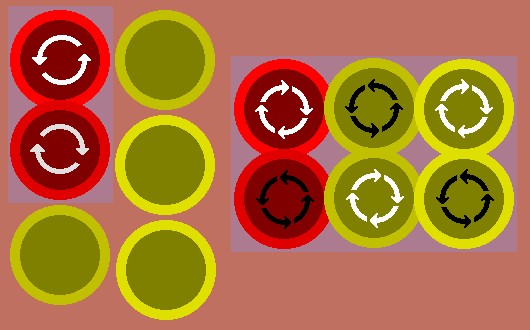

In the picture you see oxygen and hydrogen on the left. Water on the right. Water is a atom mesh, which continues to all directions.
Mechanics says, that chemical compound's overlapping fields must synchronize rotation directions and speeds. 
Without equal atom cell size, gases and liquids atom meshes would have conflicts, which would stop the rotation.
Rotation would be possible only in fully ordered atom meshes. When random titled mesh skips over row or column, there is a conflict.

CO2 density is 1.977 g/L, CO is 1.250 g/L,  one carbon liter weighs 2 267 grams.

O is 1.4290 g/L, it is obviously calculated so, that you had bag of O2 atoms, you scaled the bag and divided the result with two.

Rotational field does not have to fill the space, underlying field will fill the corners. In meshes empty corners local rotational force should be zero.


- - Strength - -

Fields force can be estimated with strength calculation tables. They have been measured for solid materials and elements. Liquids and gases do not have measurable strength. With density and solid state strength you can calculate estimations from the forces of an individual atom.

- - - -

What is hydrogen isotope ?
When atoms are classified with weight, hydrogen isotope is general name for various elements. An alternative name to for example helium.

How did chemistries of 1950's created those great manmade elements ?
They either lied or used element 91 for enriching selected elements with lethal atom lava. Since the greatest of all survived ... they didn't die, they obviously lied.