Said already earlier, that Newton missed vertical systems
and moves. He refined Galilei's gravity researches to laws.
The old Archimedes law about liquids, goes to gases with small changes.
I was making ball simulation for ATS Roulette game. Tried to
calculate kick off energies for ball. Realized that ball's
acceleration - during the moment, the push ends - is zero.
During the moment ball takes off Fk = ma results to plain
zero. This cannot be true. The ball is certain to have kinetic energy,
with what it rolls. It cannot roll without kinetic energy.
When I puzzled with the issue, came to the conclusion that kinetic
energy of an object is actually speed-weigh system at moment X.
With acceleration you calculate speeds at moment X, but actual energy
must come from current speed. When freely rotating ball slows down, ma
calculation always ends into zero. When you use acceleration for
calculating new speed, Fk = mv2 results into new
kinetic energy for the object.
Fk = Objects kinetic energy at moment X
m = mass * G
v = speed at moment X
Power of two is needed for keeping the old Newton with the formula.
This formula cannot be correct. Native unit for Newton is kg m/s2.
Power of 2 results into m2/s2
Ooops. ... In the actual calculations for balls I used air's density for
correcting the unit. Density is included in full formula for
air resistance force. Unit for density is kg/m3. When you for
example calculate air resistances for the balls, the formula with Av energy
results into incorrect unit.
Fk = A * v2 * q
Fk = kinetic energy at moment X, N - kgm/s2
q = density of the surrounding gas/liquid, kg/m3
A = frontal area, m2
v = speed at moment X, m/s
m2 * m2 / s2
and kg / m3 => kg m/s2
|
- In this formula you do not use mass. Mass affects to the
acceleration. You use the mass for calculating changes in speed.
- Dense material results in to bigger kinetic energy. When your roll
your balls in thick gas, you need more force for keeping the speed.
- When you have falling object, you calculate gravitational mass-speed
system, and add it to your force calculation.
- New formula works also in space, where you do not have gravity. You
can use it when you calculate predicted acceleration, braking and
steering forces.
- on earth speed is known to operate with curved force system.
Gas Extension to Archimedes
When object moves in gas, it follows Archimedes law about liquids.
The object takes it's volume from the gas. The difference is that, gas
shrinks and liquid escapes, when object comes.
The shrinking gas creates a pressure system around the intruder. When
you go outdoors, and stop. The pressure system spreads into surroundings.
When you move, you create new pressure systems around yourself all the time.
When you are in closed space, the pressure system cannot spread, it
remains.
It does not matter much, whether object moves or it is blown. It is
easier to keep your momentary place, when you stand in the typhoon winds.
Walk in hurricane winds is more difficult : Standing object has usually
some stable parts in the surrounding pressure system.
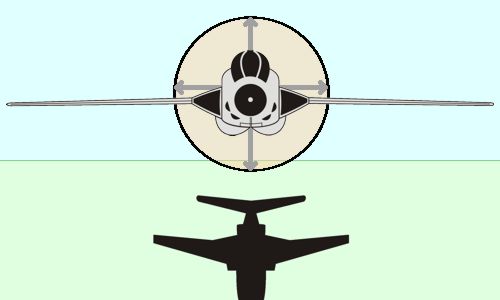
In gas captured volume creates pressure systems to all available
directions.
It is well known, that air resistance factor comes from turbulences around
object. The resistance remains relatively stable, until some major part
in the front starts to create bigger turbulences. Turbulences creates
buffers to front of the moving object. Moving object itself creates only
pressure systems to the front.
With aerodynamic front, you can slow down the creation of pressure.
With tilted top and bottom you redirect part from the pressure to the
top or bottom of the object. You cannot redirect pressure away from the
object. Moving object must always handle the pressure, which comes from
the frontal side projection.
By default gas atoms do not change their relative positions, when
object comes. The grid stretches and shrinks as whole. The atoms start
to move, and the grid gets broke, when you have too much speed and area.
Quite obvious that badly broken grid creates the turbulences to the air
/ gas.
In order to get air in and out from combustion engine's cylinder, you
must break the atom grid with speed. You cannot do such with pressure
only. Propel for example moves atoms with it's wings.
It is known that you can move atoms and objects with flow, without
turbulence. Turbulence could come from the broken movement system. When
so turbulence is born, when long threads, with what atoms moves, gets
broke : Atoms do not keep the marching order, they search new locations
from where-ever they can.

In planes the captured volume creates red pressure system to
above. Green to below.
Green pressure system creates the force, which keeps the plane in the
air.
The big red arrow denotes planes weight, and gravitational force. Car
shares the system.
From the above can say, that objects ... like cars and planes ...
would need measured cw curves for various speeds. Speed increases the
amount of turbulunces. There obviously are some key points, when for
example windshield starts to create turbulences.
When you test cars and planes in wind tunnel, you should find a speed,
when shape loses it's aerodynamics. Air becomes a turbulent mess. You
could inform the constructional speeds for the shapes and bodies. (
Idea / proof comes from pressurized gas and oil tubes.
Electric wire has similar kind of electric power limit. )
You can never measure cw factor with 3D model. Air resistance factor
must be tested in wind tunnel or nature. Pressure system around moving
object is too complicated for computer program. A small change in
mirror's mounting leads to total change in the remaining pressure system
and so on. In cars, side mirrors are well known to be one of the biggest
disturbers of the flow. Mirrors downgrades the overall ( announced ) cw
coefficient factor.
Boat with big top speed needs also aerodynamics. All boats need
hydrodynamics for the bottom. Hydrodynamics is compilation from
aerodynamics and on-ground friction system.
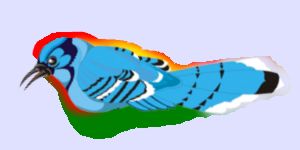
In the picture above you see diagram from bird's over-under pressure
system. Flying bird keeps top pressure steady, head and body are
straight lined. Bird can create a small vacuum to the top with it's
head. After bird has made a hole into air, with it's peak, it uses neck
and belly for boosting the lower pressure and increasing the lift. Lower
body tilt keeps the pressure under body. Feathers' small threads
obviously prevents air from escaping from under the body and wings.
Lower-body tilt and feathers allows birds to fly slowly.
Although birds flying system is widely researched, no has measured
how "poor" bird's air resistance factor is. You could have
done it with killed and filled flying bird.
Long necked bird, like swan, goes to modified needle shape when it
flies. All birds uses belly-body for maintaining the pressure under
body.
Birds are the finest flying things on earth.
Things you find from our nature are hardly ever without some meaning.
It is always a big step from mankind and manmade things. Certainty that
you are almost 100% sure to find a reason for everything eases science
making quite a lot. You do not get lost as easily as you do with manmade
things.
Better precision to gravitational friction force ( not yet finished )
Gravitational friction forces are calculated with old formulas.
But with bigger precision
When I developed formulas for ATS roulette and car simulation, the
current friction force system couldn't provide proper results for the 2D
game.
Friction for car comes from the tires. The first thing is to divide
cars mass to wheels. Calculation is based on weight center. You divide
the mass to wheels with momentum from wheel to weight center. Just like
you do in strength calculations. Cars longitudinal
and lateral tilt must be included to calculation. Direction from wheel
to weight center allows the division to boxes.
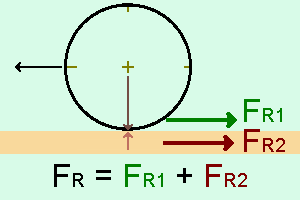
When object moves on surface, there are four primary types of
forces, which resists the movement. First two forces comes from the raw
friction. The wheel and road has unique friction factors. Friction
factor comes from smoothness / roughness of surface : Polished,
varnished wood has totally different friction than varnished, untreated wooden
plank. Material is insignificant. Polished, varnished wood is as shiny and
slippery as polished rock.
The second friction force set comes from the softness of object and
surface. When object is soft, the area with what the object touches the
surface increases. When the surface is too soft, the object falls into
surface. The effect of the fall is dependent on objects shape. Fall of
rectangular object resists the move. Fall of round object increases the
friction force. Fall of rolling round object increases the
touchdown area, then it resists the move with the depth of created pit.
The theoretical base for the system is, that ice is always slippery.
It does not matter what kind of object there on the ice. So it is
possible to define nominal friction factors for various materials.
Calculate separate friction forces for both object and surface. Sum them
together for getting the total force. Force, which is currently
calculated with paired friction factor tables.
When you use nominal friction factors for roughness/ softness, you
can build general friction systems. You do not build ready made tables
for object surface pairs. You create tables, where surfaces and objects
have roughness- softness factors for calculating friction forces.
With tables you can calculate areas for touch.
With additional factors you can get more detailed / accurate
calculations.
Softness
Softness is conditional factor, it needs a pressure-force system for the beginning
and breaking. If object or surface are strong enough to carry the load
from object, there aren't any magical, miniature deformations. Nothing
ever happens. Some materials gets polished by wear, some gets rougher by
wear. Immediate effect is typical for polishing, etc. tools. The effect
of these goes to upper atom layers, they are insignificant for rough
force calculations.
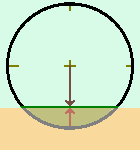
When pressure from the object is smaller than F1, softness
force is zero. When pressure from object is bigger than F2 the
underlying object cracks. There are objects, which never bends, there
are objects-surfaces, which never cracks. F1 and F2 requires indicator
for the mentioned impossibilities.
|
|
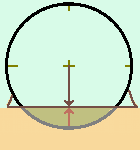
Case 1 : Object reacts, surface stable
In this case the force from object is big enough to shrink / flatten
the object, but it is not big enough for surface.
Flat doesn't change length of circle ( much ). There fore there
are two types of flattening.
- In small, standard flattening object stretches inside ellipse or
stretched rectangle. In this case touch area stays inside ellipse.
- Bigger flattening spreads touch-area outside the ellipse / rectangle.
Object spreads into surroundings.
- Switch in between small and big flattening is smooth.
With one look to cars tire, you can verify that flattening takes place
in all directions. So you need X-Y factors or graph for softness.
|
|
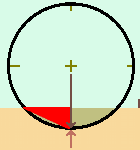
Case 2 : Object stable, surface reacts
In this case the force from object is big enough to dig a pit to
surface, but it is not big enough for object.
When moving object falls into pit, it has climb up from it. Use red force
triangle for getting which is used climbing.
- When angle is 90 degrees angle you use undivided force.
- When angle is over 90 degrees angle, you use reversed triangle.
The touch area is the bottom of rectangle or area of touching circle / ball.
|
|
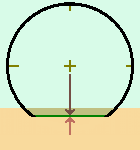
Case 3 : Object reacts, surface reacts
In this case the force from object is big enough to flatten the object
and digging a pit to surface.
In simple system you use Cases 1 and 2 for calculating the
forces.
Precise calculation needs that, you take surface's horizontal push to notice.
The pit for object resists the flattening of the object.
|
Static friction
In principle object-surface does not have static and dynamic
frictions. When you think it, it looks like that static friction
is air resistance force. When so it is dependent on objects size and
surrounding gas / liquid. You can check how it is, with tests.
Wet / lubrication factors
In lubricated object-surface system the friction grows to the full
effect. Friction begins with dry surface factor it ends to lubricants
factor.
On paved road it is easy to notice how the friction vanishes with
thickness of ice layer. In the beginning ice keeps the roads roughness,
when layer grows thicker the roughness vanishes, it is more and more
difficult to keep the car on the road.
In here partial ice cover on paved road is called black ice. It is
invisible to eye, but it is not usually as slippery as visible ice.
After certain weather system black ice covers all roads.
Water, snow and ice has many forms.
- ice, water on ice, snow on ice, etc
- soft ice, water on soft ice, snow on soft ice, soft ice over ice, etc
- snow, water-ice on snow, ice on snow, frozen snow
- water, puddles, streams and lakes.
All possible forms exits in the nature. During spring time, when sun
melts the snow and cold night freezes the melted snow, all forms are
possible. During spring, all variations exist in wider scale.
Frozen snow is born, when temperature raises over zero. The topmost
snow layer melts. When temperature falls below 0, the snow freezes. You
can even drive car over the strongest frozen snow layers. Snow carries
load like ice, but it looks like snow. Ice on snow creates thin, hard,
mirroring cover over snow. Frozen snow is thicker and it misses the
mirror effect. When go and play over frozen ice, there are usually
undetectable places with common snow layer. You cannot see the snow
pits.
Lateral factor (curve)
Tire belongs to objects, which have different xy friction factors. It
needs longitudinal and lateral frictions. In order to draw arc-ellipse
for the factor, you need elliptical line, with predefined cross point.
With elliptical line and angle you can get correct friction factors and
forces.
Shift factors (curve)
Tire which has air space needs another elliptical line for defining
the longitudinal and lateral movements movements with various pressures.
Rubble factors and forces
Sand road is an example from the surface, with has loose particles,
which starts to roll under wheel when you drive too fast.
Bounce factors and forces
Fully defined softness needs also bouncing factor. With bounce factor
you calculate collision speeds and recovery times for bounce. When you
throw soft ball towards hard wall, the ball shrinks. Then it bounces
back with a force, it gets from the bounce.