- - Combustion engine smells - -
6th May 2018
Pressure Sensors
( Jack : 2010 - 2017 )
New crank data, pressure sensors, etc. Released as an
interview.
In the end there is an example from the old, but almost lossless crank system.
|
Excuse me, but if the pressure is stable and
suspended, you
cannot possibly need the sensors and new tech. You cannot get any improvement
with them. The suspension effect of the gas is related to crank system, the way it distributes power. The effect to the time it takes to burn the fuel is marginal. The suspension effect is only a theorem, need for adjusting ignition is unchanged. The correct timing of ignition belongs to the most important things in the engine. It is well known, that one degree misalignment ( to one direction or another ) results already to power loss and increased fuel consumption. When engine runs, the ignition is adjusted constantly. New tech allows you to optimize these run-time adjustments. Change in load and gas pedal's position changes the amount of mixture there is in cylinder. It also changes the time, it takes to burn the mixture. Change in rpm, changes the time and speed with what piston moves. When rpm raises, piston reaches crank's peak area faster. When rpm changes, also the amount of the mixture in cylinder changes. On the other hand, speed with what fire forwards in cylinder is independent from piston's movement. If you ignite the mixture too early, the pressure raises too much before piston reaches the top. Fire extinguishes too early and pressure falls before crank's peak area. And if ignition goes too late, part from the usable pressure leaks into exhaust system. When engine runs 2000 rpm, there are 1 000 ignitions in minute per cylinder, one stroke lasts 15 ms. You have less than 10 ms to ignite, burn and pressurize the fuel-air mixture. At 6000 rpm, there are 3 000 ignitions per minute, stroke lasts 5 ms. You have 2-3 ms for the action. Engine suffers from misaligned ignitions all
the time. Currently combustion engine wastes 60-70% from the energy it gets from the fuel-air mixture. There are four major loss-types : cooling losses, thermal exhaust gas losses, internal thermal losses and internal pressure losses. Gas suspension effect drops crank-related losses to minor losses. Transfers great deal from the crank losses to the exhaust gas pressure losses. Things which result into efficiency losses are not exactly the same than reasons for power losses. Poor filling results power losses only. With new tech you can detect both early and late ignitions. Adjust ignition accordingly. Reduce both internal loss types. When done properly, new tech is certain to result into better engines. Since you have new theorem and sensors, with what get the data from the firing stroke, it is easy to test and make good systems, better engines. - - - - As you you can see from the text, with adjustable camshafts you get much more from the sensors. You can control the opening moment of the outlet valves. And inlet valves, too. You can use the pressure sensor for optimizing three secondary strokes, filling and emptying, too. - - Semi diesel - - Diesel engine, which does not have adjustable ignition point, can be optimized for one efficient rpm and load ( fuel-air mixture ) only. In heavy vehicles, ships and generators it does not matter much, they run with steady rpm and steady load almost all the time. Semi diesel will improve diesel engines quite a lot. Sedans, Vans ... Trucks, Buses and smaller boats are the biggest beneficiaries. Possible that some day semi diesel replaces both diesel and petrol engines. For that it needs better air filtering system. The inlet air should be almost 100% clean from dirt, small particles. - - Miraculous Harvey Hurricane - - Harvey was born one day after Finns took me to behind bars. On the same day Finnish president Saul Sperm, avec Björn Balls and the Female Setup got an invitation to White House, Washington DC. Right before trio's visit, Harvey hit Houston Texas. And NASA, to whom I had just introduced new commercial space exploration plans. Insured damages from Harvey are app $20 billions, estimated total damages are $70 billions. During the time Finns forced me to do time behind bars, disastrous Irma Hurricane hit Florida USA. Estimated total damages from Irma are $50 billions. Third related and disastrous Hurricane Jose didn't hit USA, but it made lots of damage in Caribbean Islands. Just like Harvey and Irma. Jose came to Americas after I got out from the behind bars. The capture can be considered as failed terrorist act. An attempt to prevent Boys and side-effects on-line comeback. Finns missed good, acceptable, nominal reason for capture. - - - - What is the point in small mass-produced mobile nuclear reactors. What makes them the winners ? Don't know. Since I know who are behind the sensational idea, it must be really great ... maybe you should build a big, expensive factory for your reactors. Check how it goes. Build few smaller nuclear plants, too. Get the answers to your question. - - - - When calculating engine powers, you add the energies from each firing ? Power is the amount of energy you produce in one second. When you create energy more than once in second, you add all creations together. Proof for the method comes from measured engine powers. Engine power always raises almost linearly with rpm. Linear raise is result from simple addition. Other methods would result a twisted power curve. All energy calculations are simple additions and subtractions. Calculations which results to energy are more complicated. In engines you calculate maximum and wasted energies with pressure and piston's area. - - - - The research can be released freely, as long as I am credited properly with the data. Just like all the other great scientists. Usage of presented system needs that either car manufacturers or Finns pays relatively small compensation demand from the stolen graduation work. ( acceleration chips, etc. ) Theft turned out be the major reason for total and continuous demolition of my private life. It started in 1992. - - - - How do you like parking assistance ?
Sensors and cameras would need caps, which keeps them clean and hidden when they are not used. - - Logical pressure - - You have 2 liter, 4 cylinder petrol engine. At the lowest, volume of the cylinder is app 60 cm3. This value always comes from the compression ratio and displacement. Displacement is structural. Compression ratio is dependent on fuel's octane number. If piston's diameter is 9 cm and length of stroke is 8 cm, in the midpoint the addition to the chamber's volume is 254,34 cm3 ( 4 * 3.14 * 4.52 ). At mid point, half from the total displacement is available. This big additional space decreases pressure quite a lot. The most important pressure is the pressure from the time you open the outlet valve. |
Crank forces and powers peaks in the midpoint, when arm is farthest from the axle. In the midpoint x component and torque are the biggest.
How do you take advantage from crank mechanics in combustion engines ?
By adjusting ignition so, that the pressure inside cylinder peaks right before mid point. And continues over the mid point ... not as much as before. Pressure in cylinder is potential kinetic energy, it used almost immediately after it is born.After the peak point crank system wastes energy ?
Sort of. After mid / peak point crank system starts to tear crankshaft apart from the block. Bolts which keeps crankshaft in block stretches a little. The direction of the stretch changes after lowest point. Crank system bounds back, and gives marginal help to exhaust stroke. In principle only frictional energy is lost. In overall, displacement shrinks back to original size after firing stroke. In practice the loss is not very big. The increased volume inside the cylinder lowers the pressure / power quite a lot after mid point.In combustion engines, the gas and pressure takes most from the resistance of the crank system. Gas-pressure is the weakest thing in the system, it suspends and absorbs the resistance. As long as the crankshaft lasts, the pressure does not fall as much as it should. The fall of pressure follows x-component, torque.
The pressure, the cylinder has, when you open the outlet valves, says how efficiently your crank system has worked. When you open outlet valves, the pressure in cylinder falls very quickly. It is the point, where power production ends. The open outlet valves are the easiest way for remaining pressure to escape. Piston becomes "static" object for the pressure, pressure is no longer pushing the piston down.
The difference in highest and lowest pressure says how much energy you got from the firing stroke. Pistons' area ( radius / diameter ) is needed for calculating the energy from pressure. The pressure change is the total amount of energy you can have from the cylinder. The area of the push is piston's diameter. Regardless of the shape of the piston's top. No matter how you shape the top, the total amount of Y vector force is almost equal to flat-top piston's force. Only very rare overlapping shapes / areas increases the area, you use in calculations.
In cylinder based power calculations you need more detailed pressure data. So that the power peaks, when the crank is in the best possible positions ( near mid point ). And so, that the pressure is low when you open outlet valve. If the mixture is fully burned before mid-point, crank's gas suspension should help you with the optimum peak. When you know the movement of the piston, you can calculate logical pressure, which takes notice volume changes in cylinder. With this logical pressure you can find out the moment, when pressure actually peaks.
The power needs, that you add time component to your formula. In overall power you use rpm per second. Use rpm for calculating pressure changes in all cylinders during one second. Total power is sum of all changes during one second. In cylinder based powers you use time caps between points, when valves were opened / closed, mixture was ignited, pressure peaked, pressure at midpoint, etc.
System, sensors and theorem are brand new, it is not yet known, what kind of calculations are needed for making the adjustments. Neither it is known how the pressure currently develops in cylinder. Temperature changes in cylinder affects to pressure, combustion engine converts heat and heat oriented pressure into kinetic energy. Complicated system in practice and theory, both. So complicated, that the pressure sensors are the only way to find out, what happens during firing stroke. You cannot make reliable calculations from the firing event.
You should make crank as twisted as possible ?
No. It depends on the usage of the engine. Long arms in crank slows down the piston and movement. Crank can be optimized for burning and the cause. But there aren't any tricks with what you could improve the engine powers. With pressure sensor you can optimize filling and timing. In diesel engine timing.Traditionally sport, race engines have short-strokes and shorter arms in crank. Long stroke and arms are known to result into engine, which has lots of torque. Long stroke engine produces maximum powers at lower rpm. Race engine's bigger powers are traditionally based on higher rpm. Increased max rpm is the another major engine tuning trick. Bigger displacement is the another.
Can you adjust engine powers ?
With pressure sensor in cylinder head you can adjust filling and ignition point by the load and power-torque requirement. In the future gas pedal is closer to power adjuster than now.You talk about request for power, not gas pedal ?
Gas pedal is the most important, but not the only thing which sets demand for engine power. Demand for power is dependent on how heavily car is currently loaded. When cruise control is on, the demand comes from load and hills.Pressure sensor in head is not accurate ?
It is accurate enough for filling and timing. In current classic physics, pressure is equal everywhere. There is a small delay before pressure spreads to everywhere. Delay shows well in mile long gas tubes.Is sensor system fast enough ?
Suppose it is. 4 cylinder, 4 stroke engine has two ignitions per round. When rpm is 1 800, there are 60 ignitions per second. 1 800 is near the lowest possible rpm, when vehicle is moving. At 1 200 rpm there are 40 ignitions in one second, 25 millisecond cap in between ignitions.Sensor will improve cars fuel economy, engine power and reduce pollution. Make engines more robust than now ?
Sensor allows you to burn fuel more efficiently than now. Currently fuel injection system adjusts mixture, filling and timing with inaccurate oxygen sensor in exhaust system. With pressure sensor you can adjust filling and timing so that the pressure always peaks at the optimum piston position.How does oxygen sensor adjust timing and filling ?
When you overload cylinder with fuel mixture, oxygen sensor notices, that too much unburned oxygen is coming out from cylinders. It starts to reduce filling and adjusts timing. That's all it does. There aren't any other sensors for controlling filling and timing. There is 3D map in the fuel injector chip, which tries to optimize the timing and filling. The map is based on engine manufacturers bench tests on different rpm / loads. The pressure sensor is an improved replacement for the old 3D-maps. Map system misses accurate sensors for current load / demand for power. Pressure sensor based system does not need such sensors. Gas pedal's position is the only thing you need to know and response to.With pressure sensor, you can add a switch into dashboard, with what you select power / economy mode for the engine. You can also get power meter to dashboard, it would show momentary powers from the engine. With pressure you can calculate the force, which pushes piston down.
There are many things you can do with the sensor. Many thing has more than one way to do it.
For base system you add sensors to two or more cylinders. And that's all ?
Yes. In principle one sensor is needed. Others are reserved for malfunctions. Then you need sensor for detecting crank's position, calculate pistons' positions with the sensor data. New program for the fuel injector is also needed. Program must have a mode, where it works without sensor data.Distributor must be replaced ?
No. It got electric steering system, when electric fuel injection systems came. Carburetor engines had mechanical steering system inside the distributor, below the rotator. Distributor is a system, with what you select cylinder-spark plug, where you lead the electricity from coil. Or lead awakening current to coils. You get the piston positions from distributor. When engine takes 2 revolutions, distributor rolls once.Sensors are not a problem ?
There are commercial sensors for quite a lot higher pressures and temperatures. Sensor must be very fast, but such does exist. All you have to do is to adapt the existing tech into engines and cars. Not necessarily the cheapest part to install / spare part to buy. At least in the beginning.- - Semi Diesel - -
Not that good with diesel ?
No. Diesel ignites the fuel mixture with pressure. It misses a chance to adjust timing of the ignition. If system turns out to be good, it is possible to create a semi-diesel, which uses high compression ratios and assists ignition with spark plugs. A solution for trucks, heavy vehicles and others.Spark Plugless is not the key thing in diesel engine ?
No. It is a thing that comes from high compression ratio, which is the key thing in diesel engine. Then diesel has different tubes for air and fuel. Diesel has always had a fuel injection system. Long before petrol cars got it. Diesel fuel is a problem with semi-diesel. Diesel oil starts to burn with diesel's compression ratio. Semi-diesel would need a high octane fuel, which does not start to burn on it's own ... with the same compression ratio. You cannot lower the ratio for spark plugged diesel engine, it would result into power losses.How much you must lower the compression ratio for a semi diesel, which uses current diesel oil ?
No idea. With common diesel fuel, engine does not start when temperatures falls below -15C or app. 0F. You need winter quality fuel for getting the engine running. In the older diesel engines there were starting aids, which halved the compression ratio ... to somewhere near petrol engines. Engine never started with halved compression. Halved compression was used for getting speed and heat into engine. When you took the aid off, the engine started. Remember Fordson tractors from early 1960's, which had such system.Trucks and heavy vehicles have big fuel tanks ... long operating ranges and times ... you do not need awful many semi-diesel pumps in the beginning. In bigger gas stations it is easy to re-assign some pumps for semi-diesel.
Without semi-diesel engines, diesel sedans will die ?
Quite obvious that in long run, diesel sedan will die. Semi diesel can be better than petrol engine. Quite a lot better than traditional diesel. Especially in high rpm diesel engines, which are used in sedans and vans. In principle diesel's higher compression ratio produces much more power than petrol engine. But the compression of the fuel-air mixture needs more energy than the compression in petrol engine. You spoil both engines with poor design.Can you replace semi-diesel with direct fuel injection ?
Not sure. Direct injection would need spraying, when the cylinder ignites the fuel mixture. Have a hunch that currently fuel is sprayed to cylinder before firing stroke. At the same time with air. When you spray the fuel into compressed air, it ignites immediately. There is a danger that fire spreads into fuel pipes and pump.You can use common diesel with semi diesel engine.
Yes, semi diesel works common diesel fuel. Not necessarily very well, but the engine runs.Why diesel engines do not have spark plugs already ?
Without new system and data, there is not much you can do with spark plugs. The system is the first major upgrade to engine tech after electric fuel injection systems. Electric fuel injectors came to petrol cars in 1980's, with catalyst converters. After millennium engines got 2nd oxygen sensor. It measures the efficiencies of the catalyst converter. Sensor is in exhaust pipe after converter.What is ODB ?
It is a standardized system, which detects and shows faults in car's essential electric systems. ODB doesn't belong to actual engine tech.- - - -
System does not have temperature sensors in cylinder ?
Not much usage for such sensors in common cars. Might want to use them, when you develop engines or have a race engine, where you try to maximize powers.Sensors make the development of the new engines and all kinds of engine tunings quite a lot easier and faster. Since the system optimizes itself automatically, you get results from the changes very quickly. Nowadays it is a long, messy job.
Pressure sensors are rather long tubes ?
They are much like oxygen sensors. Electric part must be rather far from cylinder head. Temperatures inside cylinder are much the same, slightly higher, than in the beginning of the exhaust system. Where the oxygen sensors are.No changes into valves ?
Not now. Very difficult to create a reliable replacement for current camshaft system. Could raise and lower camshafts as whole in the future. Create a belt system which allows you to do so.When engine has two overhead cams, like all modern engines have, raising and lowering the camshafts is an easy way to change timing of the valves. Easier than changing the timing per valve basis. Twin cams, DOHC engines, are usually made so, that there is one camshaft for inlet valves and one for outlets. Raising and lowering of the shaft can be rather easily made so, that it lengthens-shortens time the valves are open. When you tune camshaft / timing of the valves, changes are small, even then when you search maximum powers.
Belt which empowers the shafts is more difficult. It must keep it's position all the time, it is never allowed to jump over tooth. It needs reliable, long lasting and strong pulley system. Possibly two synchronized systems to both sides of the shafts. So that valves always opens and closes at the right time. Camshaft gears are usually too big for the creation of a single system to the top. Right beside the gears there is sealing and bearing. Then you have the actual raiser-lower system in the head. It needs space, too.
The 2nd stage is challenging. But the new system makes it possible to get some real-life benefit from the adjustable valve timings. So far such adjustment has been almost useless, because you didn't know what do with it. Now have a goal. Data and sensors for making the adjustments.
System does not need separate inlets ?
No. When one cylinder produces incorrect pressures and peak points, all the others do the same. You must apply changes to all cylinders.System notices leaks in cylinder ?
If all cylinders have sensors, it does notice leaks. Do not know how much use there is for detecting leaks nowadays. They are so rare in common engines.1st generation can be brought to markets quickly. Within few years.
After that you start to get new shapes to chambers and inlet-outlet pipes. Adjustable camshafts ... valve systems. New better programs. Continuous flow of improvements for the next 10 to 20 years. Oil-from-grain system secures oil's availability to the far future. No need to struggle with electric cars and other poorer alternatives.When did you design and discovered this system ?
Idea is not new. Started to finalize it in the spring 2017. After a bold jerk started to disturb me with a loud claim, that crank system doesn't waste any energy. After piston's mid point, crank system always wastes Y component from the push. When you go upwards Y component is totally lost before mid point ... in the upper quarter. In some crank systems the loss is much more significant than in combustion engines.Intensive finalization took place in September 2017. After I promised to cancel old, recently re-discovered, car purchase ban from Deadlock folders. Thought that new tech would kick-start the cancellation. Get it into force. New tech, which is more ecological, economical and powerful than current, gives you and the companies a reason to trade the cars before they reach the standard trade age / mileage. I was never asked to cancel the ban, eventually ban cut the car makers revenues app. 50%. By the time loose ban turned into a common practice.
Gas suspension is older than new tech. Probably researched and discovered after Halloween Hacks 2014, reservation for Boys site ... on-line comeback. Division of the firing stroke to firing and power transmission is from the year 2010. It explains why wedge is better than hemi. Half ball hemi is better ( almost ideal ) in firing, but it loses to wedge in power transmission. At around 1970 hemi and wedge competed in powerful engines. Hemi lost, wedge is nowadays the most common combustion chamber shape.
Why others haven't found out and developed this system before ?
Don't know. Riddles are easy, when you have access to answers. To me everything opened very quickly, after I realized, that pressure is potential kinetic energy. Brand new thing, to at least me.The pressure cap is accurate amount of energy you get with one firing ?
Small part from the pressure always leaks from the hole, which in between piston and cylinder. Leaks are the only things, which causes losses and inaccuracy. Turbulences, temperatures for example have marginal effect in sensor based energy-power calculations. Turbulences do not affect to pressure, they affect to flow. Temperature shows in pressure.Who invented otto and diesel engines ?
They were both invented and developed in Karl Benz's workshop. Otto and Diesel were Benz's workers. Although Benz didn't invent car, he created combustion engines and 4 stroke system.Is there systems which would be better than crank system ?
No. Throughout times hundreds of people have tried to find a better solution. Without finding any. There is Wankel engine, which uses gears instead of crank system. Doesn't work very well. It is weak and consumes more fuel than otto and diesel engines. Then it is possible to convert straight forwarded movement to rotation with liquids, hydraulic oil ... and vice versa ... but hydraulic converters are also poorer than crank system.Old steam locomotives with multiple axles have the most efficient crank system. Steam locomotive's crank system works so, that most of the time there is one axle, which is rolled with rods. It reduces loose Y-component oriented tensions and stretching quite a lot.
System can be and was sometimes made so, that at least one axle is sucking and converting the straight forwarded power to rotation all the time. When so, one pair of axles must have 90 degree difference in the mounting points. So that they are never in the loose Y - quarters at the same time. The stronger you make the rods and wheels, the more efficient the system is. The power and tensions are much like water, they search the weakest points and the easiest ways out from the system.
With steam locomotive's rod-axle system you can create crank systems, which are almost free from the constructional losses.
Cannot discover better systems.
Not very easily.Can you make two crank systems to car ?
Don't know. In principle it should be possible. Possible that in some points freely floating pistons go temporarily to wrong direction. As you can read from the above, loose Y component is not a very big loss maker in combustion engines.- - Example - -
Why Immo gets stuck in uphills ?
When you push gas pedal to the floor, you fill the cylinders as well as you can. Engine produces more power, but not enough for raising rpm and speed. Since the rpm ( output power ) does not response to better filling and higher pressure, the pressure which goes to exhaust pipe raises, with fuel consumption. The phenomena is result from the gas suspension effect. When you tune engine for ads, top speed, 0 to X acceleration and maximum powers at high rpm, the low rpm performance suffers.New system makes it possible to detect and fix the poor filling / performance at low rpm. When driver pushes gas at low rpm, system notices that wasted pressure raises without rpm change. With this data you can first try to use mixture with more fuel than usual, adjust acceleration pump system. If it fails, you can release the pump system and optimize the fuel consumption by decreasing filling. Currently oxygen sensor or some other system seems to limit filling in uphills and some other situations.
In the background of the attempt, new system optimizes the ignition all the time. So that the pressure peaks at the right time. Optimization of the ignition gives some additional power to the attempt. Optimizer works with pressure. Filling ratio, mixture, rpm and the way fuel is burned does not cause misaligned ignitions.
With adjustable cams, you can keep inlet valves open longer, for getting more gas into cylinder. Possibly shorten the time you keep outlet valves open. For reducing the pressure, which is wasted to exhaust pipes. Both changes are small. Big changes would make a mess from gas exchange.
Why don't you trade Immo ?
It is restored to good condition. Restoration cost quite a lot. Besides disappointing engine, it has many nice things in it. It is economical for a car of its size. Especially in longer trips, you make without hurry. The suspension makes the car excellent for transporting desktop computers and instruments. Both sensitive to vibration.- - Blast from the past - -
You think that politics will change regulations for emissions so that you can start to use optimal fuel-air mixture.
Don't know. In traffic optimal mixture produces less emissions than current thin mixture. With optimal mixture you always get more energy from gas than with thin mixture. When thin mixtures and catalyst converters came, engine powers fell over 20 percent.When you have two similar cars, another uses optimal mixture and another thin mixture. The filling ratio you need for keeping the same speed is higher with thin mixture. During equal trips, you produce more emissions and consume more fuel with thin mixture car. You cannot get as much energy from the burned fuel than with optimal mixture car.
When you take these cars rpm based emission tests, without load thin-mixture car produces less power than optimal car. And the emissions can be smaller. When you measure emissions for 10 kW engine power optimal car is better than thin-mixture car.
The system is based on well known diagram amongst people, who design and work with combustion engines. The diagram shows how much energy you get with different fuel-air mixtures. You can find it from almost all books, which talks about combustion engines.
Can you replace oxygen sensor with CO sensor ?
Oxygen sensor is better. CO is result from imperfect burning. Excessive amount of oxygen in exhaust gases can be a result from too thin air-fuel mixture. Not necessarily a sign from unburned fuel. CO levels can be acceptable with improper air-fuel mixture.Catalyst converters job is to burn CO to CO2. One reason for thin mixture is converter's need for oxygen. My Caprice has converter, the engine works with optimal mixture. If needed, it is not very difficult or expensive to add separate air inlet to converter. CO burns to CO2 with almost nothing.
Would cars be good cleaners of the air ?
Cars would be very efficient vacuum cleaners. Common engine in moving car uses 2 000 to 3 000 liters fresh air in one minute. With efficient air filters you can keep the air in your city clean. The recently cleaned air is hot, it raises up. It is replaced with colder dirty air. Dirt is easier to clean before than after you burn it. Particles are bigger and stronger.
Without good air filters cars tend to worsen, increase the pollution of the polluted city air. After city air gets too polluted, car usage is restricted. Lack of oxygen is hardly ever the reason for restriction.
Better air filters are lossless. They do not affect to the engine, fuel consumption and power production. Small increase to the service costs is the only penalty you get.
A filter system, which would extract unwanted nitrogen from inlet air, is not impossible. Either.
You could also build heater into air inlet. If you pre-heat the air before you lead it into cylinder you can get quite a lot of more power or energy from the fuel.But turbo charged engine produces more power when you cool the fuel-air before you ignite it.
Intercooler turbo can use higher pressures than common turbo. Books say, that warmer inlet air gives more pressure and power. Checked Immo's fuel consumption in cold once. When temperature fell around 20C, average fuel consumption rose almost 1 liter per 100 km. Wanted to check very common belief about winter tires. They are often said to increase fuel consumption. Made a long, almost 500 kilometers, test drive with summer tires in cold weather, the fuel consumption was much the same than with spiked winter tires.When you pre-heat the inlet air ... fuel-air mixture ... you must re-dimension the engine for 95 / 98 octane fuel.
Some older cars had air filters with two air inlet tubes. Another tube sucked hot air from exhaust system. It was used during winters. Summertime tube sucked warm air from engine room. With pressure sensors it is easy to find the optimum inlet air temperature. Not very difficult to create system, which uses two air inlets and adjusts the inlet air temperature to optimum.
- - Pressure Sensors and Semi diesel / 16-Apr2018 - -
| Fuel | Flash | % | Components |
| Drilled Oil | 220C | 100.0 | C80-83+H10-13 |
| Diesel | 250C | 104.8 | C87+H13 |
| Petrol 95 | 300C | 103.6 | C86+H14 |
| Petrol 98 | 400C | 103.6 | C86+H14 |
| Ethanol | 420 C | C52+H13+O35 | |
| Methanol | 480C | C38+H12+O50 | |
| Air Petrol 102 | 500C | 102.4 | C85+H15 |
Semi diesel is not necessarily very far from reality. Semi diesel is an engine, which uses diesel engines compression ratio and petrol engine's ignition and fuel injection systems.
Knocking prevents the construction of high compression petrol engine. Knocking breaks heads and blocks. Without knocking you could use common petrol with diesel engine's compression ratios. Diesel engine's compression ratio is around 20:1, the highest for petrol engine is considered to be around 10:1, with 98/99 octane petrol.
The latest version from Ferrari V12 engine uses 13.6:1 compression ratio. It works with 98 octane petrol. Both block and head are made from aluminum. With good design and proper materials you can get closer to the required 20:1 ratios. In principle, it should be easier to raise the structural knock resistance in common engines.
Not known how much you could raise the compression ratio with aviation gas. Air petrol's octane number is around 102. The higher octane allows higher compression ratios.
From the table on the right you see, how octane number raises, when you decrease carbon and increase hydrogen. You can also see, that flash point and octane number have a direct connection. And that diesel flashes into fire easier than petrol. Difference in between 95 and 98 octane is made with chemicals. Have a hunch, that although flash points are near, diesel will not run with 95 octane petrol.
In Ferrari FF, the previous version from this praised 6.2 liter V12 engine won an award from being the most uneconomical car and engine in the world. In Ferrari 812 Superfast V12 produces 800 hp at 8500 rpm. In Ferrari GTC4 Lusso engine produces 690 hp at 8000 rpm ( compression ratio in this version is 13.5:1 ). All three consumes less fuel than my Chevy Van from the year 1991.
The initial origin of Ferrari V12 seems to be Dino V6 engine from the mid 1960's. The base design of this V12 engine have been used in Ferrari Formula-1 cars. When I checked, Ferrari V12 was the only one, which uses over 10:1 compression ratio. Thought first, that there is an error in GTC4 specifications.
Since it is possible to exceed the rule of thumb, it looks like, that knocking comes from pressure changes and vibrations in block / head. Not from the uncontrolled burning. If old claims about uncontrolled burning were true, this V12 would not need spark plugs for igniting the fuel-air mixture. In principle, the higher pressure / ratio increases the temperature, it does not lower the flash point. Pressure obviously raises the flash point, just like it does to boiling point.
- - -
The percent column in the table shows how many ground oil barrels you need for distilling one barrel per quality. Production of diesel costs slightly more than petrol. Oil distiller tower is not booze distilling tower. It is more like steamer-thinner system. Oil fumes takes their places in the tower with density / weigh. If diesel dies, you do not collect oil from diesel's level. You collect more from the petrol output. And that's almost all. If you increase the temperature, you must recalibrate the tower. All newer towers have calibration systems and output adjusters.
When two qualities have as many carbon and hydrogen atoms, tower always outputs the qualities from the same pipe. Separation must be made afterwards.
- - Combustion engine smells - -
6th May 2018
Fire forwards with smell effect. So, as we all know, combustion engine smells, when it works. Much like nuclear plant.
- In combustion engine you should maximize smell effect.
- Fire and pressure ignores most from the turbulences. They skip from atom to atom, try to stabilize the pressure.Self ignition and knocking
It is possible that knocking comes from the random wave creation. Waves echoes around the cylinder, causes tensions towards block and head.
When fuel-air mixture ignites on its own, it starts to bomb the engine construction with horizontal and slanted pressures. Self ignition creates random pressure peaks. These peaks spread into all directions. Towards piston, head, valves and cylinder walls. In collisions with construction they blast. In collisions with other pressure, peaks act like uneven forwarding goes. Self ignition causes always losses in pressure creation. Especially in petrol engine.
In diesel engine, you can enrich the fuel right before you close inlet valve. When you enrich the topmost gas layer, the fire starts from the top. Takes a direction towards piston. After compression stroke, the pressure towards piston is slightly higher than pressure towards head. Fire tends to begin from the wrong end.
Picture
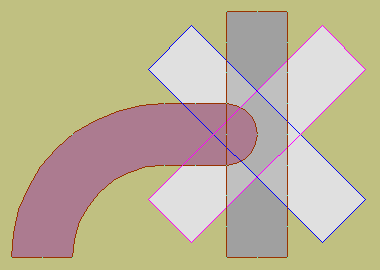
The ideal firing system for pressure creation is almost flat, rounded head, with sparking layer. When you ignite the mixture at once, the pressure goes down with smell effect. Besides steady push, the layer burns the mixture quickly. Difficult to install valves into a head with cylinder-wide layer system.
When you look at the uneven picture, red arrows have green arrows pressure. When tilted yellow arrow hits the piston, it starts to spread towards red arrow. The tilted yellow is taken from upright yellow. When tilted yellow adopts to the red, red obviously peaks and loses the peak from yellow quickly. The pressure change with what red pushes the piston is smaller. Pressure change is difference between tilted yellow and red. Tilted yellow is lost with red. Tilted yellow is saved only then, when the peak takes place at the piston.
And that's not all. When upright yellow hits piston, part from the pressure goes to spreading in sideways. The blasted pressure acts worse than tilted yellow. The push towards piston is marginal, most from the pressure goes sideways and upwards.
- When tilted yellow arrow adopts to red arrow, it obviously creates a short term pressure peak in to cylinder. In cases when this peak takes place in unburned mixture, the peak can result into self ignition.
- Regardless of the mixture's state, peak can always cause knocking with wave like pulses. Waves are created with fast under-over pressure repetions. When a single moving pulse collides, it seems to convert into wave.Firing methods
In order to improve firing, you can develop spark plugs, which creates sparks around the body. Can use head as ground for the sparks, too.
You can create good forwarding with head's shape too. In wedged combustion chamber small amount of fuel is sort of a used for creating good, even push for primary fire. In wedge pressure does not move much in sideways. On the other hand amount of the ignited mixture is small. With layer plugs you can use lower angles, reduce the delay in pressure creation. Delay in pressure creation costs at end of the firing stroke. The pressure, which goes to exhaust pipes is bigger.
In lab you can optimize head's shape by installing pressure sensors to flat piston. Check how the pressure comes to it. For forwarding and pressure creation, the pistons shape is insignificant.
Summary 18th May 2018
In diesel engine self ignition causes quite a many uncontrolled power peaks into cylinder. From the petrol engine we know that knocking reduces power. The knowledge is in line with this theorem. When compression ratios are the same and engines okay, diesel can never beat semi-diesel.
In knocking, temperature comes before pressure. Pressure does not set the fuel into fire. Self-ignition comes from the temperature. It means that with improved cooling you can prevent knocking, without giving up from the higher compression ratio.
When engine has fixed compression ratio ( like all engines currently have ) you should never temporarily cool the incoming mixture. It leads into power losses. Better way would be a usage of the thinner mixture.
Evenly forwarded burning reduces CO emissions. Collisions and peaks slows down the fire a little.
In ideal process, where the fire forwards evenly, the maximum temperature comes from the unburned fuel. Temperature must stay slightly below the flash point. Flash point is said to live with the pressure.
Power peak can be born without knocking. When so, peak does not convert into wave, vibrations and noise. Waves and knocking cannot be born without power peak : Self-ignition peak or uneven peak.
Power peak in burning fuel should not have as much effect as peak in unburned fuel. With fire you create the pressure, which pushes the piston. Burning fuel is either creating or it has already created the pressure. Fire begins a balancing state in burned part of the cylinder. In balancing state mixture is more stable. By default power peak in balancing state goes upwards, or alternatively to a lower pressure location. Although theoretical peak can be big, difficult for the burned mixture to create such peaks. Bouncing wave from unburned part is the only possible source for bigger peak.
Ideal / even burn does not suit well into way pistons are made. Ideal burn would need four mounting points, piston has only two. Problems with this conflict can also cause loud knocking and break the engine.
My own high compression ratio Mirafiori suffered from small vibrations in crankshaft. Vibrations opened a nut, which held generator's wheel in place. Blew the engine before I found a good solution for the problem.
- - New air filter - -
18th May 2018
Semi diesel raises the number of high compression engines to sky high levels. When so, only way to keep the air pollution in reasonable levels is to clean the air ... as well as you can ... before the compression and firing.
Rough filter is like common air filter.
Particle filter cleans the air from small particles.
Chemical nitro filter removes Nitrogen from the input air.Idea in cleaners is that, they provide a platform and mountings for various chemical and electric cleaning methods. By default they are empty slots, with standard size and mountings. With cleaners you can localize the system. React to for example big nuclear catastrophe. Clean the area / city from Nuclear Scents.
Cars consumes so much air, that they clean the cities from all kinds of aired dirt very quickly.
Air Mixer
Air mixer belongs to pressure sensor tech. With air mixer you can adjust temperatures of the input air.
- Although possible you should not use it for eliminating knocking.
- With air mixer you can react to outdoor temperatures. Keep the temperatures of the incoming air steady.
- Primary idea in air-mixer is a situation where you drive with partial load. With partial load you can use bigger closing pressures and higher input temperatures. With mixer you get better responses from the partially loaded engine.
- Also possible to build a boost button system, for temporarily overload the engine with higher pressures.Engines Ferrari designed for Fiat had a simple air-mixer system in air filter. I have later checked and tested that the fuel-air mixtures temperature has a surprisingly big effect to fuel economy. In cold weather Immo consumed with the same configuration and speed around 20% percent more fuel in cold weather than it does in warm weather. Made the rough test with cruise control and long trip.
The oil from sugar changes world of vehicles, but not the demand for fuel efficiency. When number of cars grow, the big cities suffer from the lack of oxygen. Demand for fuel efficiency comes from customers' wallets and general need for oxygen.
May 30th 2018 - Dropping of the nitro filter
I do not know the kind of lethalness of NO2. Breathing obviously produces the same gas. If I do not remember wrong, nitrogen burns "better" than carbon. It is used in fertilizers for plants, medicines for poor heart and dragsters.
Possible that lethalness of NO and NO2 is equal to lethalness of CO and CO2. Death comes from the lack of oxygen, not from the result of the usage. Natural emission gas. If so, nitro filter can be dropped from the air filter system.
Catalyst converter is said to convert NO2 into some other chemical compound. Idea of catalyst converter is rather stupid, it wastes free oxygen atoms from the air. Basic idea, that after burning will make the air cleaner, is weird. The more you burn, the more smoke and bad smell you exhaust into air ... less oxygen comes out from the exhaust pipe.
Converter does not clean the gases from chemicals, which are used to enhance fuel and adjust the octane number. These chemicals can end into hazardous compounds.
The most environmental fuel is raw distilled fuel, without chemicals. It safe as unburned and burned gas. Could start to use H14 and H15 fuels. Replace 98 with H15 quality. Possible to create H16 or H17 quality for trucks / high compression engines. All gas stations have pumps for three qualities.
If you use chemicals in fuel, you should always check how they affect to people, animals and plants before and after burning. You should check what kind of carbon-hydrogen compounds it forms with raw-fuel air mixture. Then you should check how it goes with other added chemicals, amount of chemical-chemical compounds is small.
Sensor tech allows you to optimize fuel-air consumption of the partially loaded and idle engine. Improved air filter system reduces creation of hazardous gases and pollution quite a lot. Improved air-filter system does not increase fuel consumption like catalyst converter does.
 - -
Electric Turbo Charger- -
- -
Electric Turbo Charger- -
2nd June 2018
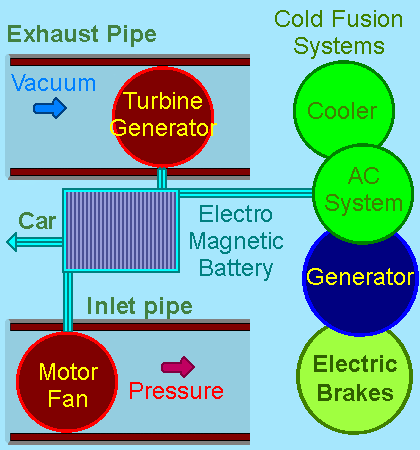
Picture on the right shows how to take advantage from electro magnetic battery and cold fusion in cars.
- You can replace cooler element with vacuum cooler.
- You can replace air conditioning system with vacuum system.
- You can collect small amounts of braking energy with small on-wheel generators.
- You can collect energy from exhaust gases.- You can use the collected energy with electric turbo charger
- Collected energy reduces the need and load of charger.Efficiency of electro magnetic collector and shift system is over 90%, when compared to direct system.
Electric turbo
Electric turbo allows you to time shift the pressures of the exhaust gases. You can collect the energy during the time car goes from one traffic lights to another. Then you use the collected energy, when stopped car leaves the lights.
As bonus you can build a small compressor system into turbine generator, which collects the energy. With small compressor effect you can create continuous vacuum into outlet. It improves gas exchange at whole rpm range. Not only from the designed vacuum rpm.
Besides the compressor-generator system, you can use all power creators and emb for running the electric compressor. Electric motor can easily reach the same rpm's as traditional turbo charger.
System is fully adjustable. With pressure sensors, you can use the motor-fan system for improving the low rpm qualities. The same system can also be used for acquiring more power from the engine.
In principle you should fill the cylinder as smoothly as you can. You should avoid turbulences, then you should try to keep leftovers from previous stroke at the bottom the cylinder. With this you should keep the pressure in inlet system steady. You accelerate the fan motor system, when you open the valves, so that pressure does not fall with increased volume ( which comes from opened valve ).
The mixing of the fuel air mixture should always take in fuel injector. After that you should try to avoid turbulences as much as you can. Turbulences after mixing slows down the movement of pressure and air fuel mixture. Turbulence creates forces, which point and move mixture to random directions. It is well known basic in gas-liquid movement and power transmission.
The vacuum you create with opening, can suck air from cylinder and resists filling. Suck effect is dependent on cylinder and inlet pressures during the time of opening. If cylinder pressure is lower than inlet pressure, the opening pushes air into cylinder.
Opening of the outlet valve never resists the gas exchange. In principle It possible to use compressor-generator as motor, and create vacuums to the outlet with the system.
Knocking
Knocking is one form of turbulence. Symptoms - noises, vibrations and power loss - equals. With variable rpm, electric turbo you can reduce knocking. In general levels you can reduce turbulences and knocking with an increase in pistons diameter and reduce in the stroke length. With sensor tech and electric turbo you can minimize the disadvantages of the short stroke.
Vacuum air conditioning, vacuum cooler and generator
In vacuum air conditioning cold comes from vacuum pump. Vacuum air conditioning works with gases. You mix the incoming air. Vacuum pump must always be in upright position. Hill climbing capabilities limits the maximum angle in fixed mounting.
Principle is the same in common piped air conditioning system. Add-on air conditioner unit does not mix the air.
Vacuum cooler can be used as replacement for cooler. Vacuum cooler is small when compared to radiator. The location is free. You have a water pipe, which circles the vacuum area at the bottom of the pump. You can cool the water as much as the coolant can be cooled without freezing. The output temperature of the coolant can be -10C or less.
Vacuum cooler is also the principle for vacuum fridge and vacuum freezer.
Generator
Cold fusion reduces generator load. Possible that someday vacuum cooler is converted into vacuum generator. Pump runs all the time and produces electricity for car. Coolant is lead into generators cooler unit when needed.
Mobile aggregators are probably the first vacuum generator systems. They don't need fuel. The electricity is free. Apparatus is light, when compared to traditional aggregator. With aggregator-emb system you can bring electricity to islands and other places, which misses power grid. Vacuum aggregator-emb does need sunlight and wind for the creation of electricity.
Electric brakes
Idea of electric brakes is impossible. Each wheel would need a heavy generator and wrist sized wiring for braking. Instead you can build a smaller generator into transmission. You active the generator, when driver pushes the brake pedal.
|
|
|
|
|
|
|
IMAGINARY POWER CURVE [Aug 2nd 2018]
|
|
|
|
Pressure sensor tech is finished now.
Yes. Sensor tech contains also brand new theoretical base for engines. Few things are reversed or altered from old. Then there are quite a many new things in theoretical base. Theoretical base is based on Wave-Smell research 2017.With cylinder, inlet-outlet sensors and related peripherals, you can make engine almost as good as possible. You can adjust filling-pressure creation. You can adjust firing and emptying. In high rpm race engine you can use exhaust system for improving emptying the cylinder, you run the turbine-compressor with generator-motor system. Produce the required electricity with generator and others only.
With em-battery and cold fusion you can collect wasted energy as much as you can. After electric turbo you can cool the exhaust gases with fusion. Possible to get fragranced, cleaned and air conditioned streets to Los Angeles, California. Los Angeles and California has the tightest emission laws for cars and catalyst converters.
How much new tech improves fuel efficiency ?
It's up to you. Engine gets three power modes. Economy, Normal and Sport. In eco-mode the tech minimizes the fuel consumption. Normal position combines fuel efficiency with performance. In sport mode engine maximizes the power production. In general levels, tech drops city consumption quite a lot. High compression engine for vans, trucks and buses cuts transportation costs.Think that new tech can restore car sales ?
Tech can do that easily. US-EU citizens do not necessarily have enough money to buy new cars. When two big buyer groups cannot afford to buy more cars, it makes the recovery difficult. Electoral and public promises are not the actual choices. Can't help it. Asian countries have lots of citizens and potential. Over half from the world's population lives in Asia. Maybe the growth comes from there.What if German and American cars ruins the dedicated recovery ?
With expensive vintage models ? Not very likely. Next generation cars are much like next generation jet and war planes. Unbeatable for vintage stuff.
They hate you so much, that they cannot do a thing ... a simple deal with you.
They made me and everyone believe so. It is not possible anymore, it cannot be true. Their primary problems are in somewhere else than here and me. Had very little to do with the demands for seizure.
You said that the attempt to steal your right to $40 trillion future expectation was desperate.
Invention-money oriented copyright violations against me are so rare, that their changes to succeed were very low. I do commercial inventions, not big military secrets. After the things I do are ready, they are freely available to everyone, with a small revenue-price related fee. No need for anyone to spy and steal anything. You and your businesses will not die to legally acquired licenses and fees.
How about the big option pack, you wrote for the record company, which makes the distribution deal with Boys.
Just ask. It is a rough pack, I haven't recorded the melodies into mp3 files.- - - -
Who invented catalyst converters.
Don't know. Environmentalists drove them into legislations. The process began in late 1980's. Don't know which one, USA or Germany, was the first to set laws for converters. Limits for CO and CO2 emissions. In Europe, circle of oxygen was taught to you in elementary school. Circle and the way to fight against green house gases has been known for ages. It has been part of the city planning for a very long time, it is mentioned as reason for parks. In 1980's environmentalists hated cars, preferred mass transports. Law making is difficult, because with laws you can make big mistakes come true. Things which would never take place without laws.Is the new system difficult to repair ?
Not much different from current. Air conditioning system is simpler than old. Cooler has vacuum pump, you usually change it as whole. Same goes to electric turbo. Some company reconstructs, refurbish pumps and turbines. Just like generators and others. Cars have had pressure and temperature sensors for ages. Control system and fuel injector are complicated, but they are not issues in common garage.All new things can be made failure safe. When part gets broke, there is a system, which passes the broken system. Can for example make cooler-generator system so, that it has two vacuum systems. Fail safe electric turbo is tricky ( in the same way than common turbo ), others are easy.
Next generation combustion car vs. electric car.
Electric car is much like nuclear plant. 10 years after shift, you realize, how stupid the idea of electric car was. Disadvantages and dangers come out with the time and widespread usage. High voltages and big currents are difficult in older cars. We do not know much about the way big motor works and behaves in vehicle. Overload locks the motor. Mechanics are in danger when they check, repair and test broken electric cars. Passengers are in danger to die in accidents.Possible that constant rpm-load changes leads into nasty surprises. Weather and electricity consumes wires. Load changes consumes bearings. Risks of fire and shortcuts grows with time and mileage.
Air pollution and air's electric conductivity creates one problem. The wiring can set the dust-air and car into fire. External fire is well known thing from electric apparatuses, from for example old high voltage tv sets. Also the reason, why high voltage power grid lines are cleared from trees and others. You are advised to stay away from the line and masts. Electric railways are walled because of this spark-plug effect.
----
Hurricanes and typhoons requires over 28C temperatures.
Yes. But the phenomena itself is based on difference in temperatures. In the nature, required difference needs over 28C temperatures.From where does the smoke come ?
Smoke comes from burning dirt in air or fuel. Oil and booze themselves do not produce smoke. Coal and wood does. Nuclear chain reaction obviously releases busloads of quantum smoke, which comes from atom lava. This smoke is invisible to us, most is left into fuel rods. Eruption of a volcano produces enormous amounts of smoke.----
If cold fusion, space solar plants and oil-from-sugar allows you to spend energy, where do you need energy efficiency ?
The new things makes spending free at global levels. At household level your incomes says how much energy you can use. Energy efficient cars and apparatuses frees household money for other usages. It assists the growth, when there are new attractive things people would like to buy. Especially now when the national debts have created demand for high tax rates. Very difficult to increase consumption at the same time taxes are collected for the payments and interests of the big old debts. There are lethal anomalies also in the western countries' economies.Very difficult to unpack the impossibilities, reckless jerks ... politics and midgets ... have created into western economies.
I am not an expert, but I do know this and that, for sure. This impossibility comes from the common sense. I do have an awful lot of common sense ?
Something like that.- - New Aerodynamics - -
18th Aug 2018Needle is the first man made aerodynamic shape.
It also the first. Penetration through stretching solid, liquid and gas goes with the same atom level basic rules. Car makers had a strong belief in drop's superiority over all the others. The idea comes from 1920's Germany ... just like one other well known scientific phenomena. Made a research from the way drop forms at around 2005. The drop form is natural for liquid, but not good for solid object. The drop's final shape comes from internal pressure-friction system. Solid object misses liquids' internal system.The aerodynamic cars from 1980's are not like drops. They were made in wind tunnels and practical tests. They are actually applications from needle's shape. The car is widest at the rear seats. Earlier aerodynamic cars, like Citroen SM, were like drops. The car narrows rather heavily towards the end.
When you design aerodynamics you should always check the pressure at the end of the body. Strong under pressure creates reversing force to the body, it drags the body backwards. You can calculate the reversing force with pressure and area. The reversing force comes from the under pressure, which effects and is at the back plate. When you measure under pressure, you do not have to pay attention to the turbulences you leave behind. The turbulences shows in the measured pressure.
Can you make a spoiler system, which creates pressure to the back ?
Yes you can, but it does not help. The force you need for redirecting the air is bigger than the pressure you create. In jets you create the turbulences for creating a stronger wall for the push, which comes from the engine. In jet you use small, cold air flow for messing and thickening the outgoing air. Aerodynamics for the fuselage-body is almost exactly the same than in cars.How does body kit and spoilers work ?
Just like before.
- Front spoiler directs air to the sides. It can create under pressure to the bottom, the under pressure improves grip. Then it prevents bottom-plate oriented turbulences.
- Widened mud covers reduces turbulences, which comes from wheels and holes for them.
- Steps under the doors redirect air, which escapes sideways. When you go into gas, gas stretches also horizontally. There is over overpressure on both sides of the car. Steps prevent gas's expansion to the bottom.
- Typical rear spoiler pushes back towards ground.Cooling and open engine room creates lots of turbulences and resistance. Bottom place is another invisible air resistance creator. Small vacuum cooler reduces high-speed air resistance, which comes from engine room and cooling. Citroen SM is obviously the first modern car with aerodynamically designed bottom.
- First aero dynamical car is Rumpler Tear from 1928.
- First modern "wind tunnel" car is obviously SAAB 92 from early 1950's. SAAB is Swedish plane maker.
- Citroen CX from mid 1970's is the first from the aerodynamic cars of 1980's. It had also the first digital dashboard, it was operated with rotating mechanical drums.- In 1980's there was ground-effect Formula 1 cars. Ground effect car has a hidden rear spoiler in the bottom plate. It redirects bottom air upwards and pushes the rear towards ground. Just like common rear spoiler. It was forbidden. When bottom hit the ground, the air inlet for the spoiler went often broke. The car lost the grip and crashed.
Oil in the sky
- - 29th August 2018 - -Finally figured out, what catalyst converter is.
Yes. Found the origin, when I made photo show stories from the old cars. In early 1970's converters came to US markets. It was taken to US cars in 1973.It seems, that catalyst converter was originally an add-on to few years old US muscle cars and others, which had over 350 cid V8 engines and were made ... or allowed ... to consume busloads of fuel. Converter burns the out-coming unburned fuel and prevents formation of the smog. In new engine you can get the same effect by improving the firing. With pressure sensor tech you can burn fuel more efficiently than with current engine-converter system.
CO2 emissions are invisible to eye. Unburned gas or fuel-air mixture is not.
Estimated that smog is born from unburned fuel-air mixture and dirt in it. When hot, unburned fuel-air mixture comes out from exhaust pipe, the heat raises it up into air. Mixture is thicker and not as transparent as clean air, it hides the sun. Otherwise it is rather harmless. Especially now, when all fuels are lead free. When you take breath from unburned fuel air mixture, it gives you a small energy boost. And that's all it does. Lead was replaced with some CH compound. The replacement misses lead's lubrication qualities. When lead free fuels came, they burned valves from the old lead-era engines.
You should always be careful with add-on ads.
Or read the descriptions more carefully.What goes in, comes out ?
-- 25th October 2018 - -Dry air which goes to cylinder has 78% nitrogen, 21% oxygen. Humidity reduces the amounts.
Petrol which goes in has 86% carbon, 14 % hydrogen.Base burn in cylinder
C86 H14 + 14.7 * ( 21O2 78N2 )Results into :
C + O2 → CO2
4H + O2 → 2 * H2O
2C + O2 → 2 * CO // = inefficient burn
N2 + O2 → 2 * NO // This is a claim.Fire in petrol engine is comparable to breathing and cigarette smoking. Without CAT ( second burn ) fire ends to listed elements.
- Creation of NO is claim. Nitrogen does not usually react into fire / oxygen. You cannot set air into fire with heat.
- NO is better known with a name laughing gas. NO is used as fuel in combustion engines. Temporal add-on gas system uses NO gas for giving additional kick to engine. Nitrogen and oxygen "hates" each other, it makes NO powerful fuel to for example cars. Possible that NO reaction is too fast and powerful for humans and animals : Veins, muscles and others cannot handle the pressure and heat, NO fire causes.
- Creation of NO2 is also difficult. NO2 is brown gas, it has strong unpleasant odor. In bigger amounts NO2 is hazardous, but not lethal gas.
- Cars exhaust gases are usually colorless and odorless. Sometimes they are gray or blue. Gray is water vapor, blue comes from leaked and burned lubricants.
- There is marginal amounts of single N atoms in the air. These N atoms burns in combustion engine, lungs, etc. They obviously enrich to N2 and NO2
1 dm3
Density
Box
weightUnit
weightUnit
countMixture
Unit
totalMixture
HasN 78,08 1,251 97,6781 28 3,4885 14,7 51,2801 53 * N2 O 20,95 1,429 29,9376 32 0,9355 14,7 13,7526 14 * O2 99,03 14,7 H2O 0,97 0,804 0,7799 18 0,0433 14,7 0,6369 Fuel 100 1,260 126 26 4,8462 1 4,8462 5*C2 H4 When you look at the result column on the right. The sample can never fully burn the petrol-diesel, which is fed into cylinder.
14 * O2+ 5 * C2 H4 ---> 10 * CO2 + 8 * H2O + 2 * H2
28O, 10C, 20H -> 10*CO2
8O, -, 20H - > 8*H2O
-, -, 4H -> 2*H2Volumes : CO2 = 10 * 46 = 460, H2O = 8 * 18 = 144, H2 = 2, Result = 606 >> CO2 = 76%, H2O = 24 %, H2 = 0.3 %
Exhaust gas needs that you remove Oxygen and Fuel. Add result to the rest. Exhaust gases volume can change, but atom counts in between result and fuel-oxygen mixture are the same.Water and hydrogen are obviously the primaries of the reaction. Idea comes from knocking. When you increase the amount of carbon, it reduces the knocking. When you optimize the fire, you should check that hydrogen atoms are split into water and H2 atoms. C and CO2 are insignificant for the efficiency of the fire. If water is primary product, the ideal reaction has different form :
14 * O2 + 5 * C2 H4 ---> 10 * H2O + 9 * CO2 + C
28O, 10C, 20H -> 10*H2O
18O, 10C, - - > 9*CO2
-, C,- -> CVolumes : H2O = 10 * 18 = 180, CO2 = 9 * 46 = 414, Result = 594 >> H2O = 30 % CO2 = 70% ( misses loose C )
In the sample 1 / 15.5 mixture provides enough oxygen for converting lonesome carbon atom into CO2. When so, 1 / 15.5 is optimal mixture for exhaust gases. Optimal exhaust gas has 10 water and 10 carbon dioxide. When you do not have enough oxygen in the mixture, the resulting exhaust gas sways around the optimal exhaust gas.
Optimal exhaust gas mixture is not the best for the speed of fire and pressure creation. Richer optimal mixture is for the fire and pressure, the richer optimal mixture is verified to be true countless times.
Humans who uses sugar and fat uses the same air, and the mixture has more hydrogen atoms than petrol. Humans can adjust the output, with windpipe and thoughts. With thoughts you can control your body. In this case it is possible that you give commands to the cells which burns the sugar-air. The adjustment of the output is thing you learn when you are young. The natural sugar is close match to methane ( CH4 ). Petrol is distilled product. Cleaned ground oil can be almost equal to petrol.
In principle creation of CO2 is easier than water. Carbon dioxide needs that exploding hydrogen atoms kicks the carbon atoms farther from themselves. Then the loose O2 molecules captures the loose carbon atoms. Hydrogen creation requires, that there are 4 hydrogen atoms, which breaks the oxygen molecule. Water creation requires more energy. Obviously it also releases more heat and temperature to surroundings. Thin mixture is known to produce less power than rich. When you look at the system above, rich mixture improves chances for getting water from the reaction.
When you use catalyst converter, it needs thinner mixture. If and when thin mixture increases the CO2 creation at the expense of water creation, you have a good reason for long term, phenomenal drought. Cars consumes an enormous amounts of air and provides lots of additional humidity to your climate. When you minimize the vapor creation with regulation, you downgrade the local humidity closer to natural levels. This downgrade towards natural levels looks like unnatural drought. When you burn fuel, the engine never dries the air from the humidity, which goes into engine via air filter. The water comes out as untouched hot vapor. ( You can never burn water or alter water with heat-pressure system )
Booze in petrol is also a thing which makes the mixture thinner and increases CO2 creation. Booze has oxygen, which increases the amount of oxygen in the mixture. Booze only fuel can be adjusted and mixed freely.
If big city like Los Angles would force people to use electric cars, it would result into major local climate change. The local nature would be unable provide enough food and water to people. People would have to move away in bigger amounts.
- - Catalyst Converter - -
24th Nov 2018When I made background research for this chapter, noticed that the only thing, which known from catalyst converter ( for sure ), is that it does not use flaming fire for doing what-ever it does. The released chemical reactions and resulting gases varies a lot. They are only wild guesses from the things, which might take place inside. Chemical fire can result into unnatural exhaust gases.
Catalyst converter has ( if I do not remember wrong ) platinum in it, the first converters cost a fortune. Reason was said to be platinum. Platinum is used for creating cyanides. Cyanide is well known poison. Cyanide is NxCx compound, but not all cyanide compounds are toxic. When you "burn" fuel without oxygen, NxHx and NxCx compounds are the only possible results.
If there is oxygen in the exhaust gas, the platinum converter will almost automatically form toxic cyanides. There isn't a way, you can guarantee harmless results. By default nitrogen does not react to oxygen and fire.
The most dangerous cyanide is said to be made industrially with oxygen, platinum and 1 200 C temperature. At this temperature the efficiency of the creation obviously around 100 %. In combustion engine the gas which goes to converter is 500 - 700 C. But the pressure and speed are high, these two boosts process. It is not known for sure at what temperature the creation reaches 100%, neither it is known how the efficiency of the creation grows with temperature-pressure and speed.
It is also difficult to say, what kind of compounds platinum results without oxygen. Obviously harmless to humans and life, not necessarily to climate.
Diesel engine and high compression petrol engine tends to increase the chances of the lethal exhaust gases. When converters were taken to use, V8 engines compression ratios were dropped to below 8. My Caprice and Van runs with 88 octane fuel. Modern engine with converter needs 95 or 98 octane fuel.
Saying that lambda sensor measures oxygen and the values you get from it, hints that the actual reaction is held hidden on purpose. From the unknown reason. Secrecy has obviously led into suspected widespread hazardous misuse of catalyst converter.
That laughing gas is obviously a result from wild imagination, possibly nasty fun making. Idea of creating new powerful fuel with fire or chemical fire is so distant. Far from reality and basic laws of physics.
Small amount of toxic cyanide causes headache. Bigger amount kills you with cardiac arrest ( your heart stops beating ). Like said earlier, it is possible that earlier public stupidity is intentional, and the idea of leaking oxygen into converter has it's origin in sick and twisted mind of Martian.
25th Nov 2018 : Cyanide study
- One of my college mates almost died to heart failure few years ago. He has been inspecting cars and measuring emissions over 25 years. He had been suffering from weakness for longer time. Some part from his heart turned out to be broke. Muscles were okay. If I do not remember wrong, latch was replaced with plastic spare part and he recovered. Broken latch / part hints to uncontrolled fire-pressure system.
- Heart is cylinder like compressor, which powers the blood circulation. In heart blood has lots of oxygen atoms, under pressure these atoms can react with poisonous cyanide : Self ignite the cyanide into uncontrolled nitrogen fire. Broken latch or some other leak in heart always causes low blood pressure.
- These self ignitions in heart can also cause the headache via nerve networks. Possible that poisonous cyanide self ignites in brains, cyanide is not known to cause brain damages. Vuf, vuf.
- B12 vitamin is used for curing cyanide poisonings. Body uses vitamins for building and repairing broken parts. Not known how.
- Beer has lots of B vitamins, good thing to drink in bigger cities and also after a working day in workshop / garage or after a working day on streets / street side.- - Back to common fire - -
7th Nov 2018In combustion engine, the reaction and results are secondary things. The key is to find the most efficient way to create pressure into cylinder. It is the only thing that matters. Inlet gases have been well known. But they missed connection to exhaust gases for a very long time. After an inquiry, I researched and released the connection in mid Millennium. After Greenhouse gas enthusiasts set their eyes to cars and their engines.
When you think, that you burn hydrogen, sugar oil is better than ground oil. When you for example distill oil, you enrich the sugar oil and ground oil with carbon. You downgrade their burning capabilities by removing hydrogen from the raw material.
You can never burn Carbon or Nitrogen. Chemical compound with Hydrogen is the one, which burns in common fire. Carbon monoxide is the only common fuel without hydrogen.
When you burn hydrogen in combustion engine, you use the hydrogen for raising the temperature and expanding the gas inside the cylinder. Since cylinder prevents expansion, the expansion converts into pressure.
Fire is nuclear chain reaction, just like cold fusion. Reaction of nuclear plant is quantum level chain reaction. It was obviously named and forged to nuclear chain reaction for giving proof to Albert Einstein's award winning, fake 3rd basic law of physics ( E = mc2 ). Would be very sad, if the catalyst converters turned out to be similar kind of secret society system, than nuclear chain reaction.
The reactions above are the ones for CxHx fires. Methane follows the reaction with it's own qualities / atom counts-weight systems and so on. CxHx fire is the dominating form of fire on earth. All the other forms are marginal.
In order to mathematically calculate the pressures after ignition you need the speed of fire, initial pressure-temperature.
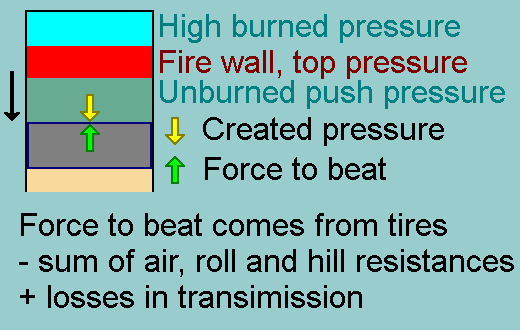
Then you need the temperature-pressure system, with what the mixture burns. It seems that the fire adds temperature-pressure system into gases initial system. Quite obvious that the addition takes place with efficiency. Efficiency gets poorer, when initial temperature-pressure system grows or is too big.In the picture you see pressure system for fire. The values of the pressure is dependent on cylinders filling ratio.
Very thin fire wall forwards in cylinder with maximum pressure.
Pressure behind-over the wall goes down with volume.
The free push pressure raises with shrinking volume.
- When piston and car moves : the pressure in push area goes always so that, it matches force to beat. If there is a mismatch, system changes the speed of piston.
- When piston and car are not moving : the pressure in push area grows, until it matches force to beat.After the mixture is burned the pressure system stabilizes. In accurate calculation both burned and unburned volumes have forwarding speeds from the wall. With computers it is possible to build complicated, more accurate calculations. Run out of paper and patience, when you use old pen and paper method.
When you design engine, your primary goal is to maximize pressure, secondary goal is to balance fire's speed and increase of volume so, that pressure remains pretty much the same during the firing stroke. You use flywheel also for balancing the pressure changes during the firing stroke. There are various pressure systems which can take place during firing, they are dependent on construction and current load. Constructional dependency comes from pistons diameter and stroke length.
With pressure sensor in piston you get the most important pressure for engine design.
Since fuel-air mixture is fixed to optimal burn, filling is adjusted with valves and pressure in inlet manifold. During filling stroke, moving piston creates vacuum into cylinder. With carburetor and fuel injector you mix the air and fuel. Then you adjust the pressure ... amount of fuel air mixture ... in inlet manifold. Inlet tubes are filled at the same time and same vacuum, cylinder sucks new mixture into it. Charger boosts both filling filling of cylinder and inlet manifold.
- - Calculation - -
25th October 2018The calculation began by defining weighs for 1 liter cube of atmospheric air. The cube is divided to boxes with the shares of Nitrogen and Oxygen in the air. Then the boxes for the elements are converted to weighs with densities. With the weight of one molecule you get the number of molecules in the box. Then the unit count per liter is shifted to with the used fuel-air mixture.
- The unit count is clamped. It refers to an enormous number of atoms. Unit counts in the table are relative to each other, far from real counts.
- In the actual spread sheet calculation there is small closing utility, with what you can shift fuels 4.846 into 5. When fuel is moved to 5.00, Oxygen raises to 14.18, Nitrogen is 52.90.
- When you play with combustion engines and air all parameters approximations. Air and fuel quality changes all the time.From the below you find general contents of the on-ground air.
Gas Atom-Mol
weightg/L Chemical Sign Share in dry air Nitrogen 28 1.251 N2 78,0800000 Oxygen 32 1.429 O2 20,9500000 Argon 40 1.784 Ar 00,9340000 Carbon dioxide* 46 1.977 CO2 00,0397800 Neon 20 0.900 Ne 00,0018180 Helium 4 0.1786 He 00,0005240 Methane* 16 0.717 CH4 00,0001810 Krypton 84 3.749 Kr 00,0001140 Hydrogen 2 0.090 H2 00,0000550 Nitrous oxide* 44 1.925 N2O 00,0000325 Carbon monoxide* 30 1.250 CO 00,0000100 Xenon 131 5.894 Xe 00,0000090 Ozone avg.* 48 2.140 O3 00,0000050 Nitrogen dioxide* 46 - NO2 00,0000020 Iodine 254 4.933 I2 00,0000010 Ammonia* 17 0.769 NH3 traces Sulfur dioxide* 64 2.926 SO2 traces Others, related Nitrogen Oxide* 30 1.249 NO Water vapor 18 0.804 H2O Petrol, vaporized 86C14H 26 1.260 C2H4 - Carbon 12 C * the way density is measured is unknown. Ozone for example seems to be calculated. So that you have divided Oxygen's mass with 2 and multiplied it with 3.
- Humidity, which varies in range 0% -100% is 0.001%–5% from the volume. 100% humidity is a point where vapor converts into water. It refers to the maximum amount of water vapors, that can exist in the air. 100% humidity means that the amount of water in the air is 0.5% at -20C, and 5% at 40C, curve is parabolic.- When you vaporize common petrol it converts to ethylene. The swap comes from difference in atom weighs, 12 hydrogen atoms weighs as much as one carbon atom. => 86 / 12 = 7 and 14 / 1 = 14. This converts into C2H4.Besides Ethylene C2H4 there is Propene (propylene) C3H6 and Butylene (butane) C4H8. All these three are possible results from vaporizing common petrol. Qualities are near each other. Possible that next in series - C5H10 - would already be a liquid. Or almost liquid.
In liquid fuel, molecules form long chained strings and rumps. When you warm the petrol, it stretches and chains get broke. Conversion from liquid to gas begins at 25C. Fly petrol begins the conversion at 40C. Fly petrol has different formula / reaction than common petrol.
The formula / calculation is not new. Someone obviously has ( long time ago ) calculated 14.7 theoretical optimum for petrol. Cannot find the reaction and the calculation very easily. With sample you should be capable of calculating ratios for methanol, diesel, fly petrol, etc. You find the vaporized forms for liquid fuels from books and tables.
Fuel mixture is often calculated with mass. The optimal ratio is said to be 14kg : 1 kg, when air's density is 1,29 and fuels around 0,75 in optimized German oriented engine uses around 14.5 : 1 volumes in fuel-air mixture. Mass and liquid oriented calculation is primitive and inaccurate. Sensors work with volumes. The mass oriented optimal mixture varies with temperature, density, and what so ever. Distilled petrol and diesel on the other hand have excellent chemical quality, untreated distilled petrol is used in for example cosmetics. The variance in weight comes from length of earlier mentioned CxHx strings. When petrol is vaporized, most from the liquid's weight variance vanishes.
- - PARTIAL LOAD - -
Nov 15th 2018
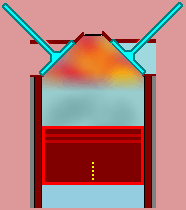 Burning and transmission volumes 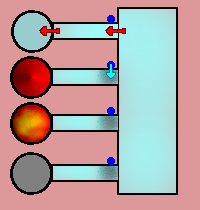
Inlet gas sequence in 4 stroke engine from Top-Bottom : |
When engine is partially loaded you have two theoretical mixture volumes in cylinder. Another one is burning volume, another is filler-pressure transmission volume. You can use the two-volume principle for calculating rough values for partial load.When you optimize the fire, you build the mixtures to inlet pipe. The first part which goes to cylinder misses fuel, at the end of the pipe you have mixture, which is burned in cylinder.
For the system you need separate inlet tubes, whose volume equals total volume of the cylinder ( displacement * compression ratio ). When you open inlet valve, the gas in the tube is replaced with new. Right before or after you have closed the valve, you spray fuel to the end of tube. New mixture has two strokes to stabilize before next stroke. With loosely timed mixing you get optimum mixtures and best powers for partially loaded engine. System is essential for boosted vapor creation. Vapor creation needs rich mixture, and by default partially loaded engine runs with thin mixture.
Partial load is controlled with the amount of fuel-air mixture you lead into cylinder. In practice you begin the spraying and mixing after or soon after inlet valve is opened. With pressure sensors, gas pedal positions, etc. you can adjust-optimize the mixing.
When you estimate vapor creation, you can start with fuel consumption. One liter fuel takes 15 liters air. From this air 20% is oxygen, so one liter fuel consumes 2.5 liters oxygen. Firing splits this 3.5 liter volume to vapors and carbon dioxide. For the calculation you need idle ... traffic light ... consumption. In cities you spend often over 50% from total drive time in traffic lights. Thing that gave me great faith in the future of copter cars. Traffic light consumption is always measured with fuel consumption per hour.
Possible to measure vapors from exhaust gases, with reasonable precision. You can even have a gauge on dashboard for exhaust gases vapors. And vapor creation. Standard equipment for real-life eco cars and environmentally conscious Californians. City people in general.
Copter cars thrust creation system is slightly different from vapor creation. In thrust creation you play with total volumes. The significant amount of inlet air is dependent on rpm and displacement. Small pressure change does not have much meaning.
- - - -
Possible that smog was only water vapors ?
I do not think so. Smog is approbation from Smoke Fog. Smoke's grayness obviously comes from the number of free carbon atoms. Carbon comes from excessive water creation. The powerful V8 of 1970 used 10.5 and 10.8 compression ratio. Amongst many other things, high compression ration and rich, powerful mixture explodes dirt in the air to atoms. Another possible source for carbon and gray scaled exhaust gas.In order to get rid of smoke, you must enrich and convert loose carbon atoms to carbon dioxide with oxygen ... or to some other chemical compound. In order to get some oxygen into catalyst converter you got to use very thin fuel-air mixture. Oxygen levels in exhaust gases remains almost unchanged, until you exceed the optimal for exhaust gas mixture. When you use thinner than 15.5 mixture, you have difficulties in getting and keeping the engine running.
When so, catalyst converter could use N2 atoms for binding the loose carbon atoms from exhaust gases. No idea what kind of compounds Nitrogen and Carbon can form. Without oxygen catalyst converter has to create nitrogen compounds from unburned fuel too. No idea what kind of compounds Nitrogen and Hydrogen can form. These Nitrogen compounds are not necessarily natural. Possible that catalyst converter does not do a thing.
Thin mixture and oil crisis cleared the skies from smog and common clouds.
Brought drought to Californians.
With sugar oil and retuned engines you can restore the humidity.What made thin mixture more economical.
Nothing. Thin mixture reduces the engine powers. Usually it increases fuel consumption per produced horse power. Thin mixture reduces the request for the power. It slows down the accelerations from traffic lights and so on. Pressure sensor tech brings a big boost to average traffic light acceleration times. New engine tech brings L.A. enough water and food for living. Sugar oil and sensors gives room for expansion in population and local wild life.How do you think that LA wild life will take the philosophy ?
Wild animals and plants always suffer more from drought than humans. When there is a drought, humans share from the water consumption grows. Human oriented consumption dries the rivers and lakes. There aren't any official water posts for the thirsty wild animals and plants. They have to suffer and die.Do plants suffer ?
They fight and struggle for their lives just like humans and animals. Quite a many goes to sleep before the natural death. Death in sleep is also a natural, painless dying method for animals and humans. It is the way we die.- - 15th Nov 2018 - -
What was the conflict in between midgets opinion and real life ?
Midgets said that, people will envy those, who can afford to drive with copter car. In real life, most who sees the copter car, wants to own and drive a vehicle like that. Common behavior is well known from example stories, which introduces dream cars and other expensive luxury cars.Knew in forehand, that when Saudi's get money from high oil prices, midgets cannot handle it. Each and everyone started to publish stories about poor Saudi-Arabian editor, who was ruthlessly killed in Turkey. Not a word about the lack of sugar oil was published. Very negative and pitiful individual often mistakenly thinks, that the thing that makes him angry and jealous, makes everyone angry and jealous.
You published biggest beneficiaries from high oil prices on purpose.
Yes, of course. Tried to make power keepers to do the right thing, unlock sugar oil. With sugar oil you do not have to get angry with Saudi's, oil prices stay low, every one happy. Locally farmed oil gives all the benefits to national economies.Unfortunately welfare of the fellow citizens is another thing, which seems to make some others very or overwhelmingly angry and jealous. When so, you can never actually do anything good for the local, national welfare. The good things always stay at the talk-cheat-lie levels.
Gearless car
- - 3rd September 2018 - -A car without gears requires that engine provides power with sufficient rpm range. Gearless petrol engine needs that the power production begins at around 180 rpm. Rpm range 180-6000 gives car a speed range from 0 to 200 km/h. In sport car 200 mph / 320 km/h needs 9 600 rpm.
Sensor engine, which begins power production at 800 - 900 rpm needs 3 or 4 gears. First gear is start up gear. Second is downtown gear, third is suburb gear and fourth is highway gear. Maximum speeds would be somewhere near 40, 100, 130 and 200 km/h. With four gears you get top-priority low rpm power-toque system to the same rpm level. With possible two or three gears everyday rpm's and cabin noises would raise from the current levels. With four gears you can reduce rpm and cabin noises in downtown, suburb and highway usage.
The new power-torque curve gives you a handy and easy-to-understand way to present your achievements in everyday qualities of your engines.
Longitudinal control bars, with weight distribution system
- - 27th October - -
Side projection for weight distribution rod system.In the picture you see weight distribution bars for dragster. In the system you have two longitudinal rods. Another is in front and another in back of the wheel. They are connected together with third rod. Third rod or rods are connected to wheel / axle. When you have stiff axle, you can weld the third rod into it.
With the system you can reverse or boost the acceleration forces, which raises or lowers the body. Schematics for front and rear wheel driven car are opposite.
It is also possible to use the same side for both body-to-axle mounting rods. When you do so, you play with rod lengths and mounting points. Most old rear wheel driven cars with stiff axle has the system in it's rods. Lower rod is below the axle, upper and shorter rod is over the axle.
In independent suspension longitudinal rod system is the best. During suspension event, the movement of wheel goes to rolling and speed. Not to lateral movement. With longitudinal rods you can use softer springs and longer suspension ranges for your car. Without making a total mess from the safety in curves.
The presented three rod system does not prevent movement of the wheel during suspension event. You can only reduce the suspension time movement.
You can naturally use more the one rod set per wheel. Like for example first set before and second after the mounting for the spring.
Top projection for longitudinal rod for steered wheel.
When wheel turns into both directions, straight longitudinal rod is the only possible rod.Front wheel driven car uses almost always lateral or heavily tilted rod systems. It is needed for providing space for steering the car with front wheels. Quite often axle has only one mounting point. Lateral slide is one possible reason for push feature in the curves.
Longitudinal rod system in front wheel needs a short axle, axle can be included to rods. Orientation of wheels suspension-time move comes from the orientation of the mounting. There has been some Mc Pherson suspensions, with small tilt angle. Mc Pherson is the most common front suspension in private cars.
Bar in the picture suits well to Mc Pherson, where the top mounting allows moves to all directions.
Front wheel driven powerful car would need distribution systems. Traction system releases the gas pedal and prevents the usage of full power. Weight distribution system keeps the traction control quiet. Weight distribution usually needs redesign to outmost bottom beam. It is usually too low ( near ground ) for getting height to the distribution system. Might want to enforce or build a beam in between the left and right mountings. Enforce the car sideways, improve the strength of passenger compartment.
Ends of the steering rods moves with wheel-rod system.
- - Electric suspension - -
How does crank system fit to power curve ?
With crank system you adjust the speed and power, with what pistons rotate crank. In long stroke engine you use more force to rotation, but the speed of rotation is lower. The power is unchanged. Crank system is also an internal gearbox for the engine.What was electric suspension ?
It is hydraulic suspension, which does not have any bouncing elements, like springs or coils. It was the original suspension system in my graduation work. Added gas balls to it, because I thought there wouldn't be valves, which would be fast enough. In early 1990's suspension was used few years in Formula 1 cars. With hydraulic system you get full control over the suspension event. Springs upright movement is rather simple and easy to control with microchip. Wheel doesn't bounce after the event. With combined acceleration chip you can prevent and control tilting of the body. You can make the suspension soft / hard on fly. At high speeds and in critical situation, you can stiffen the suspension so that it is safe. Reliable system is expensive to design, build and repair.Requirement for the stiffness of the suspension is heavily dependent on speed. Suspension which works fine at 200 lm/h / 130 mph, is almost non-existing, when you cruise with 90 km/h / 55 mph speed. Immo which has the final gas-ball version from the suspension, works well with both speeds. Have tested it few times. Besides speed, payload changes requirements for suspension's stiffness quite a lot.
In traditional suspension, they use progressive coils, for getting wider operating scale for the suspension. The more you push progressive coil, the stiffer it gets. A car with big payload has stiffer suspension, than lightly loaded car. Aerodynamics is a way to get speed related changes to progressive suspension. With aerodynamics you can push the car tighter towards road, create additional payload from the air resistance. Citroen is probably the only car maker, which has used 0-G aerodynamics in it's mass produced cars. Citroen SM from 1970's had 0-G aerodynamics in it's body, it had hydraulic gas-ball suspension.
Sure that your suspension is in newer Citroen cars ?
You cannot adjust stiffness with only one space. When you increase pressure to single space system, it raises and lowers the car. You need two spaces for creating the overall pressure, without change in ground clearance. Another space pushes car upwards, another downwards. You need either two liquid spaces or two gas spaces for creating the required opposite forces. Older Citroen has adjustment for ground clearance only. If you take a look at the Citroen's suspension system, there aren't any rods, which would maintain the clearance with different stiffness setting.Mercedes and Rolls Royce has used Citroen's hydraulic suspension.
Do not know. If so, not very long. Other cars uses coils and adjustable shocks. Or alternatively additional air springs and softer coils.Add-on air spring system is pretty much the same than hydraulic suspension. Lowering car to almost ground, needs non-existing coils. Otherwise coils prevent the lowering. Primary purpose of the coil system is to provide mountings for the actual air springs.
What kind of an education car engineer gets ?
Car engineer is kind of an all-around engineer. From the engineers car engineer has the widest range from taught things. Car is an application from almost all mechanical and electrical invention-apparatuses in the world. Physics, chemistry and environmentalism are important in cars. Things are taught to you briefly, hardly anything goes into details.Car is complicated apparatus. Many things are based on experience and tests. Not into mathematical formulas and calculations. Idea that you could design fully functional car from scratch is impossible.
What kind of cars car engineers have ?
It depends on your employer. Company cars are usually big and fine. Think that most from the owned cars are old. Much like Immo. Purchase and usage of the old car does not cost much. In car businesses wages are not very high. So many wants to work with cars, that there are always lots of applicants for the jobs. It keeps the wages low. Car salesman, whose earnings are bound to sales and proceeds, have big earnings. Traditionally better than in other businesses. Amongst common payroll people, best salesmen had the biggest earnings . Do not know how it goes at the moment. In many countries car sales has declined.Mechanics and technicians do not usually drive with the latest and most expensive cars, either.
+ + Nov 27th 2018 + +
What was wrong with autonomous, driverless cars ?
It needs forbidden 3D scanner tech. Scanner was an aid for driver. Even then when you violate my rights-instructions and copy the scanner into your vehicle, the scanner cannot know the difference in between unexpected objects, which comes into way. In scanners eyes one millimeter newspaper looks pretty much the same than 1 meter concrete wall. You need a driver for the decision, whether to drive through or stop.In factories, where they use driverless cars, workers must step away, when driverless car comes. Then you must keep the driveway clean.
You were cheated with catalyst converters ?
Yes. Can show a book from 1980's, where catalyst converter is said to work with oxygen. Without a word from chemical reaction, platinum and nitrogen compounds. All hazards come from cylinder, catalyst converter acts like an angel. Book from where I checked converters is published by Bosch from Germany. Bosch manufactures fuel injection systems for cars. When Bosch like company says, that there is additional oxygen in fuel air mixture, you cannot slash the claim just like that. In electric fuel injection system you adjust the fuel-air mixture all the time.Converters were good business for Bosch and other injection system manufacturers. They said that catalyst converter will not work with carburetor. Carburetor cannot response to the readings from lambda / oxygen sensor. Pressure sensor engine does not work with carburetor.
Familiarized myself with the operating system nonsense at around 2005. Presented idea from converter, which uses separate air inlet. For getting oxygen for burning remainders from fuel and enriching CO1 to CO2.
GM is closing 5 factories and firing 17 000 people. 3 assembly lines of cars. What will happen next to pressure sensors ?
Don't know. You originally asked something for saving GM and the jobs in car manufacturing sector. Developed the sensor tech for combustion engine. If President Trump creates one million jobs a week, 17 000 layoffs and car manufacturing has very little meaning to his ... and other power keepers ... polices. Just a one day news for the vuf-vufs. With one super sexy, cool statement from the president himself.** President Trump said he had contacted privately owned company. He had asked why GM is closing plants. GM responded that cars do not sell well. Trump said he had asked GM to develop and build cars, which sells well. Majority owner is the only one, who can contact a company and give direct orders to it. Force it to run on losses, and not to cut the costs. Default speculator would never give such advise / commands to his own company. Super sexy, Mr. Cost Effective, seems to have forgotten, that he and his vuf-vufs just prevented US car makers from manufacturing best selling sensor cars. Idea that you can simply ask someone to build better, more competitive cars is weird. Competition from the buyers is so tough.
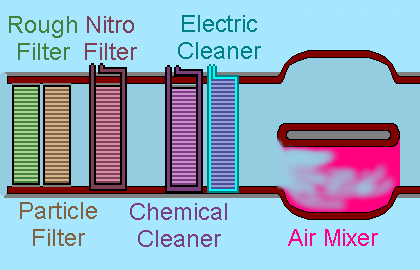
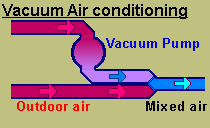
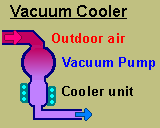
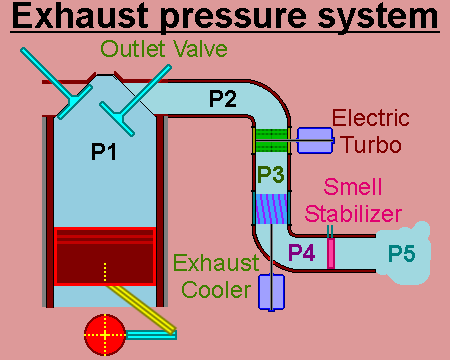 Exhaust
pressure system
Exhaust
pressure system Heavy
duty engine
Heavy
duty engine AC
Spark Plug
AC
Spark Plug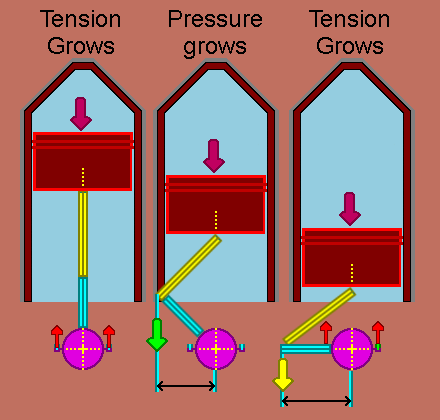 Internal
Power transmission
Internal
Power transmission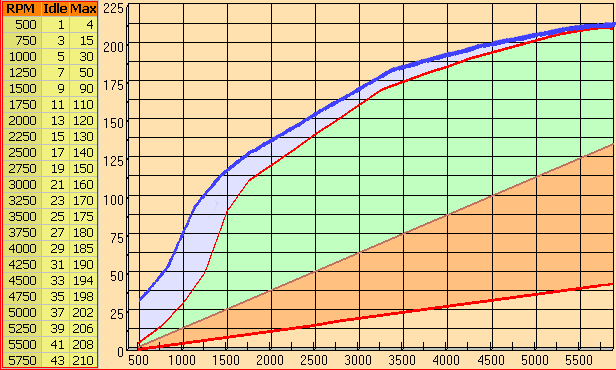
 The
actual pressure sensor [Aug 2nd 2018]
The
actual pressure sensor [Aug 2nd 2018]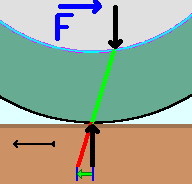 -
- Soft and Hot wheels - -
-
- Soft and Hot wheels - - -
- Free roll, friction factors - -
-
- Free roll, friction factors - -