| RD | Space 2018 |
| Diagrams :
Gravitational Machine + Combustion Collector October 6th 2019 |
Page about the basics for gravitational systems and combustion collector.
There is also basics for ground vehicle tubes.
Gravitational Shields and Machines - October 3rd 2019
|
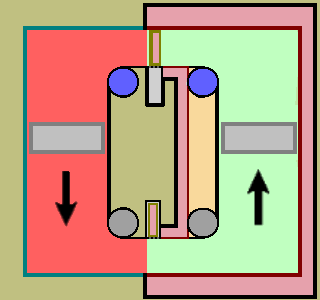
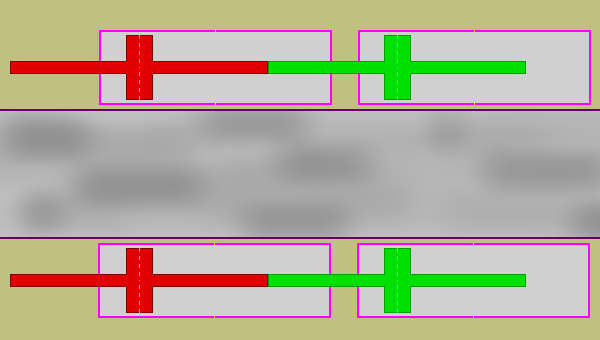
![]() - Red area on the left is high pressure tube, where you collect energy. - Green area is the low pressure tube, where you lift the weighs. Low pressure tube is surrounded with pink gravitational shields. - Steady run needs more than 2 weighs. Might be possible to build machine with one tube. Move the shields sideways instead of pistons. - - - - System where you pressurize the shields is obviously inefficient, possible that you need more energy to pressure creation than you get with the machine. Can use such adjustable system in every where else but in energy creation and power plants. |
Combustion Collector + machine powered tubes for ground vehicles
Calculations
Piston-rod system for exhaust pipe
|
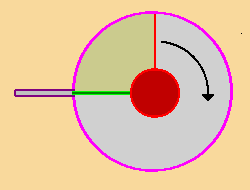
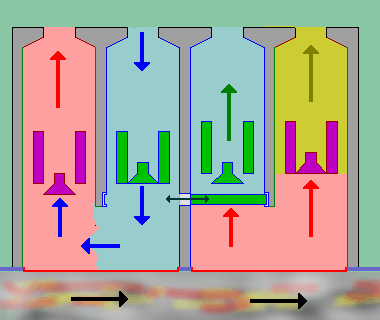
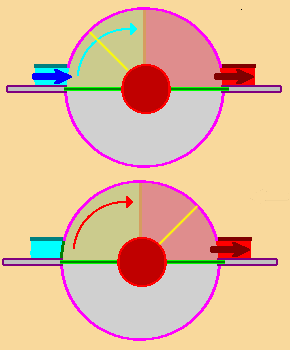
![]() Collector operates with a fact, that when you need 1 kJ for raising air's temperature with 1C, lowering the temperature with 1C must release 1 kJ energy charge. Temperature is a quality or property of an atom, compound and material. Temperature moves with the object. When so, the temperature and heat energy must be stored into object. Collector uses heat for increasing the pressure-volume system's energy. With piston crankshaft system, you get kinetic energy from pressure system. Collector is very quiet, much like steam engine. You can use steam locomotives double direction cylinders in the collector. Steam locomotive's cylinder is pushed all the time, from both directions. - - - - In the cylinder
From the table you can see, that copper is 4 000 times better heat conductor than water and 15 000 times better than air. Copper doesn't need pumping like water and air. Heat moves in copper faster than in pumped water. - - - - Cast iron needs around 0.45 KJ for 1C hike per kg. Aluminum needs 0.90 kJ and copper 0.38 kJ for the same hike. Cast iron is not very efficient heat conductor. Aluminum is almost as good conductor as copper. You can calculate the mass of iron and aluminum in between the rods and cylinder. - - - - Heat energy contents is always calculated with relative values. The energy contents is calculated with heating factor. Heat losses come from the radiated heat, the object spreads to surroundings. Radiated heat downgrades object's energy contents and increases surrounding content. The loss should be related to objects and surroundings heat conductivity. There is a maximum speed, object can transfer heat from the center to sides. Then there is a speed, with what the surroundings can suck the heat to itself. - - - - Humidity's - microscopic water drops - meaning to climate shows also
in the table. Water can absorb lots of heat. Combustion collector reduces the manmade heat load to the climate. It drops traffic's oil consumption quite a lot. |
||||||||||||||||||||||||||||||||||||||||||||||||
|
Rotating system
|
|||||||||||||||||||||||||||||||||||||||||||||||||
|
Tube system for cars and ground vehicles
8th October
|
HYDRAULIC GEARBOX Hydraulics is sort of easy to design. You can use transparent tubes and color pigments for checking the flow. You can record and revise the flow with hi-speed or frameless video camera. Power axle When you design and build the system, you should keep the logical power transmission axle always in one line. Otherwise the axle vibrates the engine-box-shaft system. If you build double piston pump, you might want you ships system and operate the pump directly with pistons. Efficiency of the hydraulics Efficiency of the hydraulics is dependent on tube lengths and used
liquid's quality. Hydraulic crank and empowered double piston pump needs good hydraulic oil. When you increase pressure and speed, the viscosity falls. You can build almost rod like internal system with high pressure and speed. But the pressure-speed increases friction against tube. In curves you can improve turning by increasing the tubes diameter. Increase slows down the fluids. Tilt angles for the increase and decrease must be low. With rod or rods, which has pistons at both ends, you can transfer hydraulic pressure losslessly over longer distances. You can never transfer fluid's movement with rods. Pressure only. Hydraulic crank Since you have a hydraulic gearbox, you can also use hydraulic crank system. In hydraulic system you lift the pistons with the same cylinder, you push during firing stroke. Inlet stroke needs additional pipe and valve system. Since you have hydraulics in the block, you can use hydraulic air pump for pushing the piston down and filling the cylinder. Hydraulic crank can be controlled with valves. When so, you can adjust compression ratio and displacement of the engine. During outlet stroke, the valve system allows you to move the piston
into displacement volume and get almost all from the burned gas away
from the cylinder. If you use almost gearless system, you can adjust also the speed of secondary strokes. You can fill, compress and empty the cylinders at randomly selected speed. Piston needs rings at both ends, but it doesn't tilt sideways. System doesn't need flywheel. You can collect energy into gas spring. To the spring you can collect energy from for example braking. You can use engine, electric pump or collector for charging the spring. Spring can be integrated seamlessly into hydraulic power transmission. New upright door, needs powered hydraulic or electric lifter. You can use the spring with hydraulic lifters, openers and movers, when the engine is not running. - most blocks can be configured so, that engine doesn't vibrate
in sideways. - was the original system in my graduation work. Abandoned the system because of the claimed poor efficiency. At the same time crank was said to waste 70% from fuel power. Heat losses were nothing. Claim inspired German Felix Wankel and many others to waste their time with a non-existing, marginal loss. - - - - In principle it is possible to extend the hydraulics to shafts, which rotates wheels. VW has used hydraulic differential. In front wheel driven car you can easily use two double piston cranks. Attach shafts for the wheels directly to gearbox. Pressure in the double piston units should balance different rotating speeds. You can build slipping clutch and fixed mechanical locks into cranks. In rear wheel driven car with engine at the front distance is rather long. Maybe too much for hydraulics. Hydraulic system is simple and has good efficiency ratio. 90 degrees angle goes in a conversion from horizontal movement to rotation. Hydraulic system can have brakes. |
||||||||||||||||||||||||||||||||||||||||||||||||
|
Hydraulic gearbox
9th October
|
4 wheel steering - 10th October
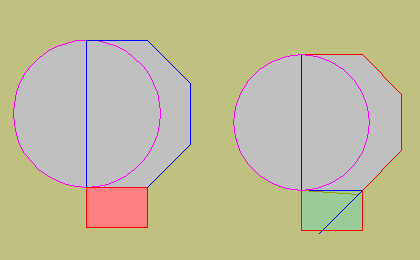
In the picture you see system, which could be somewhere near steering and 4 wheel steering. Steering belongs to chained physics.
- When you turn car and put wheels into 45 degrees angle, car's front moves sideways with 45 degree angle all the time.
- Wheelbase is well known to affect to turning radius.In the picture the chain is simplified into three 45 degree turns. The length of simplified line is car's wheelbase.
In the picture wheelbase is 3 meters. Angle of the front wheels is 45 degrees.In the left car's inner turning diameter is 7.24 meters. And with pictures 2 meter width outer circle is 11.24.
In the right rear wheels are turned 5 degrees. The rear wheel turn is used for reducing the wheelbase.
With 5 degrees angle wheelbase falls to 2.76 meters. With this wheelbase inner circle is 6.64 meter, outer 10.64.Results should be rather near reality.
In reality rear wheels pushes rear farther from the front all the time. This push makes the 4 wheel steering fast and efficient.
|
|
Turn theory Turn in sideways creates momentum, that prevent movement of the front sideways. At rear wheels the momentum tries to move wheels side ways. When so, tires' steering in sideways increases the turning diameter. If tire has theoretical 0% stiffness in sideways, the car doesn't turn. It moves in sideways, and keeps the direction. Same sideway movement happens, when you have only one wheel steering system. Turn needs always two mounting points. The turning center comes from the momentum. The momentum changes
direction at the longitudinal weight center. Rear follows the front wheels with momentum and body based connection
to front wheels. Detailed calculations are possible with momentum, wheelbase, weigh
center and front wheels angle. 4 wheel steering moves rear wheels farther from front wheels, with
rear wheels steering angle. When you move the
rear farther from front, you make the car act like a car with short
wheelbase. When car is in 4 wheel steering mode, the weight center should lose it's meaning for the momentum. Weight affects to the grip and tires own sideway movement in it's air space. Never seen tracks from 4 wheel steered car. Have a hunch, that tracks and shortcutting would match car with shorter wheelbase and 2 wheel steering. In theory it might be possible to build a good full-time fixed 4-wheel steering. Build a system where front and rear wheel angles are optimized for the steering angles. Switch into park mode after angle grows enough. Such system would reduce uncontrolled sideway movements at rear wheels. System could optimize also outer and inner wheel angles. Computer controlled steering for a car with softer suspension is obviously rather ambiguous. Possible that you end into continuous addition of sensors and subroutines, that handles various tilts and suspension events. A bigger rock in the curve, under only one wheel is an example from the thing, that can mess up your routines. The rock and it's movements are nothing for fixed steering. When you take control over steering, you must handle the rock's disturbance in your program. In principle you give up from the control only then, when some emergency sensor goes on. Designing steering When you build electric
steering, first you design default steering. After this you can build more sophisticated electrically assisted hydraulic or electric system. All electrics for at least the brakes should also have documented override switch ( if not in dash ). Override systems must be made so good, that 3rd, 4th, 5th, 6th, ... owner can use the car and take the car to inspections with override switches on. In order to keep the sales of the new cars running, you must ensure, that the car does not become unwanted during it's lifetime. Bad reputation is easy to gain with poor electrics. Bad reputation drops the resale value. Low resale value has strong effect to the sales of the new cars. Nobody wants a car, whose value falls twice as quickly as others. If all cars have a bad reputation, the overall car sales falls. Politics are very familiar with the effect of the overall bad reputation. In all countries there has been a time, when electoral activity was 80-90%.
|
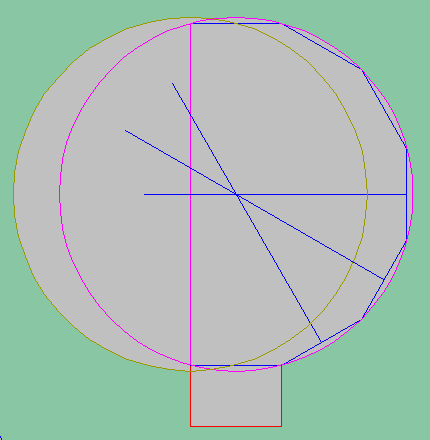
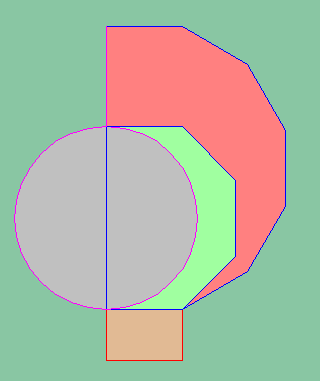
Front wheel turns with 45 and 30 degree angles.When you simplify the turn, you make as many segments as it is needed for 180 degrees turn. Formula and system has a built in logics. - In chained physics you can usually simplify the system. Credit demands applies also to super smarts, who knows everything,
without knowing anything ... |
Where do you need new theory and explanation about steering ?
Only the super smart ad-sellers, Google and midgets can steer car with computer, without proper mathematical presentation from the steering. They are not bound to reality.You need explanation and calculations for the intended parking aid and for optimizing steering. When you optimize the steering angles, wheels have better grip in curves. You either take curves faster or alternatively get better safety in curves. Theory, which belongs to chained physics, is brand new, there aren't any other vehicle level theories about steering.
And with gas spring flywheel you collect braking energy from the traffic light stops, and use the collected energy in the next traffic light start.
Gas spring flywheel is based on new definition of pressure. Pressure is potential kinetic energy. Hydraulic power transmission has many advantages when compared to mechanical system. With combustion collectors and other alternative power sources robust integration you can convert the hydraulics poorer efficiency into a huge advantage.Brakes are powered with hydraulics. With discs and drums it is not possible to collect the energy, they convert kinetic energy into heat and dust. You need a propel or turbine, whose power creation slows down the wheel. Hydraulic brake needs overhauling after 200 000 - 300 000 km. In between the unit is care and fault free. Closed unit doesn't get stuck like mechanical brakes. Unit can be designed so, that you can also power the wheel with it.
Dust creation ?
Dust creation, removal of the small particles from the pads and discs, needs lots of energy. If you have million cars, whose average mileage 10 km a day, daily mileage grows to 10 000 000 km. If brake pad last around 100 000 km, city consumes 4 x 100 pads per day. Around 100 kg per day is not very big amount in big city. Pads are nowadays asbestos-free, their dust's hazardous effect is not that big anymore. Asbestos endangers your health and ruins your lungs.Hydraulic brake unit should be lighter than mechanical. Same lightness goes to hydraulic crank, gas spring flywheel and hydraulic transmission, too. Combustion collector has many steel tubes and steel axles, they raise the weigh.
September 29th 2019 - Prologue for Gravitational shields
It seems that you can build gravitational shields, without lethal side-effects.
Dense, good and complete 100% shields must be checked before widespread usage.With the shields, it is possible to build gravitational machines,
Perpetual machines, that produces more energy, than they need.In gravitational machine, you lift weight with and over the shield,
then you drop it without shield.Gravitational machine's principle can used in elevators.
Shield can be used in movers and vehicles for reducing the required powers.In principle it is possible to build similar kind of perpetual machine for rotational field.
The rotational machine should work in interstellar space, too.
Since pressure seems to stop gravitational drag efficiently, one form of shield could be a double plate, with high pressure space in between the plates. Plate weighs quite a lot, but it would suit to on-ground usage. To for example elevator and other usages, where the shields own weigh is insignificant.
Pressure plate suits also to mounted gravitational machine and theme parks jumper attractions.
- - - -
Gravitational machine is third perpetual machine in our world. According to old physics hydro and wind power are perpetual, they work without external energy. Gravitational machine is the best from three. The machine produces steady power. Power is not dependent on seasons and winds. Vacuum process is kind-of-a perpetual process, the power comes from sun beams, just like in solar panel. All these 5 work until the day, the world ends. Or the machine gets broke.
Drag moves away from the gravitational center. It is not yet known if the shielded machine needs more than just bottom plate. Need for sides and top cover are possible. The crust's and core's gravitational resistance blocks the center from all directions.
From the splits you find a difference and a connection in between rotational and gravitational resistance. When gravitational resistance falls, rotational resistance grows. And vice versa. When ancient earth rotated faster and had smaller gravity. Internal drag resistance was bigger and rotational resistance smaller than now.
Due to this connection it is possible that both gravitational and rotational forces are the same. Got to build or try to build that big and tall atom and wind free box for getting the angles and other characteristics for the gravitational forces.
Energy source of gravitational forces is unknown and invisible to us. The force obviously comes from the next universal level. Rotational universe with time tube can grab and modify the energy from Godly Space. In multi layer universe, centers could be energy portals in between the levels. So that atoms grab energy from our gravitational and rotational fields. Energy portal fits to the idea of gravitational resistance. Both pressure and denseness increases the power, atoms need for rotation. The increased power and pressure reduces the atom level rotational slip. Better grip boosts the rotation speed.
In liquids and gases the higher speed comes from viscosity. The required rotational force is smaller. Within a form pressure-density system works like described. Inside the core, the higher pressure and smaller diameter increases the volumes of solid and liquid parts of the ball.