At the other end of the chain of sounds we find speakers and
headsets. From the microphone to the speakers and headsets the sound is
unchanged, but it is not sound.
Microphone converts the small changes in air pressure into electricity,
and at the other end the speakers convert the electricity back to air
pressure.
Amplifier
There are three major units in amplifiers. There are pre-amplifier,
amplifier and power source.
When signal comes to the amplifier it is directed to the pre-amplifier.
In pre-amplifier there are switches, with what you choose the source use
you want to listen. After the switches, the chosen signal is sent to
modification circuits. Treble, bass, balance and loudness are the most
common modifications, pre-amplifier does. Dolby Surround chips and
circuits are also in the pre-amplifier.
The volume slider is connected directly to the pre-amplifier. With
volume slider you adjust the voltage levels of the outgoing signal. Even
then when when you bypass the pre-amplifier, the signal goes through
volume adjusting circuits.
In quite a many amplifiers there are output-input jacks right after
or inside the pre-amplifier. These jacks are used to connect external
apparels and sound modification circuits to the amplifier. If you for
example buy an equalizer to your audio system, you wire the equalizer to
the amplifier with these jacks. If your amplifier has Dolby Surround
system, it is usually an external unit, which is connected to the
pre-amplifier. With internal pins / wires.
After the modifications, the signal is sent to the actual amplifier
unit. The main amplifier generates the powers from which the sales and
market men are always talking about. The main amplifier is almost seamlessly
connected to the power source.
The main amplifier takes the marginal, mill Volt level signals as an
input. In the main amplifier the mill Volt level signal is directed to
transistors. Transistor is an electric component, with what you can
steer mainstream voltage levels with a small steering signal.
In amplifiers the marginal steering signal comes from the
pre-amplifier. The electric current comes from amplifier's power
source.
There are three pins in a transistor. One pin is for the
marginal steering signal, which is connected to the pre-amplifier's
output pin. Second pin is an inlet for main stream current, and which is
connected to power-source's output pins. The third pin is for the
manipulated output signal. In amplifier the outlet jack is connected to
the speakers.
For the amplifying job, each output channel needs one transistor. In
stereo amplifier there are usually two transistors. In four channel
apparel there are four transistors.
Nothing prevents the usage of more than one transistor. Electricity is
not like sounds, it is much like light. When you connect two transistors
into same output jack, the power you get from the output jack is the sum
of the currents which are led to the jack.
Using more than one transistor per channel, increases the number of
required connections, and usually results to the poorer sound quality.
Not forgetting very complicated construction.
Power Source
At this point you probably guess, what is the primary meaning of the
power source. The maximum power of the power source is the limit for the
amplified and adjusted power - current - signal, which is sent to the
speakers.
If your amplifier has 300 watt power source, maximum output power is
always less than 300 watts. The output powers could be 4 * 50 watts, 2 *
100 watts, 1 * 200 watts. But it is not possible to get over 300 watt
powers to the speakers.
- - - -
If the amplifier has digital inputs, the signal is always converted
to analog before the pre-amplifier. If the amplifier has optical inputs,
the signal is first converted to digital signal and then converted to
analog signal. You cannot send analog data through the optical wire.
Powers II
In general there aren't any limits for the power you can
get from the amplifier. When the amplifier is overloaded, at some point
the heat destroys the electrical components inside the amplifier.
The power is always announced with the level of
distortion. The level of distortion tells how much the amplifier
cracks the signal during the amplifying process. You can hear the
distortion and cracking from the speakers.
The speakers have the similar kind of distortion based
power announcement system.
Speakers and headsets
The journey of sound is coming to it's end. The chain of sound ends
to speakers and headsets.
Headsets are actually speakers, too. They are miniatures from the
bigger speakers. Since headsets operate in "closed boxes", right beside
the ear, they do not need much power for making changes to the ear
pressure, ouch air pressure inside the small box. So they can be made
very small. It is also very easy to make permanent damages to your ears
with headsets.
Active speakers and speaker sets , which are used with computers have
amplifiers inside them. The speaker unit is similar to the other speakers.
In the past sound cards had small amplifiers in them. Nowadays they have
only pre-amplifier units.
In speakers there are three major things. The box, heart and cone.
The padding inside the box is fourth thing in a native speaker. Padding
prevents the box from echoing the sound. If you take the padding away
from the box, the sound changes to the hollow / echoing sound.
Many ways to do the business
In the shops there are many types of boxed speakers. One-way, two and
three way speakers. In one-way speaker there is one speaker element
inside the box.
In two-way speakers there are two speaker elements inside the box.
One small element for high frequencies and one big element for basses.
Three-way speakers are much like two way speakers. Three way speakers
have one additional element for the mid-range frequencies.
Most of the better quality speakers are three way speakers. Quite a
many of the audio enthusiasts prefer the old two way speakers from three
way speakers. So in high quality speakers two and three way speakers are
both very common.
Boxed one-way speakers are nowadays very rare. One way speaker systems
on the other hand are very common. They are used in phones, transistor
radios and very many other peeping devices.
Boxes
Box is very important thing in speaker.
When you have a speaker element without a box, the changes in air
pressure are always rather modest. Without the box part of the air
flows slowly to the back of the speaker. Without keeping any noise. The
box prevents this unwanted movement.
There are two kinds of speaker boxes. Closed and reflective boxes.
Nowadays almost all speaker boxes are reflective. They have
small tube and hole, from which the air comes in and goes out from the
box. Dimensioning and placement of the tube-hole system is very
important. The air traffic must be synchronized with the movements of the
speaker elements. In principle the air should come out from the box at
the same time, the speaker elements are moving forward and increasing
the air pressure. The tubes are usually dimensioned and positioned so, that they follow
the movements of the bass element. These boxes and speakers are called
bass reflex speakers.
Resistance
Resistance of the speaker says how much power it is needed for moving
the speaker. The speaker's resistance level must match the resistance
level of the speaker jacks in the amplifier. The resistance of the
speaker is summed from the elements of the speaker. The way electricity
is summed, depends on the way elements are connected together. In serial
connection resistances are added together. In side-by-side ( parallel )
connection the resistances are first divided and then the results are
summed.
Nowadays it is no longer needed to check resistance levels. There are
two general use resistances for the manufactured speaker elements. 4
ohm, 8 ohm. With these elements the resistance levels of the
speaker boxes varies from 4 to 8 ohm. And on the other hand all speaker
jacks in the amplifiers support 4-8 ohm resistance range.
When you search maximum power from the amplifier you should use 4 ohm
speakers. Increase to the resistance lowers the power you can get from
the amplifier-speaker system.
In theory, 8 ohm speaker system has more torque than 4 ohm
speaker system. In theory, with 8 ohm speakers the distances from where
you can hear the sound are longer. But on the other hand, the sound
levels near the speaker are lower.
In the outdoor and big arena audio
systems resistances used to be quite high. Guitar amplifier for example
had over 400 ohm speakers. Nowadays PA systems are made with marginal 2
ohm resistances and huge output powers. If you buy a ticket from the
back row, you don't need earplugs for protecting your ears. There is
awful lot of noise in the front, but levels fall rather quickly.
Almost all three way speakers are 6 ohm boxes. It is the lowest
possible resistance level for the three way speaker, which suits to
standard 4 to 8 ohm range. When you play with big powers, the resistances of
the available speakers raises to 8 ohm
In US markets common resistance range goes up to 16 ohms.
Heart cone system
Heart-cone system of the speaker is reversed version from
microphone's heart-cone system. Instead of measuring the movements of
the cone, the heart of the speaker element moves the cone.
Bass element
The bass frequencies / pulses are slow and big. The required changes
in air pressure are slow and big. In order to create such changes, you
need big elements, and flexible, long hearts.
The shape of the bass cone comes from megaphone effect. Coned shape
and megaphone effect gives additional power to the bass element.
Megaphone effect is an acoustic effect. You can create the effect for
you speech just like that. All you have to do is to create cone in front
of your lips with your hands. The cone directs and aims pressure changes
and pulses into one direction. The person to whom you are shouting hears
you better, but the person, who stands behind you, cannot hear you as
well as before.
Subwoofers / Home theaters
Subwoofer systems were originally developed for car audio systems. In
home theaters the subwoofers are compromises between the space and sound
quality requirements. Four full sized two or three way speakers produces
far more better effects and basses for the audio systems than
subwoofers. But the full sized speaker sets takes lots of room,
and all speakers must be positioned correctly.
In subwoofer systems singing, dialogues and other high frequency
sounds come from the designed / correct direction, but there is only one
bass source in the system. The subwoofer plays basses from all four
channels. If there is big blast on the right, the sound comes from the
center instead of the right side.
By the way, the car audio systems, with
boosters or amplifiers are very good proof from the pulse form of the
sound.
The cabin of the car is too small for the wave
theory. If the sound forwarded as wave, you could never hear low
frequencies and big basses from the car audio. A thing from which the
powerful car audio systems are famous for.
According to the wave theory, room length has
to be over 7 meters before you can hear the basses. And the car cabin is
only two meters.
If you are not familiar with car-audio, the
booster is special amplifier. It is connected to the speaker jacks.
Input levels / signals for the boosters are bigger than in common
amplifiers. Most of the boosters have also built in equalizer in them.
|
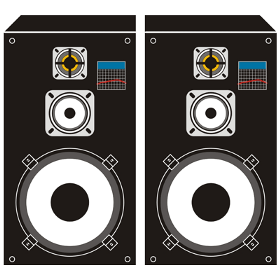
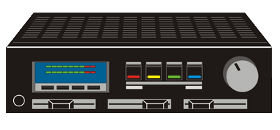
Amplifier-Speaker system finalizes the chains of the sounds. When you
look at the speakers, their movement is one directional. And they move
without any vibrations. There is absolutely nothing in the speaker which
could form waves to the air.
The cones which are often believed to be the wave makers are not
necessarily needed. You can, for example, playback sounds with a simple
tin plate. If you watched bio picture from Johnny Cash, at the end of the
movie his kids are playing with the old fashioned, fully functional tin
can phone. Tin can phone is good sample from playback system, which do not
use cones.
Mechanic Chain
Electricity is not the only way to transfer sound and music. Electric
sound system is needed, when you store or modify the sound signal.
When you for example play your stereos too loud, you usually get the
feedback through the mechanic Chain of Sound.
When your neighbor takes the hammer and hits the battery with the
hammer, he or she delivers his-her multimedia messages
to you with mechanic chain of sound.
Battery and the pipes delivers the knocks from the neighboring
apartment to you apartment.
A knock on the outdoor is another example from the Mechanic
Chain of Sound. When a visitor knocks at the door, the door vibrates and
creates the required pressure changes inside the house.
Monkey business
Monkey business is my business also in here. There is quite a big
monkey made invention in the theoretical basis of the Chain of Sound.
In classical physics the electricity and heat are separate forces. Heat
comes from light, and electricity usually from induction or some chemical
reaction.
If your physic teacher starts to talk about a single wave
form, which
transforms light ( source of heat ), radio broadcasts and electricity, it
is quite obvious, that he is not telling the truth.
It is not possible for the light and electricity to have
same sources. If you show the other end of the wire with a flashlight, you
cannot see the light at the other end of the wire. But when you attach the
other end of the wire to the battery, the electricity flows through the
wire just like that.
Separation of the radio and radio waves is explained in
Wave Research 2017. Radio wave is likely to be a special form of
electricity.
In classic physics all energies transforms to heat. So it is very easy
to invent and "find" waterproof evidence for the simple single
light wave based waveform.
Wiring business
Audio systems are connected to each other with wires.
Nowadays all wires are copper wires. Copper is not the best possible
wiring material. The best possible material for wiring would be gold, but
it is so rare and expensive, that you cannot use gold in wires. When
you do the wiring, the diameter of the wire has some
meaning. Diameter must be big enough for transferring the maximum powers.
( From amplifier to speakers ) If the diameter is too
small, the internal resistance of the wire grows to sky-high levels. The
wire warms up, and you never get the maximum powers to the speakers.
Filters and capacitors
In the old days speakers with ,multiple elements had
filters for dividing the frequencies to each element. Nowadays speakers
are made for certain frequency range. They ignore signals from lower and
higher frequencies.
Sometimes there is a capacitor inside the box, in the
internal wirings. Capacitors are short term power storages.
In speakers they are used for preventing overloads. When
low frequency power peak comes to the small high frequency element, the capacitor
grabs the overload from the wire to itself. After the power peak is over
the capacitor starts to release the overload back to the wires. It does
it so slowly, that the elements do not get broke from the sudden power
peak.
Quite often the capacitors are attached to the power wire
which leads to the treble / high frequency element.
Powers
All speakers and speaker elements have nominal maximum powers.
They are printed into technical specs of the speaker.
Sometimes marketing people adds speaker powers to the
powers of audio system. The powers of audio system are always equal to the
maximum power levels of the amplifier. Speaker's nominal powers have
nothing to do with audio system's power levels.
The speaker
powers are the maximum powers and power levels, the speaker plays without getting
broke, or at least without distorting the sound.
The announced powers of the speaker do not necessarily have anything to
do with the
sound quality and volume levels.
High frequency elements for example usually
have big nominal power levels. But they are rather quiet, when they are
used with maximum powers.
If you are looking for the maximum volume levels, the
efficiency parameter in technical specifications tells how much noise the
speaker makes ( with predefined, standardized amplifier power ).
The unit is decibels per watt, dB/W. The value varies from
85 to 100 dB/W.
Powers II
Lets assume that you have an amplifier which has 20W
power with 1% distortion. You accept 10% distortion in the sound,
and your listening experience. If there is enough range in the volume
slider, with 10% distortion you can get around 40W power from the very
same amplifier.
10% is usually the maximum distortion for listening. With
bigger distortion levels the sound cracks so much, that only heavily
intoxicated can stand the sound.
Speakers have two important powers. Another one is musical
and another is continuous power.
The continuous power tells the general power level with
what you can listen the music. The musical power is the momentary / short
term power the speaker stands ( without cracking the sound ). In the peaks
the momentary powers which come to speaker are sometimes very big. Peak
powers can be over two times bigger than the continuous, average signal.
|

