Speakers are the another important thing in audio system. No matter
how good your amplifier is, you can ruin everything with poor speakers.
Historically speakers and speaker boxes had only one general use
element in them. Elements with more than one element came to wider use
in 1960's. With Stereo and Hifi. These things created a need for
better speakers.
Key thing in speakers are the powers they can handle. Another thing
is the space you can use for the speaker boxes.
When you search the best and
richest sounds, you should use full sized speakers in all channels.
Sub-woofer with small satellite speakers is a replacement for the
full sized speaker system. If you for example search basses to your
system, powerful amplifier with full sized speakers beats the sub-woofer
systems - without difficulties.
After you have ensured that the boxes suits to your amplifier,
listening tests are the only way to compare speakers. Recommendations
from friends and acquaintances are another way to find the best sounds
and speakers to your system.
Size matters
When you choose speakers, the sizes of the bass elements are the things
you should look. When you want the best possible, the bass elements
should be 8 inches or more.
The size does not have a straight
connection to the frequency range. But the amount of air - a cone vibrates
grows in power of 2. You need two 6 inch elements, when you create
an effect which is similar to one 8 inch element.
8 inch elements are the most common in better speaker boxes. The popularity
comes from the required floor space. The boxes have to stand of the
floor, therefore you cannot make narrow speakers - if you do so, they
fall very easily.
8' element fits into the width you need for keeping
the box standing stable.
When you buy those small and high 3 inch boxes,
with bass elements on the sides, the required floor width varies from 5
to 7 inches. They only look small. And the box is too small for good
bass playback.
Buying floor speakers with multiple 6 inch woofers ( element which
plays basses ), takes as much or only a little more floor space, and the
sound is almost always better. The number of 6' woofers varies from 2 to
4. Then there is one woofer sized mid tone element. From the sidebar we
see, that four element 6' tower has as much bass-power than the very
common two element 8' floor speaker boxes.
Magnets
In commercial talks magnets are said to be heavy and strong. The
magnets should be in balance with the cone size. So that they have
enough power to move the cones. In theory big magnet has longer response
times and it misses details from the recording. Therefore it is
important, that the magnet is just the right size. Not too small or big.
The actual key thing in magnet is the range it can move the cone. If
the range is too small, the cone's heart hits the magnet. There
will be short cuts and mechanical extensions - quite soon faults break
the element. When you play music, you can hear the hits. The basses
start to distort and crack.
The range - cone can move ] - is the thing, which dictates the lowest possible frequency,
an element can play, with maximum volume level.
With lower volume levels
element plays all frequencies from the recording. Tested the thing with
our older audio system and computer speakers. Speakers in these systems
had app 60 - 10 000 nominal
frequency range. The speakers didn't have any difficulties in playback,
when we fed the speakers with 32 Hz synth sounds.
This does fit to the theory. The volume level says how much cone moves per
beat. When you increase the volume, the recorded wave is multiplied with
some factor. The difference between positive and negative peak grows
bigger.
This leads us into a new thing, the input power changes
the maximum frequency ranges of the speaker. So, the frequency range
should be measured with maximum continuous power.
In tweeters and high tones the magnet must be small. High tones are
very short, the element must change direction very quickly.
 Ideal floor placement
This is the best layout for music and basses. Besides
"corner" echoes, this layout creates invisible buffers for
basses. When the sounds from opposite speakers meet in the listening
area, opposite waves neutralizes each other. This boosts the sounds in
the center and reduces the leaks to neighboring apartments and rooms.
You can use bigger volume levels, and the sound is better. You need
four bigger boxes for this layout. Back boxes need proper bass-elements,
not necessarily as good and big as in front.
Satellite - Subwoofers on the floor

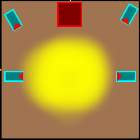
The four
basic channels in surround system are recorded / mixed so that the 4
base channels are front and back channels. In principle the layout in
left is correct for the 4 channel video. In six channel video there is
one layout for center channels. On the right you see an optional
layout for 4 channel video. In this layout you should use the fader and
reduce the volume levels in both back channels. The naming of the
multi channel system In multi channel amplifiers 5.1 usually means
that amplifier has four common amplifier units. Then there is one
amplifier-connector system, from which you can get mono signal for
subwoofer speaker. In multi channel amplifiers 7.1 usually means that
amplifier has six common amplifier units. Then there is one
amplifier-connector system from which you can get mono signal for
subwoofer speaker. In multi channel amplifiers 7.2 usually means that
amplifier has six common amplifier units. Then there are two amplifier -
connector systems from which you can get mono signal for subwoofer
speakers. Eeeks ! Then these 5.1, 7.1, 7.2 codes can also point to an
amplifier, which has only connectors for subwoofers. You got buy a
subwoofer with amplifier to these systems. + + +
+ Almost all sub woofers have internal amplifiers. And almost all
primary units have amplified sub-woofer connector. +
+ + + Before buying subwoofer, you should check that your amplifier
has a suitable connector for sub woofer. When your subwoofer has
amplifier and your primary unit misses connectors for non-amplified mono
/ subwoofer signal, the sub woofer got to have connectors for speaker
inputs. The powers in line outputs and speaker outputs are so different,
that you cannot connect them together. The sub woofer needs an
electrical circuit, which balances the input signals.
|
There is lots of talk about basses
and low tones. Basses do not mean pop-rock drums only.
All primary instrument
series :
violins - flutes - guitars + piano & organs,
are capable of playing basses and low tones. Basses
are things,
which are wanted from the systems.
Over 80% from the complaints
come from the poor bass playback. Basses
are most difficult to create.
In music and audio apparels, both.
Pushed / effected areas
| Diameter |
Cm2 |
| 6 inch |
2 800 |
| 7 inch |
3 800 |
| 8 inch |
5 000 |
| 10 inch |
7 800 |
| 12 inch |
11 300 |
| 15 inch |
17 600 |
From the table you see the areas, speaker elements
pushes during the playback. 32 Hz Hits
From this picture you see what happened
in the 60 Hz - 10 000 Hz speaker element.
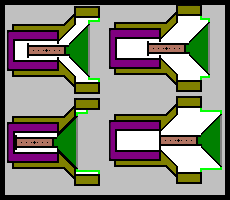
The upper speakers show the movement
with common volume levels. The lower speakers shows what
happens,
when you overload speaker
with volume levels and low frequencies. The
frequency alone never disables
the element. Low frequency needs more movement, than higher frequency.
Losing basses with wires As
you know from the texts, speaker elements move in two directions. They
have positive and negative bound. When you install speakers always make
sure, that you do not mix Plus and Minus
wires. Incorrect wiring does not break the
speakers. But mixed wiring causes speakers to
operate in different phase. When left speaker makes positive hit, the
right speaker makes the negative hit. The pulses
from the incorrectly wired speakers neutralizes each other. As a result,
you cannot hear much basses from your system.
Bass boost by placement

Placing boxes near corners boosts
bass playback capabilities. Corners create
"additional" echoing box for the speaker. 
This the way you had to install speakers
for HiFi systems. It leaves the basses
unchanged. If you are not "in" for powerful
basses, or your system outputs nothing but basses, this is the placement
for you.
Trebles - High Tones
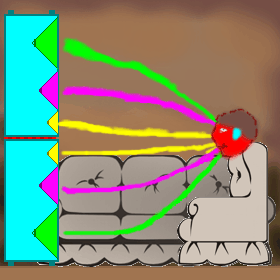
High tones are weak. They are directional - straight forwarding sounds.
Furniture and other obstacles fade them away very quickly. Therefore
you should provide them a way to listeners ears. Also the reason, they are
at the top in all floor speakers.
|
