Media Player
Media player has converted from simple replacement for
CD-DVD-BD player to a next generation computer and networking.
- computer gets frameless analog video, ac data transfers, new boxed discs,
slot-cards and slot-memories, chained cards, etc.
- in ac networking there is digital democracy, official electronic mails, html
based banking-billing system.
- due to some native born jerks, the most wanted thing, very fast Deca-Tech
CPU-GPU-DSP is still pending.
Multimedia computer created over 300% growth into IT sector in a short
time. Simple replacement for CD-DVD-BD player has grown into a next generation
computer. Almost everything changes and the player extends into almost all
sectors, where computers are used.
The word almost comes from CPU and the lost Deca-Tech. The new A/C
transmission tech makes the data transfers from one peripheral to another at
least 10 times faster than now. Just like boldly slashed deca-tech would have
done to CPUs and computing. With media-player upgrades forsaken deca-tech
would have brought you a brand new analog computer. With only handful of
similarities with current binary system. We would be at the edge of the new it
world, wouldn't we ?
? The new A/C network is one part from the A/C data transmission. A/C
transmission includes internal transmissions, displays, printers, etc.
I have been using media player computer prototypes many years already. It
is care free and durable. The proto is playing movies almost all the time I am
somewhere near. It has been playing movies over 20 000 hours,
during the time, one crash caused minor damage to media files and directory
structure. Player lasts easily 8 years in common use, with 2 hour daily usage
the current 20 000 hours equals to 27 year usage. Dead or poor player will
not kill your interest in music and movies.
I have a system, into which you can add up-to 4 media players. Then you can
use up-to 4 displays with the system. All 4 displays shows the same
picture. I am using two displays and two players. Another, poorer player
is for web usage ( currently broke ). Computers have docking bays. Needed docks for powering the
laptops without opening the lids. Both displays have speakers and amplifiers.
Audio is made so, that you can use these speakers. Another possibility is to
lead the signal into audio system. Audio system is constructed with as few D/A
conversions as possible. After first conversion the signal continues as
analog. All A/D-D/A conversions reduces the quality.
Despite heavy usage, electric bill have been reasonable. Almost invisible.
Heavy desktop usage shows in bills, during longer sick leaves consumption
falls.
I have been using the computers so, that I have wireless mouse on table and
keyboard hidden under the table. Keyboard is hardly ever needed. Tried to find
a remote control like mouse for the system, such does not exist. Such pointing
device needs digitizer layer in the display.
- Player is much like movie channel, but with player you can watch your
favorite movies, when ever you wish. Had a satellite movie channel once. Quite
often when I had time for watching, the broadcasted movie was either far from my
favorites, or I had just seen it. In pre-estimation movie-makers, distributors
and theaters ... and movie sector in total, would gain grosses from the
popular player. But broadcasters would lose ... possibly and in long term
quite a lot.
- Music makers would gain too.
- In third, photo sector, camera
makers would get some boost to their products from the player.
Video games + Morrowind
In video games,
popular player would re-introduce old simpler tv and desktop games. For single
and multi players. Made add-on for Morrowind game, to the media player. The
add-on introduces an idea of an whole family game, based on experiences from
Remember Me game. Heart of add-on is virtual reality. There is an art gallery
where you can watch Remember Me arts. Then there is ring, where you can watch
fist and other fights. It has also runway, where you can watch fashion show.
There is zoo, where you can go and watch animals of the Morrowind. Then there
is Lanters area where you can have sex with hookers. The existing animations
didn't allow the creation of striptease performances, sex shows and fuck
animations.
All new features will also get a story line. Ring will get a short armorer
skill related story line. Fashion show missions are cloth related, in
matchmaker storyline you arrange marriages, from the zoo you get animal
trainer - domesticator missions. From the library you get book collection
missions. From the lanterns you get sex missions. You for example cure
customers with gonorrhea / syphilis ... possibly AIDS.
If I do not remember wrong, Remember Me used to be the most popular
computer game in the world, with a huge cap to google, DNA and other fucking
hacking jerks ... popularity.
Media player costs and usage
After the construction, the monthly costs
are at the same levels with movie channels. In average I have bought 1-2 new
movies per month. In the beginning bought much more, wanted to get my older
favorites into it. In second hand markets the value of one boxed, almost
unused DVD is around 5 dollars / euros. So the value of the 200 boxed
DVD-collection is around 1 000 ( not a very wise thing to purchase and
download the files - only - from on-line shop keepers. ) The player with one big disc costs around $250.
Extension with one big 1TB disk, with USB box, is app. $70. 2TB is currently
little over $100.
In the long run lack of interesting new movies started to slow down
monthly purchases.
Most popular Media Player movies are not necessarily the same than in
theaters. Most popular Media Player movies must be durable. Watch count per
single movie is quite a lot higher than with other systems. Porn movies which
are known to have the highest watch counts / user are probably the most
watched and wanted movies within the player systems, reign continues.
|
What is proudly presented quantum computer ?
A filthy lie, fools day story. Computer is an electric apparatus,
quantum mechanics is a set of mathematical formulas. You cannot build machines over formulas.
Electric machines are built from raw materials, circuit plates and
components.
The most you can do is a
software library. DLL file, which has the quantum formulas. When you do so, your
DLL is not very likely to raise to the most popular DLL libraries in the
world. Quite sure that few have already written DLLs for the quantum
formulas.
|
Hard disks uses FAT32 format, DHTML-4, separate( discrete ) graphic and
sound chips / cards
Media players would work with modified Windows XP SP3 Tablet operating
systems. This is the last operating system, which can be installed onto FAT-32
partition.
- balance control in XP does not work, unforgivable programming bug for Media
Player.
- media player edition needs proper FAT-32 formatting tools.
- Max HDD size for FAT-32 standard is 16TB. It comes with biggest file
allocation unit. You can extend the support in new players / operating system.
- Windows limits both FAT-32 and NTFS volume sizes to 2TB. Over 2TB disks are
not accessible.
Big file allocation unit makes the disk i/o faster. On the other hand it
wastes space, when disk is full of small files. Media player should have at
least two volumes. One for operating system and another for big media files.
It optimizes speed-space system. And makes backup-crash related operations
easier.
- Due to the poor security and third party involvement DHTML 5 browsers are
not welcomed. DHTML-4 with small graphic, video and audio upgrades is enough
media player. Media Player needs proper DHTML based playback system for all
three. So that you can create custom players with Java Scripts. Cannot Windows
Media Player etc because they are OS dependent. But you can make a predefined
object interface, into which you can create media players for your OS.
- DHTML-4+ would need a small improvement into IMG tag. IMG tag misses the
original picture size. You can't find the missing attribute from the unsafe, jerk-made
control freaks dream ... DHTML-5 ... either. DHTML misses a chance to retrieve
original picture size from the browser ( size is usually stored by browsers ).
You need it when you resize pictures with JS.
- HTML is made for on-screen viewing. It has the best qualities for viewing
textural data from variable sized forms. It can adjust table sizes, text
widths according to current screen size. Other enhanced text formats - like
popular PDF - are for printers, they miss parameters for making nice on-screen
presentations.
- MS IE 8 explorer has utilized almost all DHTML-4 specs. Small Internet
Explorer 5 has also full support for DHTML-4, you can use it ( modified
version from it ) in small devices.
- a chance to use the mentioned remote mouse. You could make remote mouse,
with acceleration chip-sensor techs. Sensors have a small ball, surrounding
surfaces detects the movements of the ball. With the chip system, you do not
table for detecting the moves. The mouse would convert the movement into PS-2
signals and send the signals into remote receiver.
- standardized, programmable remote control system, with IR-RF receivers in both
display and apparatus. Display receiver is for video, and apparatus for audio.
- analog and digital multi channel audio / speaker outputs.
- VGA, RCA, DVI-HDMI video outputs and inputs.
- chip for decoding MPEG-1, MPEG-2, MPEG-3 and all MPEG-4 formats. Data
which is read From Hard disks, USB and Firewire connectors.
- support / drivers for Blue Ray drives.
- it would be good if there was one or two USB-2 connectors ( card
reader ), which feed data directly into DMA channels. It would make external
BD drives fast enough for BD discs.
- hot swappable external s-Ata connectors. Sis made s-Ata controllers support
Hot-Swap feature. Sis HDD-controller chips have been the best and most
reliable. There are controllers for 2 and 4 sAta disks.
- media player needs good quality sound chips, with detailed technical
specs.
Player has to be quiet
Basic demand for player is, that it has to be quiet. Throughout the
lifetime. It never takes long before bearings in desktop fans start to keep
noise. Width is another thing in them, the width should be equal common
home audio width, which is app. 40 cm. All fixed connectors should be in the
back plate. Then they would need an external power switch ( in front panel or
some other place, where it can be accessed easily, without opening the lid ).
Fixed bays for hard disks should be in front panel. IBM Ultrabay disks can be
removed and added to system just like USB disks. You can swap also secondary S-ATA disks on fly.
Attachment and detachment of secondary disks is called Hot swapping, seemed to
work. s-ATA is the current
hard disk connection standard. When compared to USB disks, s-Ata is faster and
almost break free. sAta connections are not shared, then their pins have
higher priority. Hot Swap is s-Ata definition, it does not necessarily work in
all computers. If you swap disk without the Hot Swap capability, disks are not
usually damaged. Some computers hangs up and starts normally after reboot.
Some computers needs resetting of the primary BIOS. When I tested
non-supported PATA swapping with forsaken modern miracle ... Blue Ray proto
... it burned integrated HDD controller from the motherboard.
I have USB disks and Thikpad Ultrabay disks for videos. The system has
grown quite a lot. It is
currently operating with small system disk and 2 x 1TB and 2 x 2 TB USB disks.
Then it has one 3TB network disk. When you have WiFi router shared media disk
can also be in some media player unit. All you have to do is to share the disk
with others. When you share volumes of units, the unit must be on line, before
others can access the shared disk. Some computer have a "Wake on
LAN" option in their BIOS. When the option is enabled, the request for
the contents puts the computer on-line automatically. If you have power down /
suspend / hibernate enabled, the unit with shared volume goes back to off-line
state automatically.
Usually it is a good idea to check the simple ( Windows 3x ) sharing from
folder options. NT sharing needs some experience from computers and Windows
operating system. If you have OS on different volume than media files, simple
sharing is just as good as NT sharing. NT sharing - with its security and
sharing options - merely messes the system. When shared volume does not show
in another computer, the reason is usually conflicts in NT sharing. NT sharing
has also few bugs in it's implementation. Sometimes you have to reinstall the
whole computer, before the shares work properly.
Arranged USB disks so that disks with free space are in Ultra bay boxes and the full disks in USB
boxes. Ultrabay slot is faster and more reliable than USB connection. USB
targeted ripping and copy fails quite often. USB-USB copy fails very
often. USB misses ATA's safeguards for reliable disc I/O. IBM-Lenovo's
Ultrabay is the only good swap-disk system in laptops. It supports USB / ATA
devices and batteries. Haven't experienced bigger problems with it. Sometimes
Windows XP fails to notice new or changed hard disc.
Originally system had small system disk and two 1TB disks in Ultrabay
boxes. Then I tested system where the system disk was big 1TB disk, it was
handy until I had to watch movies with another laptop player. There was also a
system, where I had one favorite for the latest and most interesting. System
had two other disks, which had copies from everything.
Changes to hard disk policies are lengthy and sometimes tricky ( because of
the lack of free disk space ). So you should always think in fore hand, how
you build the system.
USB disks are not very
handy at home. They need surprisingly lot of space from the shelf. Another
problem is that Windows stops connected USB disk on random basis. Usually it rolls all the time.
I have tools ( Windows Me installed in few computers ) for formatting big up
to 2TB hard disks with FAT-32 partition. All home audio apparatuses need
FAT-32 compatible partitions. None of the built-in features work with NTFS or some other
disk partition. Neither can you find USB-3 connectors from home-audio systems.
All tests with Blue Ray have failed. Had problems decoding, after these
were resolved, CPU decoding turned out to be too slow for smooth play. There
was occasional long breaks in footage. Tried to find BD encoder cards for
laptops / desktops, but there aren't any. On the other hand, demand for being
quiet, prevents the usage of faster CPU. Fan speeds and noise grows with the
speed. Put all 3 , one BD player and two BD drives, back to boxes. When DVD
came, there was add-on cards for decoding and encoding DVD files, fast enough.
Checked that such cards ( PCI, PCIe, PCMCA ) does not exist for Blue Ray
decoding and encoding.
Modern miracles cannot match my old Jack 3's excellent streaming
capabilities. You got to have busloads of additional computing power before
you get rid of the short, annoying breaks in the playback. Jack 3 was capable
of capturing two DV video streams with stereo voice at the same time. It makes
2 x 30 000 kBit/s. When you capture two streams at the same time, CPU shifts
from one stream to another all the time.
Media player proto
The player uses the biggest available 2.5 inch hard disks.
When one DVD is app 7GB, one 1 TB disk can store around 130 movies. When I
constructed the player, thought that one 1 TB is more than enough. But after I got
the player going, started to buy movies to it. Didn't take long after the 1st disk was
full. It turned out, that when movies are stored with DVD quality,
an average player would need 2-3 TB disk space. Blue Ray quality movie needs 3 -
4 times more disk space than DVD movies.
In the Fall 2016 maintenance, I upgraded the mediaplayer's storage to two 1
TB hard disks. There aren't bigger 2.5 inch disks available. ( First
2.5" 2 TB disks came to markets app. six months after this ) With 2TB
disks you can get 4 TB storage space into player. The upgrade project was
quite a mess, lost the DVD partitions (with all the data stored onto them )
few times. Halloween Hackers are also known to have tools, with what they can
ruin the partitions. They are not that well protected ( difficult to temper ).
All you need is time and inspiration ... for writing such programs.
Media player is currently merely a movie player. Music player programs do
not suit well for the new player. The ATS games' player will be synchronized
with the system.
When the player is based on laptop it is good platform for burglar alert
systems. The battery keeps it going during and after electric breaks. Wrote
the guidelines for living room computer over 10 years ago. Besides burglar and
surveillance system, with living room computer you can control heating and
lightning. Optionally living room computer can control apparatuses in kitchen,
watering system in garden, etc. Safety is important, when you add these
additional features to the media player. Web connection was/is forbidden in
computers with these additional features. Burglar alerts for example should be
sent via phone, not via web.
Player rips DVD's with 18 MB/s or 140 MBit/s speed. And it could be faster.
Required speeds are too much for web distribution. When you purchase / have a
movie without disc, you have to make a backup copy from it. Especially if your
player is connected to web. With media player, you can watch old recorded VHS
tapes, home videos and others alongside with digital movies.
Have been rather happy with the new multimedia laptops. Worst problems are
in the performance, just like it was with first current multimedia / home
computers ... 6-8 GB DVD copy takes about 30 minutes. 20 - 40 GB Blue Ray copy
takes over 2 hours. CD drive slows down the speed.
Blue Ray quality would need 10 - 40 TB hard disks, which are 20 times
faster than current disks. DVD quality would also need more speed. HW makers
are challenged for beating Jack 3 in real life and for real.
4k pictures and movies are impossible for PC's, computers which are used at
home. 4k video will not work well in MPEG-4 format. MPEG-4 has memory and
speed problems with big pictures. It was developed for delivering small videos
via web, cost of smaller file is bigger demand for the required RAM and CPU's
computing power. 4k picture is too big for MPEG-4. You should extend simpler
MPEG-2 so that it supports 4k picture sizes and bitrates. MPEG-2 works
internally with two buffers / frames, MPEG-4 creates display buffer from
buffer stack. Algorithms with what the pixels' colors are calculated are the
same. MPEG-4 is said to be almost useless with photo realistic pictures like
video footage.
Since there is new display and recording systems coming, might be a good
idea to forget 4K, build the systems directly to new the tech. The underlying
HW for the new wave tech is very different from current RGB system. Media
Player has enough Video RAM for 32 bit 4k video. Uncompressed 4k picture needs
32 MB free memory. Media player has 128-256 MB cards. But 4K doubles demands
from Blue Ray playback ... and computers are having difficulties with DVD
level video footage.
CBS system
Photos
All photos and videos have a small 3d effect.
It comes from the speed of light in
gravitational field and air resistance. Speed varies with color,
brightness saturation. Eyes gets the returning signals at different
times.
Eyes obviously uses these times for creating shapes from the
photos. This time is not available for programmed shape detector.
Great deal from the eyes better shape detection comes from better
processing of the signal.
Eyes can draw missing outlines, they can rotate shapes, they can
create colored / shaped areas into picture. Then they can match
created shapes into stored picture bank.
Creation of the program, which do the things, eyes can do, would
exhaust all existing computers.
3D-movies
I was never allowed to see 3D movies. Did say that the old 3D tech
is nothing. I was informed that they are good / something. Quite
obvious, that if had seen 3D movies I would have slashed them. |
New display pixel has three components like before, but the data is
different. Color, Brightness and Saturation supersedes Red-Green-Blue values.
You can blend the on-screen colors with R-G-B bulbs/canons and still get
better quality. When so, your blending system must be better than RGB color
coding system. Blender system and bulbs must be capable of creating more
accurate colors than you can present with old R-G-B coding. RGB has only a
handful of codes for recording bright colors. Slightly shaded white is
impossible in RGB. Next to white has only 6 codes : Red, Yellow, Green,
Green-Blue, Blue and Blue-Red. With more accurate input values, you can ( in
principle ) create all next-to-white shades with blending. In CBS system all
brightness levels have the same number of codes. The number of codes per
brightness level is dependent on the input and internal field size. If you
pack codes into Single ( 4 byte float ) each level has app 10 000 000 color
codes / shades.
It is the same with recorders, you can calculate new values from the given
R-G-B values. Conversion is possible with three input values only. It is
impossible to create conversion formulas for four or more input colors. Three
color conversion formula is power of 4 formula, difficult but not impossible.
Wrote formulas for input and output for CAL color system. CAL is almost equal
to new CBS system. Conversion based system is not as good as native system. In
the conversions, you have to calculate / estimate Brightness and Saturation
values from the colors. Conversion for display ( from CBS to RGB ) does not
produce as much errors.
CAL coding was made with base color numbers which had a range from 0 to 3.
Fractional part had more accurate definitions, with floating system you can
use variable field sizes in the input. If the input comes as Double, and the
display supports Singles, you can ignore the over floating part, and still get
the correct CBS value. With integer part, you get a hint from the presented
color for the pixel. Useful information for modifying photos and drawing the
pictures. Needed when you for example select color with what you modify the
photo.
CBS-D violates human rights
In principle CBS should be CBSD color system, where D is distance /
time.
After I failed to detect shapes from photo with CAL color coding, I
introduced 3D scanners Scanners raised enormous interest to violate
human rights. Midgets, politics and movie makers started to introduce cameras,
with what you can survey people's moves on the streets and everywhere.
With CBSD system you could detect shapes from photos and do awful many nice
things. Better industrial robots. Driverless cars. Displays, which creates 3D
impression, with the delay in screen creation. In tech you would set bulbs for
pixel with the recorded D component. Then you can create hologram displays,
where the surface raises and lowers with D component.
Unfortunately there isn't a way you can prevent violations against your
rights to privacy, travel freely, and so on. In principle addition of 3D
component to cameras is easy. Reflection Balls says, that camera is radar
system. All you have to do is to record times, when pixels get the return
signal.
Reflection Balls says also that current 3D tech is not real. Capability to
see 3 dimensional things comes from eyes radar system. 3D games and others
uses 3D drawing tech for creating 3D impression to display. 3D drawing tech is
based on perspective, black outlines and lightness. Colors and shapes creates
3D impressions to all pictures. After 24bit true colors came to computers in
mid 1990's, 3D drawing tech boomed. Almost everything you saw on the screen
was enhanced with 3D lines and impression.
Then it says, that you need only one eye for 3D impression. Without 3D
sight it is not possible to detect shapes and objects from our world.
Eye-patched pirate would be bouncing to walls, hitting his hands and feet to
tables, chairs, etc. Without radar, eye would be almost as poor as CAL color
coding. Reflection balls hints that two eyes widens the sight ... sharpens and
lengthens sight from the shared sector.
Efficiency of CPU
I have been testing CPU's. 2.8 GHz seems to be the limit for the speed.
After you go over 2.8 Ghz, the energy consumption and need for cooling starts
to raise. After 2.8 GHz computer becomes unstable. A computer which works fine
with 2.8 GHz CPU, was much like it was broke with 3.4 Ghz processor. Power on
failed often, without more powerful fan the computer overheated ...
temperatures rose to 80C ... already during the boot, etc. P4 478 2.8 GHz CPU
consumes 80W and operating temperature ( without load ) is less than 50C.
Constant 100 % load raises the temperature with around 10C.
- Difference to P4 478 1.6Ghz is small. Energy consumption is much the same,
1.6 Ghz has slightly lower operating temperature. Combined speed, energy
consumption and operating temperature refers ( demand for cooling ) to the
efficiency of the CPU.
- For some strange reason 2.6Ghz CPU's in Jack 3 copies has the same energy
consumption but higher operating temperature than 2.8 Ghz CPU. The low
temperature cannot be faulty, I have nowadays two computers with different
boards / P4 478 2.8Ghz CPU's. Both give the same results. 2.8Ghz with the
newer 7xx PGA heats much more than the 478 version, but has worked without
reliability problems.
- In electricity, heat is result from leading too much power into conductor (
wire ). When this happens you must increase the wire size. Cooling has no
effect to the internal friction, which causes the heating.
- In CPU the increased conductor size reduces the speed. Without special
internal design smaller on/off transistor works faster than bigger switch.
- The two existing protos have Intel 64-bit duo cores, another is 2.5 GHz,
another 2.6 GHz. both suffers from overheating problems and sudden power
downs. Faulty mpeg encoding is most common reason for over heating, sudden
power down. Longer period of continuous exceptions raises operating
temperatures to critical levels.
? When multimedia computer project was launched in the early
1990's the maximum data transfer rate was 1 MB/s, and the required level was
current 20 - 40 MB/s. For Blue Ray copies and capture you need almost 1 GB/s (
= 8 Gbit /s ). In tests Jack 3 reached 270 MB/s, in practice transfer speeds
were around 80 MB/s. Theoretical maximum for pAta-100 was / is 100 MB/s. Hard
disk does not need fast CPU, hard disks use DMA channels for transferring data
from disk to Ram memory. DMA is an approbation from Direct Memory Access. An
IBM / AT computer has DMA channels for Hard disks and other storages. DMA
channels are controlled by chipsets, they do not need CPU. In late 1990's
Creative's sound cards used DMA channels for feeding Wave data into Sound
card's DSP.
USB connector is replacement for old Com-ports. USB memory
devices never use DMA channels. If your computer has COM, LPT and USB ports it
is good idea to disable Com and LPT ports. If you have COM or LPT device, you
can buy USB adapter for it. All enabled COM ports, USB ports and Network
controllers polls the ports continuously. When some other device uses the same
physical pin, polling causes short operational breaks to these devices.
In total there are 16 physical IRQ pins
- IRQ-1 is always reserved for system
- IRQ-2 is always reserved for system
- IRQ-3 is for Com-1 and Com-2 ports. Suits well for Add-on Network / common
usage Firewire controller.
- IRQ-4 is for Com-1 and Com-2 ports. Suits well for Add-on Network / common
usage Firewire controller.
- IRQ-5 is free, often used as default for add-on Sound Card
- IRQ-6 is for Floppy drive.
- IRQ-7 is for LPT / Printer. Suits well for add-on Sound Card.
- IRQ-8 is always reserved for system
- IRQ-9 is free, often used for controlling integrated Sound and Network
controllers.
- IRQ-10 is free, with 2nd best priority. Good for Video Capture, Video
Security or add-on HDD card.
- IRQ-11 is free with the highest priority, it is usually used for graphics
card. ( Assigned to first slot on board )
- IRQ-12 is for PS/2 keyboard and mouse, when assignable this has better
priority than IRQ-11.
- IRQ-13 is always reserved for system
- IRQ-14 is always reserved for system
- IRQ-15 is reserved for HDD controllers. Some boards allows the usage of the
HDD IRQs for some other meaning.
- IRQ-16 is reserved for HDD controllers. Some boards allows the usage of the
HDD IRQs for some other meaning.
If your graphics card and USB-2 / USB-3 port reserves the
best possible - IRQ-11 - both graphic card and USB connector tend to suffer
from random breaks. Most chipsets assigns priorities so that IRQ-1 has the
lowest and 15-16 the highest. Good board assigns USB ports to IRQ-3, IRQ-4,
IRQ-6 ( if not reserved ) and IRQ-7. And USB-2/USB-3 controller into
IRQ-9 or IRQ-10. If there is a conflict with these HW pins, the problems do
not always vanish with OS/SW based APIC IRQ assignments. ( Depends on the way,
the board makes these SW-OS assignments )
In Windows programming, you deal with one Interrupt Request,
WM_PAINT message is result from graphic card's interrupt request. You can evoke
the request with SendMessage / PostMessage functions. Most from the IRQ
mechanism is handled by chipset / operating system. When you for example read
data from hard disk, you do not have to wait and response to WM_DATAREADY
message.
Laptops have usually space for only two mounted hard disks. With Peltier
plate based coolers, you could get desktops running quietly enough. Into
desktop you can safely install 4 x 2TB hard disks. After that the system
almost always becomes very slow and unstable. Into a desktop it is easy to add
receivers for radio, TV, satellite, Live / security cams, etc.
Windows XP ( all versions ) is the last operating system, which can be installed onto FAT-32
disk. Unfortunately XP misses native support for hard disks which are bigger
than 127 GB. When you have 1 TB Fat-32 disk, and you start the computer in
safe mode, you can access sectors from the 1st 127 GB part from the disk.
Within a drive, operating systems writes the files to randomly selected free
spaces ... with big disks, you need at least two partitions : 1st at C-drive
with operating system, must be smaller than 127 GB. Then you assign the rest
to the D - drive. All drives which are needed in safe mode, must be smaller
than 127 GB. When you boot the computer from Diskette or CD, they have usually
the 127 GB size limit.
General demand for video recording / processing is that operating system
and videos are not on the same physical disks. New s-Ata disks and multi-core
CPUs seems to cut the streaming more often / easily than the old P-Ata
computers. Streaming problems begins already in less demanding music
making.
The Fat-32 USB disks misses this size limitation. When you format and
partition big disks with Windows Me, usually it must be done via USB.
In principle for BD quality player, FAT-32 file system can be extended by
changing the file allocation size. Default allocation size ( with what the 2TB
limit has been calculated ) for FAT-32 disk is 512 bytes. The 2TB limit comes
from the maximum unsigned integer. The maximum
allocation size is 256kB ( 262 144 bytes ). With next available - 1024 byte
allocation size - the max HDD size is 4TB. With the biggest common - 64k -
allocation size the maximum FAT-32 disk size is 288 TB.
Besides some old dedicated
formatting tools from HDD manufacturers, in Windows Me you can set the
allocation unit size when you run format from DOS command line. When your HDD
is dedicated to big picture, music and video files, the bigger allocation unit
makes the disk quite a lot faster. The allocation size is the smallest
possible physical size of file. Even a one byte text file takes this
much physical space from HDD. In principle this means, that this option is
dependent on the way HDD drivers are written, how the big disks are made.
Haven't used NTFS format, but it
has exactly the same formatting parameters than FAT-32. Possible that it
increases the allocation size ( for disks which are bigger than 2TB ), just
like FAT-32 should do. Not known how the additional systems support the
non-standard FAT-32 partitions. Splitting a big hard disk ( internally ) into
standard FAT-32 "volumes" is certain to work with additional
apparatuses FAT-32 interfaces. The latter introduced problems with NTFS are
very difficult to players with fully loaded discs and in general to home
users, who cannot ask help It department / support person.
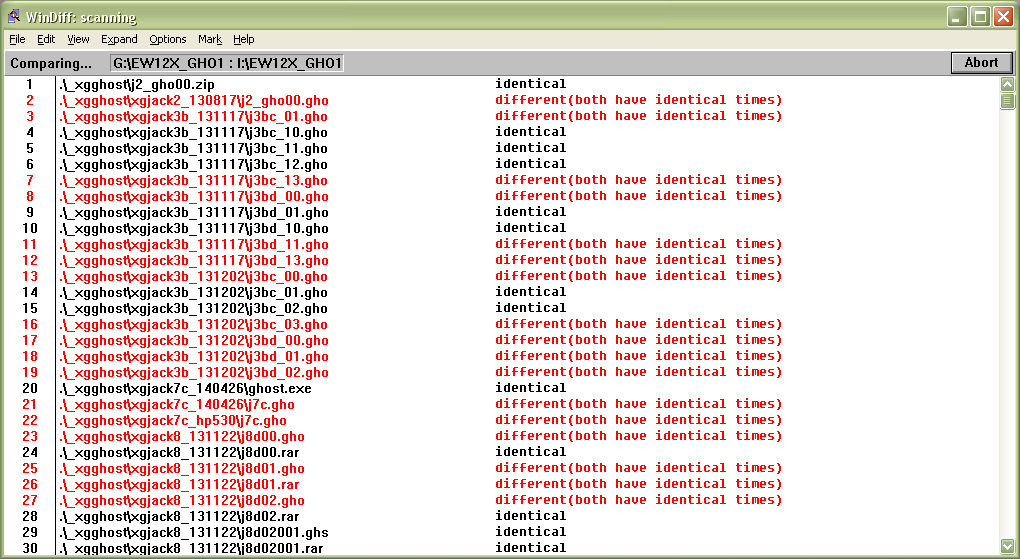
A screen shot from the results of Windiff scan. Got the same
list first with my own Filecomp routine. The difference in file contents is
not a result from virus or hack. Files were copied from one hard disk to
another with Windows Explorer. Windows XP was first operating system since DOS
operating systems from the 1980's which has problems with common file
copies. In DOS copy command you had a switch, with what you could verify
the writes. Windows XP and later misses the switch. Made the copy with modern
miracle alias Lenovo Thinkpad T61. When I do similar kind of copies with XP
and P4 PGA 774 computer, results are also unpredictable. With this system lost
once around 100 GB files during common file move from one HDD to
another. But when you do these things with P4 478 computer ( old Jack 3
proto, which has fast HDD interface and slow 1.6 GHz CPU ), similar kind
of copies goes without problems, file verification lists are clean also under
Windows XP PRO SP2. Copies with Win 9x or Win 2000 Pro usually succeeds,
regardless of the underlying hardware.
Ripped almost 7 000 songs from CDs to Media player. Ripping project last
almost one week. Stored the original files on FAT-32 disk. Then I copied all
files to NTFS disk / volume, used this volume for writing and testing Bass
player. After one crash, Windows XP2 and it's successors refused to open the
files on the NTFS drive. Windows Explorer showed the names, but it was not
possible to open and play the files. They urged administrator to pay a visit
to administrator, for checking whether you are eligible to open and use these
files. Files were playable only in Windows 2000 SP4. Struggled one day with
the NTFS disk, without success. Had to clean the disk and make new copies from
the files ... on FAT-32 disk.
Faults in floats, Single, Double and later
Ever since Intel embedded self-made math co-processor into CPU, there has
been a bug in all floating calculations. Although single can have 7
significant numbers, after calculations result has often strange very small
fractional part. And it is the same with all Floating data types. Another
bigger problem with floating data is that, it is powered binary number. In
Arabian, 10 rooted, system some floats have more than one binary presentation.
This results to faulty comparisons. Two equal 10 rooted numbers are not
considered to be equal. Then there are 10 rooted numbers, which misses exact
binary presentation.
The only fully functional float type in almost all computers is currency,
currency is common integer with four fractions. In graphic cards / GPU's
floating calculations work better. GPU's internal float is single. From the
below you see, that 3D worlds max cell range with 3 fractions is -83 000 to 83
000.
- Single has 23 bits for actual value : 0 - 8388607 this 7 char value can be shifted with
4 char 8 bit integer (-127 to 127). Total size is 4 bytes / 32 bits. First
bit is for sign.
- Double has 52 bits for actual value : 0 - 4503599627370495 this 16 char value can be shifted with
5 char 11 bit integer (-1023 to 1023). Total size is 8 bytes / 64 bits.
First bit is for major sign. Negative shift pushes number into decimals, it
does not change the sign.
When you for example rotate picture with CPU based calculation, the
floating error results to black pixels in the rotated picture. In financial
application the fault causes errors in interest calculations, rounding errors
in General Ledger, etc. When you play with billions, errors raises easily to
millions. In geographical, strength and scientific calculations the floating
faults are often intolerable / dangerous. If you for example navigate ship in
archipelago / shallow water, floating faults can lead you onto rocks.
Textbase introduces an idea of integer arrays. Integer array grows and
shrinks by demand. It can have and it can be used with fractional numbers,
too. The array made from 8,16 or 32 bit integers, then it has pointer for the
first fractional array entry. Integers and fractions are always divided to
separate array entries. Fractional array has at least two variables.
Difference to common variable handling are over and underflow checks.
- Lets say you are cruising 54 light years from earth, and you have to
navigate to a platform at planet's space harbor. First you need enormously big
numbers for your earth oriented location in kilometers. Then you need very
small significant numbers for navigating your space ship onto the platform,
these numbers are in meters or less. In the example both big and small
significant numbers should be in one variable.
- When you cruise in the space, you have many rotations and gravitational
forces, which must be taken to notice in the navigational calculations. Origos,
which are needed for calculations can be very far from the place you are
currently cruising. Sagittarius A, whose rotation must be taken to notice in
space navigation, needs an awful big number for distance parameter. The used
unit must be the same than in other, much more smaller parameters.
- Calculations for gravitational layer, artificial gravitation systems, have a
demand for wide ranged small, fractional numbers. Then the number of cores per
layer raises easily to trillions or more.
Movie Player
Purchased huge porn collection in the spring 2017. Partially for checking
and testing media player proto. App. 350 box collection needed three 1 TB
disks. Ripping and cover scanning took little over week, as primary activity
for sick leave ... day after Finns became aware about the Speed of Light
theorem, got an enormous portion of poison ( probably from near by shop,
purchased cup of coffee with cream ).
Movie Player needs a chance to call and position it remotely with Chapter +
Title data and also with Chapter + Title + Position data. Playlists, DDE,
Drag-Drop and command line got to support this positioning system.
Porn movies have two chapter division systems. One goes with the beginning
of the clip and another with the beginning of the action in the clip.
Divisions are for the people with different taste. Almost all old discs
missed another base positioning system, or then they had busloads of chapters.
In the caller program user can make his own chapter divisions. Either from
existing division, random chapters or from the scratch with Title + Chapter
& hh.mm.ss position.
All porn movie discs are collections from hardcore action scenes. Full
features have a coherent story in between the action. In more popular clip
collections, the "in between" contents varies. It can be a short
preceding story, an interview of the girl, striptease act, masturbation act,
etc. Some clip collections do not have in between footage, most have
something.
Another required thing is a chance to use add on subtitle files with the
player. These files could be dropped into TS_VIDEO directory, when so, the
player adds the add-on sub titles into subtitle selection. Usually the best
viewing experience comes with native language and subtitles. In dialogues and
monologues over 50% from the acting is voice acting. Subtitles are rather
cheap, simple translations from the script or footage.
Third thing are on screen preset settings for brightness and contrast. You
need at least two or three on-screen presets for watching clip collections. In
the clip collections lighting conditions varies with every clip. It is not
rare that after clip changes, the screen becomes either black or white : with
only one setting some clips are either too dark or bright. With user defined,
on-screen Dark, Normal and Bright settings, you can quickly change the
brightness and contrast when needed. According my experience two was already
enough for watching the clip collection discs. Important that the settings are
in the remote control buttons and on the screen. In some clips you would have
to adjust brightness-contrast for cuts already. Videos which were made for CRT
displays are often too bright for the flat / led displays.
Player would also need double-level skip commands. One for scrolling around
titles / clips / albums, another for scrolling within title / clip / album.
The collection I purchased, had over 30 discs with footage from Italian
porn star Birgitte Bui-Bulgari. In order to watch your favorite star's
production, you got to be capable of creating your own play lists. From the
clips, scenes and movies, where your favorite performs.
Programming Media Player Applications
The media player programs have one major difference to all the other
computer programs. Remote control for home Audio-Video system has arrows and
enter for screen navigation. You can go Up-Down-Left-Right. Then there are
Enter and Escape buttons in the control. When you write media player
compatible programs, everything on the screen needs fully functional pre-mouse
program like keyboard-oriented navigational system.
All toolbar containers for example must be converted into windows controls,
with what you can operate-navigate inserted buttons with arrows, enter and
escape. Tabbed property sheets / pages do not work with the available
controls. Remote misses shift. Nowadays there are lots of captioned graphical
buttons, which misses keyboard interface, with remote you do not have Alt key
combinations. Menus cannot be accessed with remote, you cannot get menus open.
Remote misses F10 and Alt shortcuts. Possible to reassign some standard keys
for operating programs. There are menu key, numbers, volume and channel
setting keys. All remotes have numbers 0-9 with a chance to enter 2-3 numbers
with the buttons.
- - - -
Developed few years ago new object type for programming. There is for
example ThBevel object. ThBevel is an advanced version from GDI / Graphic
Cards Rectangle function. You call ThBevel-object just like Rectangle function
: You pass handle and coordinates, where the rect comes. After call
ThBevel uses predefined properties, when it draws rectangles to the
screen.
ThBevel can for example draw all HTML-CSS rectangles, it handles paddings,
spacings, line-colors and line widths. Line styles are not yet fully
implemented. Complete HTML-CSS attribute implementation requires, that you provide a chance to
change everything. Then you got be capable of drawing boundless backgrounds,
pictures and borders to unknown positions on screen. Bounds for painting are
calculated in drawing routine. Ms Internet Explorer has around 99% from
DHTML-4 utilized, others fall below 50%.
When ThBevel is used with buttons, it handles all 12 possible stages. In
paint function you set the state of button and call ThBevel. You set the looks
for each stage, when you design the form. Hosted objects have a simple sync
system, with what you can embed them into all components.
Text Base
Text base has got it's final form. It is based on lists from disk contents,
porn collection catalogues, Maxwell Thunderbird authoring tool,
translator-spell checker add-on utility, picture and sound files
playlists, HTML-CSS definitions and ATS Games files.
Text base has two base file types. There are data lines and definition
sections. Line files are usually lists from files or words. Further / deeper
information about the line goes into definition file.
In Porn base line file has chapter positions, play times and other things
which are shown in player program. In definition files there are lists from
actors / characters, short descriptions from the clips, and so on. Definition
file record / section has multiple lines. Definition file can have single or
multi lined properties. In porn base there are for example Female and Male
cast properties. These properties contains lists from the actors who plays in
the movie. Then these property list entries have sub properties. In the sub
properties there are for example chapters, where the actor plays.
All properties are optional, if you do not know / care about some property,
you do not add it to the def-file. Property name cannot have spaces, it must
end into semicolon or equal sign.
When file is indented, like Pornbase, semicolons and equal sign are not
needed. Line iterator checks the number of spaces before the beginning.
Section has 0 blanks, Property 1 blank, property list 2 blanks. Sub properties
increases the number of blanks. Sub property for Cynthia, Lavigne would have 3
blanks. Sub property for Cynthia's sub property would have 4 blanks.
Non-indented sub property needs root structure or sub property marker
character.
Below there is sample from definition file. In field definitions you can
create links from female and male cast lists to the actor base. In actor base
actor names are used as record names / keys. In definition-files you can add
your own comments / notes to almost everything. They have no affect to the
functionality. /PosFema, for example is an informative parameter : it is
possible, that this stage name refers to a woman.
[Krigsbyten]
Tit.Ita = 1945 Prede Guerra
Dst = Metro2000
Cast:
Bambola
Cynthia, Lavigne
Eva, Falk
Male:
Titoff
/ PosFema
Roberto, Malone
Richard, Langin
Remigo, Zampa
Federico, Tommasi
Gabriel, Montaia
In the player you can review the definitions, perform SQL like selections
and sorts to the playlist entries, with definition files. You can for example
create a playlist from all movies, where Bambola plays. Movies for an actor
are gathered / checked from the movie base. Movies is property for an actor,
it has a physical list from the movies. The list is updated and maintained
from movie base data. So that you can review data with common / external text
editors.
In line file Krigsbyten has the following entry ( it is coherent full
feature, it misses chapters ) :
B m 2 1 2010-12-21 | 1.56.08 | Krigsbyten <Pos=t1c1
Lng=ITA>
- these lines contains data which is needed for setting the player into
correct title and chapter. The movie starts from Title 1, Chapter 1. There is
a tool, which extracts chapter data from DVDs.
In photo directory Krigsbyten have scans from covers :
_eScan\Disc 2\eMovie\Krigsbyten [150].bmp
_eScan\Disc 2\eMovie\Krigsbyten [300].bmp
- since scan names are equal to movie name, the movie does not need a list
from scanned cover pictures.
- when you scan covers, it is usually good idea to scan the cover with 150 and
300 DPI. Printers use 150 DPI by default and 300 DPI for better quality
prints. Printer settings do not show DPI values anymore, they use words. All
picture file formats and editors uses DPI values.
Music and Mainstream movie bases are much the same than porn base. Disk
content system was the only one, which didn't need definition file. All the
others needed multi-singleline, optional properties. Besides vertical lists,
there are also horizontal lists.
Then there are properties and field with more than one value : category
for a clip can be cat=blond+outdoors+shaved+dp+movie+cum+oral
When you search category you get the movie into results with all listed
values. TB grid can expand so that it shows all listed categories in separate
cells. Alternatively, you can show all in one cell, on one line or a property
per line. TB Grid will get a multiline editor. Then you can create pop-up
menus and combo-box systems for multiple values.
Morrowind Elder Scroll III
Have been checking a freeware game for ATS site ... media player computers.
With Media player you cannot play games with high HW demands. If you for
example listen radio, player can be on-line 24 hours a day, 7 days a week. In
public places players are also on-line very long times. Energy consumption and
heat are much more important than with desktops.
The player proto has been on-line for a very long time. Without a need for
maintenance. Tape and recorders needed maintenance once a month. Vinyls everytime
you play them. CD, DVD, BD players need major expensive repairs after around 1
000 hours. Writing capability dies after you have burned 50 - 150 discs.
Morrowind is one of the rare 1st / 3rd player games, which are not only for
shooting and killing. It has good object creation system. Rather easy to make
continuous updates over the game engine. Then you can make Christmas, New
Year, Easter, etc editions for the game.
The system could be used for creating movie-directors utility. You can
create settings, rooms, etc. Place characters into them, make them walk ( not
yet like you want ).
Game is so old, that it misses wide-screen support.
I would like get publishing rights and sources for this game. Ubisoft has
published the game.
Players are like audio apparels, after purchase you use them 8 years or
more. Operating System is never upgraded. Game engine remains the same. All
they need is bug fixes and practical improvements. Updated engine must be
compatible with earlier maps / saves.
Have no idea who was the stupid jerk, who got famous from saying that with
32-CPU, 32 bit variables are the fastest. This wide-spread statement is not
true. Fastest boolean comparison is bit-boolean comparison. Currently you can
create 8,16,32,64 bit boolean arrays. They are checked and set with AND, OR
commands.
In variables bytes are the fastest. Detecting the value of 32 bit variable
needs 32 comparisons, 8-bit value needs only 8 electrical comparisons.
When 32-bit CPU's and Operating Systems came, they were overwhelmingly slow,
when compared to 16-bit systems. 32 bit system, with optional 64-bit
variables, meets common demands for calculations. There aren't many things
where you need 64 bit numbers. With 32 bit bandwidth you do not spend busloads
of time for transferring useless bits.
When you go to future, you have a need for manipulating pixels and samples
very quickly. Multimedia streaming is usually made through uDma channels. If
media player get USB-2 ports with DMA support, it will reduce the need for
wider bandwidths.
Double pin memory
For 3D graphics and games the media player needs new kind of 3D cards. The
cards memory slots must be double pinned. With double pinning, you can set
part of the memory into static and dynamic mode. The size of the reserved
double memory is set by programmers ( required amount is depent on current
game / 3D world ). In dynamic mode, you load static parts from the model into
double memory. After you have loaded the memory, you switch the memory into
static mode. After you switch the memory into static mode, you get the loaded
static parts from the model as base for your drawing loop. In static mode
copies from static buffer to active buffer is made electrically ( very fast
).
Since around 50% from common 3D screen is static, this fast, multipin
electric copy gives you busloads of additional CPU / GPU time for gaming /
screen manipulation. with this trick a native media player game / 3D program
can be faster and have better graphics than other games. I was very
disappointed to OpenGl - DirectX systems because, they miss this essential
feature.
In order to keep to copies fast, memory reservation blocks should be big. 1
MB or so. Switches consumes some time. The have a small internal resistance.
Big blocks make the switches from static to dynamic fast. In some games /
gaming situations, switches are in used in almost every loop. If you for
example play Morrowind and fly with 500 pt speed, the underlying cell changes
very quickly. Usually you walk / run slowly on the ground. Another very common
situation is, when player / viewer is at the border of two worlds. When player
turns around, you have to load new world into memory after each turn.
If you your world needs 32MB static memory, 64-bit CPU-GPU copy needs
around 4000 electric loops. The whole system is unavailable during the copy
loop. Electric copy with 32x1-MB pins needs only one internal electric loop.
The actual copy reserves graphic card only. Switch settings need two
additional electrical loops. Outside 3D-video graphics, there is not much use
for this system. RAM does not need double pin memory. In music, which is the
second biggest consumer, there hasn't been performance problems for ages.
Possible that media players sound cards would get a similar kind of system (
for storing 3D audio streams ). In sounds you would load streams into memory,
and call them from graphic card / program ( with current 3D coordinates ). In
sound cards it would be a fast caching system for sounds.
3D walls are not sound proof. If you call graphics card with current 3D
coordinates, graphic card could check the coordinates against sound sources
add fade/wall factors to programmers play sound call. Graphic card could check
walls between current view and sound source. Calculate fade factors for each
source, before passing the command to the sound card. The factor can be
calculated with a set of common collision checks.
Media Player cannot have integrated graphics, integrated sounds, integrated
sound-graphic systems. Integrated poor quality bulk systems are against the
usage. Player can have integrated networks and other communications only.
Web connection
In Media Player XP the original Web browsing utilities must be disabled, or
replaced with safer system. The replacement must work within general human
rights. Privacy must be protected. People have a freedom to do what-ever
they wish without surveillance, they are free to move freely. The replacement
must prevent attempts to access client via web. Then you must disable hidden
and automated communication possibilities with web. Then you must find a way
to prevent hardware hacks, and track the hackers ( with machine addresses ).
Before web connection is possible WWW must be cleaned from NBDs,
extremists, jerks and other dirt bags.
Private and business networking should be separated from web browsing. When
you share your hard disks for personal and business usage and there is one
computer with web connection, you open the disks also to Google, DNA,
Telia, etc.
RD Billing comforts old book keeping systems and laws, with a possibility
to take advantage from electronic billing. The copies from both printed and
eMailed bills are in simple HTML files. The archives are on HDD and CDs. Easy
to find and search the copies, when customer calls or accountant asks. All you
have to do is to add invoice number and customer key into HTML file names.
When you do so, you can search files with common wild cards and order them
with common file ordering systems. One directory can have 10 000 entries,
before first file viewers fail.
Bills have standardized HTML ids for key data. With these standard ids you
can build automated payment systems, and fully automated routines for reading
these bills to your financial system. The ids makes printed data available for
programs. After you have generated bills , you can write additional notes onto
bill. Taylor book keeping prevents changes to billed amounts after the bill is
generated. HTML supports pixel based positioning, you can use pre-printed
papers with the bills if you want to. You need a new secure net work channel.
It is possible to build a personal finances application into media player.
The program takes the standardized HTML bill and HTML accounts receivables as
input. In fully utilized system there is module with what you can pay the
bills. After payment, bank sends you HTML receipt from the payment. In money
related things, you should never trust others, like banks services. When you
have your own burned / paper copy from for example payment, it is difficult
for a scoundrel company to say, that you never paid the bill. Even then when
your bank and government are "too close" to the scoundrels, and bank
is willing to fortify your archives for ally's advantage.
Might be better if you used old land-lines for payments. Old land-line
systems have the highest security. They were made before extremists, control
freaks, NBDs and others started to present their lies as a reason for this and
that ... violation to human rights. Sources for the application must be freely
available. It makes program developing easier, and prevents creation of hidden
features. When you have the source, it is easy to track errors and reasons for
malfunctions from your own code.
NEW WEB
World has changed quite a lot. Right after web got popular, web-jerks
started to ruin everything. Since web-jerks have shown their strong will to
get rid of the clients and other disturbers, the current web is about and is
also free to die. If media player gets a web it is different from
current.
Network should be more like toll, jerk and spy free highway network. Global
network, which is maintained locally from taxes.
All citizens need a national e Mail address. Address, which is like street
address. Officials can send digital announcements, tax-forms, etc. into it.
You get for example typhoon / hurricane warnings to your official mail.
Companies can send bills, ads, etc. into it. Then you can send / receive
digital parcels into it. The security and laws should be equal to common
ground mail. In web it is possible to send also voice mails. Web is not a very
good platform for real-time phone calls. Web operates so, that the single data
transmission is sliced into smaller pieces, transmission has always shorter
and longer breaks. Possible to search addresses from the local/global web. The
current web was supposed to improve your changes to find someone. But greedy
web and mobile phone operators killed old fashioned catalogues, from where you
can search for example address with a name. System where you force people to
ask addresses and names can be considered as violation against human rights.
With over 20 years experience I can assure you, that violations against human
rights are one the easiest to downgrade or kill your businesses. Haven't seen
a single exception to the rule.
Search engines are built to the web. The business search should have yellow
pages like categorized system. When you register company, you get it
automatically into yellow pages. It is also possible for entrepreneurs to add
their businesses into yellow pages, but you must ask for listing. You are not
allowed to add non-existing, frauds into page system. Pages are global, but
you can limit displayed contents.
The yellow page system should provide local/global market places. Flea markets,
classified ads for people and small companies.
You can check existence of all registered domains automatically. If domain
exists and has index.html page, it can be added to built-in search
automatically. Sub indexes can be added with meta tags, possibly with
predefined yellow page like category settings. Site keeping takes so much
time, that privately held sites are so rare, that there is no need to reserve
domains for people. Various Deadlock folder oriented applications have been
popular amongst common people for about 20 years now. Simple text messages and
photos with short descriptions fulfills people's right to express their
opinions and experiences to others : unknown people and bigger masses. Unlike
Facebook, Google, Twitter and others claim, when you start to maintain public
data on regular basis, you are almost certain to get regular visitors (
readers / viewers ) to the things you publish. The popularity is dependent on
subject's closeness to mainstream's opinion and taste.
Translators and spell checkers
Media player OS will get built in translators and spell checkers. Had an
idea that universities / linguists would maintain the translation / spell
checker word bases. You can get upgrades from libraries and web. Spell checker
and word bases can be used in all applications. They are text-base formatted
text files. You can search words / translations from the bases' indexes
already with common text editor, which has search function. Index files uses
the actual words as indexes. One line contains either forms, synonyms,
translations or related words for the word. From the definition file you find
description and collection from all indexed words. Definition file contains
also grammar and translated grammars for languages. Word bases are helpers,
which allows you to form your presentations properly. Improve your language
skills. Language skills belong to educational / governmental functions.
Thought that maps and navigation would belong to built-in features. All
maps are maintained by governments, with tax payers money. Map system can be
integrated to yellow pages.
You can add governmental services, which are already paid from taxes,
into new web.
General human rights must be respected in everything you do and add to new
web.
Simple USB Connector interface
Due to the planned usage, media player will bring old COM-port features to
USB connection. It is always easy to write driver-communication systems
for COM port devices. USB misses such. Media players have reservations
for the usage as controller for heating-air conditioning, theft-alarm,
lightning, etc systems. In order to get these things in to new computer,
driver-communication systems needs easy to use programmer interfaces.
USB storages are handled with common file I/O functions.
All other USB devices needs a user friendly names. First you ask USB device
with friendly name. With the handle and read-write functions you can read and
write USB data. With set-get code you can can control USB device and get
current statuses for the controls in USB device. With get-set name you can get
literal name. With Id functions you deal with known and enumerated
entries. For devices with more than two nestled levels you need tree-view like
Get-Set child functions. USB device and device driver must support + document
available Read-write and get-set functions. Then you need events for
code-value changes and at least arrival of new data.
UsbOpenDevice('DeviceName) : Handle;
UsbCloseDevice(Handle) : Handle;
UsbReadData(Handle, Data, [Code]) : Integer;
UsbWriteData(Handle, Data, [Code]) : Integer;
UsbSetCode(Handle, Code, Subcode, Value) : Integer; // Value for control
UsbGetCode(Handle, Code, Subcode) : Value : Integer;
UsbGetName(Handle, Code, Subcode, Value) : Integer; // Text for control
UsbSetName(Handle, Code, Subcode) : Value : Integer;
UsbEnumIds(Handle, SeqNo) : Integer;
UsbGetIdCount(Handle) : Integer;
USB device with own screen needs general usage UI functions, set-get-enum
Menu. If device uses MP operating system, the desktop can be extended with USB
device. MP operating system has core components only, it fits into all
devices. You can write and test programs for USB devices and others with
desktop computer. Drop executable to device when needed, after it works.
Possible to burn the executable with required core components to ROM module.
When you go the bottom, MP operating system is a set of file formats and
sets of function headers for named dll files. You are free to build your own
implementation for the OS standards. MS Windows XP core of cores, User.Dll
system, is around 3 MB. Graphical core, GDI32 is 300 kB. Most from actual GDI
is in display drivers.
Keyboard and mouse
Electric-digital keyboard can be altered with USB functions above. Keyboard
and mouse input needs pressure values. Pressure has data from pressure
sensors. When device misses sensors, variable has full pressure value for key
press or mouse click.