|
If diamonds are girls best friend,
rubies are the second best ?
In principle diamond is the most valuable gemstone. This is true,
when you compare prices of one karat. But in our time gemstones market
prices are matched. So that typical size of each stone costs as
much.
If your wedding ring has 0.5 carat diamond and your friend's ring has
bigger 2 carat ruby, both costs as much. Difference in carat price becomes
visible, when jewel's surface start to limit the number of gem stones.
If your wedding has enough space for 20 diamonds, the same ring can have
only around 5 equally priced rubies.
Diamond, Corundum and Beryl are the only full scaled valuable
gemstones. Pearls are not prized with weight. All pearls are fairly
expensive. Opal and Topaz have valuable colors. Turquoise can have
special stones, whose carat price raises to 1 000. Other gemstones for
jewelry doesn't have much value as investment.
Diamond is an ordered and compressed carbon stone. Expensive gemstones
weigh of volume is around 50% higher than it's source components.
Diamond's weigh of volume is 3 500 kg / dm3, carbon's weigh
of volume is 2 260 kg /dm3.
Diamond is natural rock form. Creation of matching synthetic diamond
is almost impossible. Carbon has the highest boiling and melting points.
When so, the Jewel furnace's combustion chamber melts before you reach
the required temperature-pressure system. Earth's core creates the
required temperature-pressure system in the center of the ball. The
temperature-pressure system falls, when you go farther. Such system is
impossible for us. Electromagnetic field is the only thing, with what
you might be capable of creating diamonds. Electromagnetic field doesn't
need physical core, but by default electromagnetic field doesn't create
temperature-pressure systems.
Diamond is the only unburned valuable gemstone. Four other
valuable gem stones, sapphire, ruby, red beryl and emerald are typical
fully burned oxides. Each stone has approximately 2 oxygen atoms for 1
source atom. Or alternatively 2 oxygen atoms for each atom in the group
of burned sources.
|
|
Corundum - Sapphire, Ruby, Emery
Corundum is transparent form of aluminum oxide, it exists in all
colors. Rarer ruby is
bright red, black is Emery, other colors are Sapphires. Typical sapphire
color is blue. Red or pink sapphire is not as bright as Ruby. Aluminum
Oxide's color is white. Gemstone sapphire sizes extend to 500 carats,
biggest Rubies are 150 carat.
Corundum or aluminum oxide is natural, mined form of aluminum. Part
from poor quality corundum is used in various rubbing tools and
machines. Aluminum oxide comes to us in lava ... via eruptions and continental
splits. When lava comes to ground Aluminum Oxide is already in solid
form.
Corundum and Aluminum Oxide can exist in toxic form. You should never
use aluminum in kitchen ware and with food related systems. Make ups,
which has aluminum oxide can have small amounts of toxic compounds.
Saltwater tends to convert valuable Corundum into worthless aluminum
salt. Reversing can be made by warming aluminum salt to over 1
100C temperature, but the valuable transparent lattice order is lost.
With magnetic field you might be capable of manipulating lattices in
liquid or gas form. Corundum is electric conductor.
Corundum's chemical formula is Al2 O3, Ruby is said to have Chromium
atoms, which makes it red. Emery has magnetite, hermatite or hercynite.
Transparent stone's density or weight of volume is 4 020 kg / dm3.
Common oxide is 3 987 kg / dm3. Aluminum is 2 700 kg/dm3. Hardness is 9.0 Mohs. Melting
point is 2 044 C, boiling point 2 977C.
Vaporized aluminum can be burned with CH3 ( = hot booze vapor ) and
Oxygen / Ozone. Clean or perfect fire needs 3 CH3 molecules and 1 Ozone
atom for 2 Aluminum atoms. Fire needs combustion chamber / high
pressure. At atmospheric pressure demand for the temperature is 2
500 C.
Aluminum is fairly immune to air, efficient corruption needs water
and booze vapors. Water and booze vapors corrupts Aluminum into Aluminum
Oxide and upgrades Booze vapor into more powerful Methane vapors. In gas
form Booze and Oil are very near each other.
With Fluoride and Hydrogen Corundum can be burned into Water and
Aluminum Fluoride.
|
|
Beryl - Red Beryl, Emerald, Golden Beryl, Morganite, Aquamarine
and Goshenite
Each Beryl color has it own name. Rarest and smallest Red beryl is
bright red. Emerald is green, Golden beryl yellow. Morganite is red
shaded or pink beryl. Shades of blue are Aquamarines and almost
free Goshenite
is colorless stone, it could also be named and used as Crystal.
In jewelry Emerald extends to 1 000 carats. Golden beryl to 2000
carat. Biggest discovered Morganite gemstone is 23 kg or 115 000 carats,
record for jewel quality Aquamarine gemstone is 110 kg or 550 000
carats. In gemstones, the biggest discovered stone size refers to prize
and rareness of the stone.
Beryl separates from Corundum with poorer electric conductivity. Beryl is dirty silicon
oxide. Dirty parts in pure beryl stone are Beryl and Aluminum In our nature ...
temperature and pressure ... beryllium, aluminum and silicon never reacts with
oxygen. They don't get corrupted like steel, food, wood, cloths and
others.
Transparent stone's density or weight of volume is 2 760 kg/dm3.
Silicon is 2 330 kg/dm3. Hardness is 7.5 - 8.0 Mohs.
Beryl's chemical formula is Be3 Al2 Si6
O18. Beryl is natural rock form. Poor quality beryl stones
are used as primary source of Beryllium and secondary source of Aluminum. Beryl is always
toxic, it comes from beryllium. Beryl handling needs much more care than
Corundum.
In Jewel furnace Beryl needs 3 300 C atmospheric fire. Besides natural beryl, there are synthetic beryl's. These synthetic
beryl's are never burned in high pressure like natural stones. When so,
it is almost impossible for these synthetic stones to have matching
qualities with natural stones.
|
Opal
Opal has 2 + 2 forms. Gemstone opal is precious opal. When
light hits precious opal, it flashes in various colors. Both
precious and common opal can be white, boulder or black.
Background color of the most valuable black opal is black, dark
gray or dark blue. Transparent and other colors are white opals.
Dark background makes the flashing more visible.
Over 95% from Opals come from Australia. Fire Opal comes from
Mexico, color scale is yellow-orange-red, Fire Opal can be
transparent / translucent. Water opal flashing / precious
transparent opal. Rose Opal is the only common opal, which
is used jewelry. Rose opal is bright pink, it doesn't flash.
Hydrofan opal is black. When it is dropped into water, it
becomes colorless.
Opal is hydrated sand or silicon dioxide SiO2 nH2O.
The amount of water varies from 5% to 10%. Weight of volume is 2
090 kg / dm3. Hardness is 5.5-6.0 Mohs. Hard hit
breaks the opal rather easily. Salt water and various acid melts
opal.
Topaz
Topaz is often used as fake diamond. It doesn't shine as
brightly as diamond. Topaz exists in all colors, including
translucent, except bright green.
Orange topaz is called Precious Topaz, Imperial Topaz is
pink, yellow, brown or golden topaz.
Topaz is hydrated aluminum silicate Al2SiO4(F,H2O)
The amount of water is around 20%. Weight of volume is 3 500 kg
/ dm3. Hardness is 8.0 Mohs. Hard hit breaks the
topaz rather easily. Topaz has often "break-lines",
from which the stone gets break in a hit.
Quartz - Amethyst, Tiger's Eye, etc.
Amethyst is the most valuable quartz, unique color varies in
shades of purple / violet / magenta.
Quartz's qualities and colors can be manipulated rather
easily. There are many cheap named gemstone quartzes.
Names refers to colors and looks of the stone. Names without
quartz are Agate, Aventurine, Chacledony, Carnelian, Citrine,
Herkimes diamond, Jasper, Onyx, Rock Crystal and Tiger's Eye.
Green quartz is called prasiolite or lime citrine or vermarine.
Quartz is silicon oxide SiO2. Weight of volume is
2 650 kg / dm3. Hardness is 7.0 Mohs. Quartz is
strong stone, it doesn't melt or get broke easily. With heat
quartz needs 1 650C temperature for melting.
Others
Garnet is an old gemstone. Colors are red, green, orange and
yellow. Blue is very rare. Red is most common and emerald green
is most valuable. Garnet is general name for silicate minerals,
formulas are in form X3Y2(SiO4)3.
Weight of volume is 3 520 - 4 320 kg / dm3. Hardness is
6.5 - 7.5 Mohs. Red Garnet is birth stone of January.
Peridot is olive green gem. The color comes olive-mineral.
Peridot is birth stone of August.
Moon stone is silver or blue shaded stone. Golden rings with
big rounded moonstone were popular in the past. Sun stone is
yellow, glittering variation from moon stone. Other colors are
possible. Sun stone has stronger colors than moonstone.
|
Pearl
Pearl is the most valuable organic gem. Pearl is an egg-like
seed for sea shells oysters. Sea shell raises the pearl inside.
After pearl is big enough, shell opens the lid and throws the
pearl away.
Pearl's base color is white. Pearl can have shades from all
colors. Then there are Black Pearls and Pink, Yellow, Golden
and Brown Pearls. Pearls are never bright blue or bright
green.
Pearls, whose shape is not ball, are called baroque pearls.
Pearl is made from Calcium Carbonate, CaCO3.
Weight of volume is 2 700 kg / dm3. Hardness is 2.5 -
4.0 Mohs.
Amber
Amber is another popular organic gem. It always
golden-yellow-brown. It is often used in string of pearls.
Baltic Amber is the most common in jewelry. It comes from Baltic
area.
Amber is fossilized tree resin. Weight of volume is 1 000 kg
/ dm3. Hardness is 2.0 - 4.5 Mohs.
Coral
Popular organic gem - Coral - is hard skinned animal. Coral
can exist in all colors. Coral is often used in necklaces.
|
Jade
Jade is obviously the best known and most popular gem, which
can be carved. Typical Jade is green, but cream and black are
possible. Rarer colors are blue, brown, red, black, dark green,
lavender and white.
Asians, Oceaninc Aboriginals and Mexican Indians have made
decorations and jewelry from Jade for ages.
Jade has two forms : nephrite is Ca-Mg-Fe compound and
jadeite is Na-Al compound. CaCO3. Jade's weight of
volume is 3 000 kg / dm3. Jadeite's hardness is 6.5 -
7.0 Mohs. Nephrite's is 6.0-6.5 Mohs.
Central and South African green jewels and decorations are
made from malachite. Malachite has green shaded rounded shapes
on the surface. It is much like marble. Malachite's base element
is copper, weight of volume is 3 400 kg / dm3.
Hardness is 4.0 Mohs.
Turquoise
Turquoise has given name to it's base color,
mixture of blue and green. The name comes from French words,
which means Stone of Turks. It is place from where ancient
Europeans got the mineral. Aztec Indians and ancient Egyptians
were familiar with stone, made decorations from it.
Turquoise is hydrated copper-aluminum phosphate, formula is CuAl6(PO4)4(OH)8·4H2O.
Weight of volume is 2 600 - 2 900 kg / dm3. Hardness
is 5.0 - 6.0 Mohs.
Lapis lazuli
Lapis lazuli is third ancient carved stone. Color is bright
blue. Name comes Persian word latzward, which means blue. Best
and oldest rocks come from Afghanistan, Chile and Russia.
Besides jewelry, lazuli has been used as color pigment.
Ancient Arabian blue constructions are covered with lapis lazuli
paint.
Basic component in lapis lazuli is sulphur. Weight of volume
is 2 800 kg / dm3. Hardness is 5.5 Mohs.
|
Frames and metals for the jewelry
From the metals into which gemstones
are embedded, gold is the safest and most valuable. Gold is also care
free. Solid 24 carat gold is too soft for Jewelry, it bends and twists too
easily. 18 ct is typical gold quality, which is used in Jewelry. It means,
that 75% from the metal is gold. The rest is used for improving the
metal's strength.
Gold keeps it's value, falls in value are rare. Gold doesn't have industrial usage, which would bounce the value.
Nations and investment businesses keeps big gold reserves. When some
nation runs out of money, it sells gold to market. Massive sellouts
creates rather short peaks to gold prices. In investment world money is
not an issue, problems are in availability of expensive things. Big and
expensive things attracts buyers. When there is more than one buyer, the
gold, stocks and others are auctioned to buyers. Auctioning raises the
prices.
In high society man with lots of gold jewels is often
considered somehow weird, vulgar or gay ... American self-made or from
rags to riches billionaire. Yellow gold and beauty is dedicated to women.
Silver and steel belong to men, with an exception of wedding ring and
rings in general. Man with simple suit and without much visible
decorations, emphasizes the beauty of his partner. Chest with medals ...
awards from achievements ... is always accepted for men.
Man can typically have one ring, with big stone. With this
ring people used to seal documents You get right to use this stoned ring,
after you get adults rights. Members of some guilds uses rings as signs of
membership, these rings are usually simple silver or steel rings.
For men there is white gold. White gold has gold's price
and qualities, it looks like silver.
For golden teeth there is another white shade for gold.
Gold is excellent material for implanted tooth. Teeth gold is for those,
who don't want to bully with yellow, golden teeth. Gold has been used in
tooth implants and fillings for ages.
Silver
Silver reacts with oxygen, it darkens by the time. Silver
needs regular polishing, and airtight box. Typical silver polisher
creates wax layer, which reduces the darkening and reactions with oxygen.
Silver is toxic, modern silver kitchenware ( knives, forks and spoons
) has only silver handles, the part with what you touch food is made
from steel.
Silver's price is 1 to 2% from gold. Silver has lots of
industrial usage. Silver doesn't have / need
gold like carat system. Stuff, which is sold as silver, is made from solid
silver. Cheaper silver compounds have the names of their own.
Others
Platinum's color is white-shaded gray. It is some times
called white-silver. Platinum is 50 - 80% cheaper than
gold.. Platinum used to be the most expensive. Platinum can form cyanide,
which is lethal chemical compound.
Steel and titanium, which are not noble metals, are so cheap, that
they are sold in pounds, grams and kilograms.
Titanium and steel are safe, carefree materials.
Steel, which is used in jewelry and kitchenware, is high
quality stainless steel. This steel doesn't get corrupted. Stainless steel
was originally developed for tools. Stainless steel is the most expensive
steel quality, too expensive to for example cars.
? During time of release, in February 2019, Gold cost
$1 300 / oz, Platinum $1 000 / oz, Silver $20 / oz.
|
|
Ivory and Bones
Outside western oriented world, animal bones are popular
material for jewelry. In some areas human bones are also used in
decorations and jewelry.
Ivory is name for animal's teeth. Typically Ivory refers to
elephant's tusks. Ivory is forbidden in most western countries.
Ivory was banned, because of widespread illegal / unlicensed
hunting of elephants. Same thing has made furs of wild animals
unpopular. In principle there is nothing wrong in ivory, which
is taken from animal, who has died naturally.
When you go deeper in hunting, animals can increase the
reproduction so, that the species is not in danger to vanish.
When some species is endangered, the primary reason is not
usually in commercial hunting. In Africa and many other places,
raped, poor soil, downgrades natural food production. Hunger and
starvation is common amongst animals, who lives at grassland
areas.
Expansion of human settlements is another thing, which causes
major troubles to wild animals. Before humans, wolves
ruled northern Europe. Humans killed and exiled wolves to
northern Russia.
Sugar-cane, sugar-beet and wood oil farming
"employs" wild animals, animals are needed for CO2
creation and maintenance of ecosystem. Enormous need for
oil per capita prevents creation of dense human settlements into
farmed areas. Commercial employment creates need and money for
taking better care from wild animals and plants.
In principle it is possible, that humans ( African and South
American vegetarians ) start to share the diet with wild meat
eaters. You can start to keep antelopes, impalas and other pray
species much like reindeers at the wild life areas. Let the wild
animals kill and eat animals from half-wild herds as much as
they wish and need. In Europe reindeer keeper gets compensation
from the animals, which were killed and eaten by wildlings. Can
apply the same policies to sugar-wood oil oriented half-wild,
free cattle keeping.
|
|
Red Rules
In gemstones bright red color is the
most valuable, Red ruby for example is around 50% more expensive than
white diamond with matching color and size. Red diamond which matches Ruby
is far more expensive than ruby.
| Gemstone |
1 carat |
| White Diamond |
10 000 |
| Corundum |
| Ruby |
20 000 |
| Sapphire |
5 000 |
| Beryl |
| Red Beryl |
10 000 |
| Emerald |
500 |
| Morganite |
250 |
| Aquamarine |
150 |
| Golden Beryl |
150 |
| Opal |
| Black Opal |
10 000 |
| White Opal |
10 |
| Topaz |
|
| Red Topaz |
3 000 |
| Orange topaz |
1 000 |
| Blue Topaz |
5 |
| Others |
| Red coral |
5 - 200 |
| Quartz - Amethyst |
5 |
| Turquoise |
5 |
| Amber |
0.5 |
Pearls are not in carat system.
Pearls are not sold by weight. Range is 300 to 1 500 pcs. Price depends on
size and looks.
Drugstore jewelry
Cheap gems are used in drugstore
jewelry.
Women and girls buy lots of cheap
jewelry. They are carefree in wild evening at restaurant, school, work and
daily usage.
Drugstore was the place for buying
cosmetics, perfumes, jewelry and others. Warehouses beauty departments
have superseded and killed most drugstores. Small stores couldn't compete
warehouses in prices and opening hours.
When monopoly warehouses raises
their margins to over 60%, it is easy for small drugstore to beat
warehouse in price competition.
Nowadays internet allows small shop
to create it's own product delivery systems with Asian manufacturers and
their agents.
Cuts
First jewel cuts were made in 1476.
Rose cut was developed during 16th century. Brilliant cut during 17th
century. Modern brilliant was introduced at around year 1900.
Transparent glittering stones are
usually cut as brilliant or rose. These cuts has internal prism system,
which creates light rays to various directions.
Brilliants

Pure brilliant is round shaped stone. It has many variations
- trilliant is triangle-shaped brilliant.
- pear is drop shaped brilliant
- oval is elliptical stone
- cushion is rounded rectangle
- princess is squared rectangle
- marquise looks like human eye
- heart looks like heart
Then there are two cuts, where
rounded corner is replaced with tilted border. Rectangle is called
radiant, squared asscher cut.
Rose cut

Older rose cut has flat bottom and tilted surfaces, which forms ball or
rounded shape.
Step cut

Step cuts misses brilliants and roses complicated optical system.
Emerald cut is the most common step
cut. Emerald cut is rectangle with removed, tilted corners. Another name
for emerald cut is octagon cut. Sharp cornered rectangle is called oblong.
Cabochon and Lentil cuts
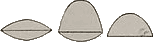
Cabochon cut has two simple rounded shapes, which forms a lens. High
Cabochon misses the top-bottom symmetry. Lentil cut has flat bottom.
These cuts are used in big and small
opaque stones.
Gold
Carats
Carat for gold tells the amount of
gold in the metal. 24 carat gold is solid gold. From 18 ct ring 75% is
gold. From 12 ct tiara 50%.is gold.
Gemstone Carats
In gemstones carat refers to weight
of stone. Gems are very small, one carat is only 0.2 grams. 5 carat stone
weighs one gram. 100 carats, which tops the diamonds and rubies is 20
grams. 1 kg is 5 000 carats.
Birth stones
January - Red garnet
February - Purple Amethyst
March - Blue Aquamarine
April - Diamond
May - Emerald
June - Pearl
July - Ruby
August - Olive Peridot
September - Blue Sapphire
October - Blue Opal
November - Orange Topaz
December - Turquoise
Birthstones for each month varies a
little. This list is used in Europe and USA.
Godparents buys sometimes jewelry,
photo frames and other decorations with birthstone gems to new born baby.
|