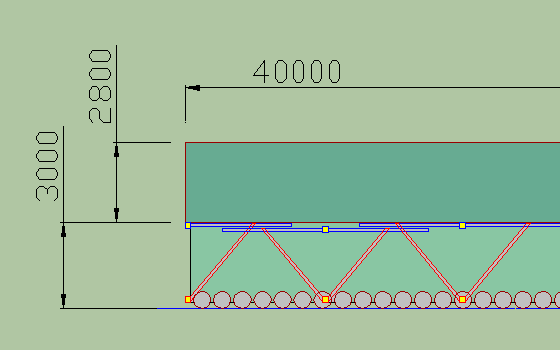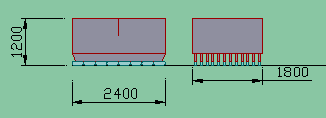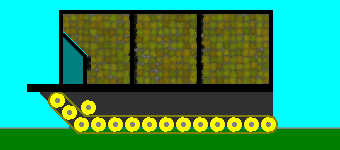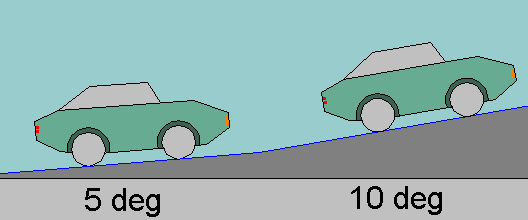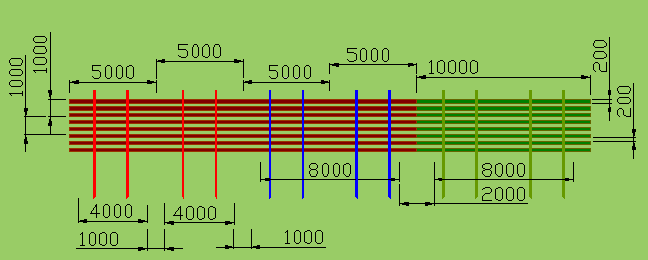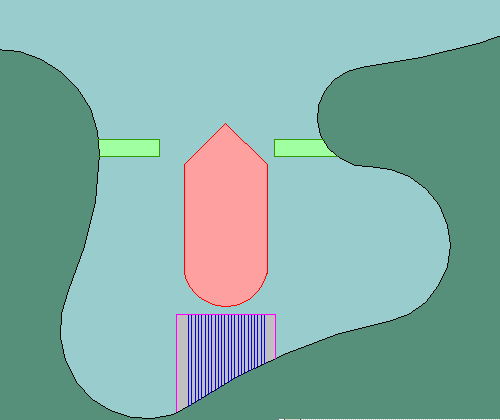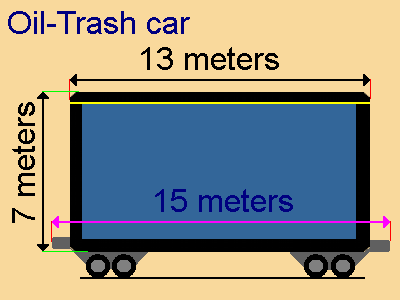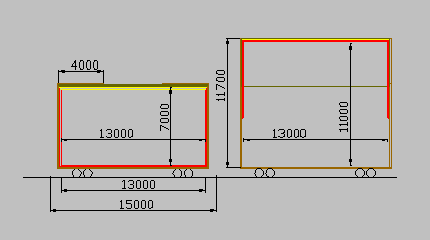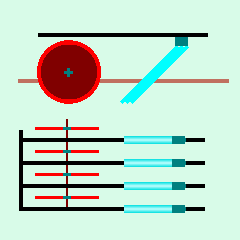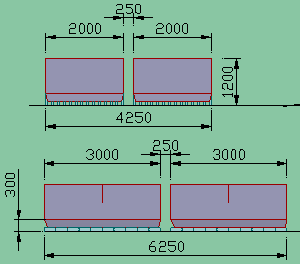
In hill climbing pillar got new dimensions and standard 12 m height.
Car is ( at least internally ) divided to four 20 x 30 meter boxes.
Boxes allow car to bend, when it goes over small bumps. Car has trailers air
suspensioned 3x3m track units.
Module is capable of going over 24 degree bumps. With bending modules angle
grows from that.
Max inner bending, before boxes collide is 12 degrees. Pillar car is a jeep
/ all terrain vehicle.
Suspension and modules reduces tensions and tiredness of the chassis.
During climb and weigh check both machines got payload upgrades for
handling bigger than expected harvests.
Modules are big enough for carrying harvesters. When you move, you drive two
trailers above each other.
In standard 3+3 harvester configuration, both cars have one free module for
mover.
| Energy |
41 |
MJ/kg |
|
Barrel |
158,987 |
liters |
|
Shift
hours |
9 |
|
| |
41
000 |
kN
/ kg |
|
Sugar
weigh / m3 |
500 |
kg
/ m3 |
|
Weekly
hours |
108 |
hrs |
| |
34
235 |
kN
/ liter |
|
Steel |
7
830 |
kg/m3 |
|
Yearly
hours |
4968 |
hrs |
| |
|
|
|
|
|
|
|
|
|
|
| Cars
payload |
10
000 000 |
kg |
|
Friction |
0,1 |
|
|
-
average max load |
5
333 333 |
kg |
| -volume |
20
000 |
m3 |
|
Air
resistance |
0,8 |
|
|
Cruise
speed |
60 |
km/h |
| Ground
clearance |
3 |
m |
|
Projection |
453,33 |
m2 |
|
Average
load |
50 |
% |
| |
|
|
|
Hill
climbing |
30 |
deg |
|
Average
hill |
0 |
deg |
| Cars
Width |
40 |
m |
|
Top
speed ( loaded ) |
100 |
km/h |
|
+
Cruise Power |
840 |
kW |
| Cars
Length |
60 |
m |
|
|
|
|
|
+
Load power |
6
377 |
kW |
| |
|
|
|
Own
weight |
3
500 000 |
kg |
|
+
Hill Power |
0 |
kW |
| -
needs height |
8 |
m |
|
Fuel
tank |
800
000 |
liters |
|
Average
power |
9
021 |
kW |
| -
area |
2
400 |
m2 |
|
-
mass |
668
000 |
kg |
|
|
12
268 |
HP |
| -
load |
4
167 |
kg/m2 |
|
+
Own Power |
4
089 |
kW |
|
|
|
|
| -
total height |
11,33 |
m |
|
+
Load power |
9
810 |
kW |
|
Fuel
Efficiency |
0,2 |
|
| |
|
|
|
+
Hill Power ( both ) |
6
949 |
kW |
|
Fuel
power |
45
104 |
kW |
| Weight
efficiency |
0,35 |
|
|
+
Speed Power |
3
887 |
kW |
|
|
61
342 |
HP |
| -
Total weight |
13
500 000 |
kg |
|
|
|
|
|
Energy
consumption |
162
374 854 |
kN
/ hour |
| -
load |
5
625 |
kg/m2 |
|
Axle
power |
24
735 |
kW |
|
|
|
|
| |
|
|
|
Efficiency |
0,8 |
|
|
Run
time |
4 |
h/
shift |
| Tracks |
|
|
|
Engine
power |
30
919 |
kW |
|
-
Consumption |
4
743 |
l
/ hour |
| Track
Width |
0,5 |
m |
|
|
42
049 |
HP |
|
|
18
972 |
l
/ shift |
| Track
Length |
40 |
m |
|
Displacement |
|
|
|
|
227
662 |
l
/ week |
| -
area per track |
20 |
m2 |
|
RPM |
1200 |
|
|
|
10
472 431 |
l
/ year |
| Tracks |
26 |
|
|
-
fuel Efficiency |
0,2 |
|
|
|
|
|
| -
area |
520 |
m2 |
|
-
fuel power |
154
593 |
kN |
|
Machines |
900 |
|
| -
load |
19
231 |
kg/m2 |
|
-
fires / sec |
10 |
|
|
Yearly
to all |
9
425 187 955 |
l
/ year |
| |
|
|
|
-
force/firing |
15
459 |
kN |
|
|
59
282 759 |
barrels |
| Powered
tracks |
26 |
|
|
-
fuel for firing |
377,0551 |
grams |
|
Price |
|
|
| -
track power |
1
617 |
HP/track |
|
-
vaporized volume |
188,5276 |
liters |
|
Price
/ ton |
3
000 |
USD |
| |
|
|
|
-
displacement |
2
827,91 |
liters |
|
-
weight |
3
500 |
tons |
| Wheel
diameter |
0,6 |
m |
|
|
|
|
|
-
price |
10,50 |
millions |
| Wheel
distance |
0,1 |
m |
|
Trailer |
1
500 000 |
kg |
|
-
price from all |
9,45 |
billions |
| -
count |
57,14 |
|
|
-
fills |
7 |
|
|
|
|
|
| -
all tracks |
1
485,71 |
|
|
Trailer,
average |
800
000 |
kg |
|
|
|
|
| |
|
|
|
-
fills |
13 |
|
|
|
|
|
Latest idea in this is, that you change and empty car every hour. And
that car can take load from 8 trailers.
During hour six harvesters collects 6 000 tons and eight 8 000 tons.
So the caterpillar car has to be at least 8 000 tons.
In the table there is 10 000 ton car.
Car must always be wider and longer than it is high.
Pillar car needs big ground clearance for air suspension.
Car runs with around 30-80 km/h speed. With 60 km/h speed, maximum 15
km trip to railway, takes 15 minutes, with return half an hour.
- When I calculated top speeds, 30 km/h top speed needed 11 000 HP engine
powers, 80 km/h needs 12 000 HP for full load.
The clumsy car should have steering system for both directions. When you
change the direction, you do not turn the car, but yourself.
Tracks gets an air suspension, similar to trailer. Top speed should be 160 km/h or 100
mph.
Without load 42 000 HP engine power is enough for over 170 km/h top speed.
AIR RESISTANCE
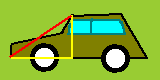
- When you calculate air resistance forces with energies and per
second basis, you should use 0.5 * cw * A * v3.
- When you calculate pillar cars max speed with official air resistance
force formula and power of 2 speed, top speed raises to over 2 000 km/h.
- Someone has obviously missed the whole idea about the forces and powers.
Force is always the power you need for 1 second time.
In the picture you see basics for air-resistance. When you increase
the speed, the time you have for compressing, shortens all the time.
Since you are compressing volume, the speed effects to the required
compressing speed with power of 3.
Cw factor is actually the angle system, with what the object raises
up. The angle has strong effect to the required compression speed.
In the back, all you have to do is to minimize under pressures, which
effects to body. Turbulences and smells you left behind are insignificant.
Vehicles engine powers are also incorrectly stated. HP and kW are actually
horse powers per second and kilowatts per second. Or kilo Newtons per
second.
Almost right after the mounting climbing, ended into problems with
acceleration.
Sowing machine stops and starts with 20 second interval ... blank space in
the books ... how to estimate required engine powers and fuel consumption ?
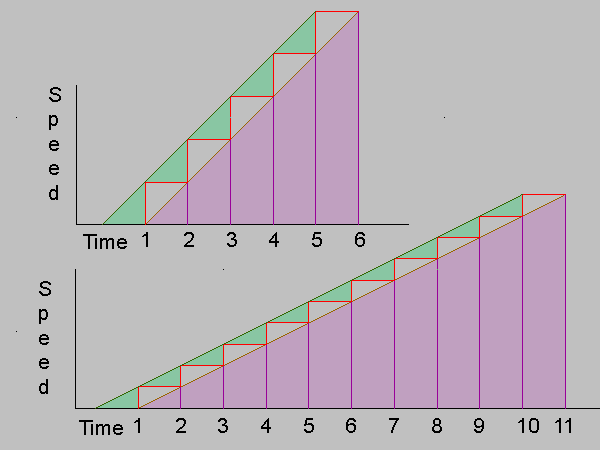
The acceleration force comes from the power you use in one second. In
upper chart, you make the acceleration in 6 seconds, in lower 11 seconds.
The triangle comes from the difference in speeds. And the force with
Sin.
Acceleration force is hill like addition, the force is merely a
multiplier to rolling and air resistances.
| Acceleration |
Angle |
Sin |
Time |
Force |
| Upper |
45 |
0,71 |
6 |
4,24 |
| Lower |
27 |
0,45 |
11 |
4,99 |
Oops. Faster acceleration results to smaller force than slow
acceleration.
The difference comes from the time you spend to acceleration.
| Acceleration |
Angle |
Sin |
Time |
Force |
| Upper |
45 |
0,71 |
6 |
4,24 |
| Lower |
27 |
0,45 |
6 |
2,72 |
During 6 second time, faster acceleration needs 4.24 N and slower 2.72 N.
Difference in fuel consumption comes from the distance, vehicle moves during
the acceleration.
The diagram is for slow sowing machine, when deal with faster vehicles,
you must add increase air resistance force into calculation.
- - - -
If you look at the diagram, you can see that, speed is objects kinetic
energy at moment X. With acceleration you increase and decrease the energy.
Weight / mass is needed in collisions and other acceleration / braking calculations.
Non-powered roll is one form of negative acceleration.
In horizontal ( on ground ) move gravitational acceleration is 0, gravity
affects via friction. Friction results into negative gravitation, which
resists the speed.
In liquids and air gravitational force is non-zero. You play with viscosity.
This Acceleration force system is brand new thing in physics and car's
dynamics.
Start up forces
There is only one friction for each surface-object system. Start up force
comes from air pressure. It is around 10 N / cm2.
For 1 m2 front projection it could be 10N * 10 000 = 100
000 N or less.
Private car's front is around 1.5 x 1.5 = 2.25 m2 The start up force
is 225 kN.
Exception to the single friction rule is soft surface, into which object
sinks.
On soft surface object sinks until the density-strength system grows so
much, that it can carry ground load.
When you use force system, objects do not have centrifugal forces and
momentum. They are embedded into forces vector system.
- - Soils viscosity, pit creation - -
This start up force misses soil's viscosity. When you stop the vehicle,
it always digs a small hole to it.
Hole digging must continue until soil is capable of carrying the ground load
from a wheel.
When ground load is 15 tons / m3, soil's pressure-area system must match the
ground load.
In solid materials we use Poisson number for viscosity. Poisson number
tells the ratio of expansion, in between width and length.
Poisson number is accompanied with bounce factor. Bounce factor tells the
amount of expansion in length.
- These 2 measured values have two ready made derivates. Slide and
compression factors are calculated with Poisson number and bounce factor.
Soils viscosity has never been measured, other values hints, that soil's
viscosity is 10 - 25%. Steel and metals expand around 30% in sideways.
Asphalt / tarmac could be around 25%, concrete-cement is 10 - 20 %.
Bounce factor for soil varies a lot. Cool asphalt-tarmac could be 2 000 - 5
000 MPa ( = 2 000 000 - 5 000 000 kN ),
cement-concrete is 10 000 - 40 000 MN. Steel is around 200 000 MN, iron cast
is around 160 000 MN.
In simplified system, where the depth is one meter : When you push tarmac
down with 5 000 MN force-pressure system, the system creates 75 cm pit into
road.
When the ground force is private cars 15 000 kg/m2, the pit in cool tarmac
is 0.03 mm. On very warm day tarmac can fall to tracks, without hole.
- when you calculate pit with 25% viscosity 75% goes to length and 25 % to
sides.
When private car leaves visible 1.5 cm deep tracks, soil's bounce factor is
around 10 000 kN. Tracks without visible hole ( 1.5 mm ), needs around 100 000 kN bounce
factor.
Invisible track ( 0.15 mm ) needs 1 000 000 kN bounce factor. Stuck in the mud ( in over
15 cm pit ) goes down from 1 000 kN bounce factor.
After you get the pit, you use the hill force formula. The angle comes
from wheels radius.
From the above desert sand has 100 000 kN and good soil 10 000 kN bounce
factors.
Soil misses speed factors for the escape and compression, just like water
and air.
Moving vehicle creates the pit to the area, it moves in one second.
- Width comes from summed wheel widths, the length comes from speed. The
force comes from gravitation.
- The pit depth and force are dependent on speed. Speed reduces the depth.
- - - -
When you deal with soil, it hardly ever breaks. Only a hill can fall down
under pressure.
Due to this, soil's bounce factor varies rather independently from density.
Desert sand for example weighs a lot, but the small and hard particles makes
the bouncing easy.
In more accurate system, the pit creation factor = F / (A*E), where E is
bounce factor, A is area, F is gravitational force per wheel.
When you down, the force falls with viscosity. With 25% viscosity, on ground
10 000 N force is 2 500 N at one meter.
Dimensioning
The harvesters forwards 40 meters per hour.
Estimated that harvester trailer would follow trucks trailer, and the
weight efficiency would 0.35.
When so, car could weight 3 500 tons and fully loaded 800 000 liter tanks
700 tons.
With 0,1 friction, the force for moving the pillar car is around 14 000 kN.
For 100 km/h speed with 0.8 Cw and 450 m2 projection needs 3 900 kN
Required engine for fully loaded 100 km/h missile is 42 000 hp.
Pillar car runs half of time with full load and without load. Average load
is 50%.
Pillar car speed is around 60 km/h : Average air resistance force to beat
is 840 kN.
- these two totals to 9 021 kN.
With 20 % fuel efficiency, car consumes 162 374 854 kN fuel power in one hour.
Such amount of energy comes with 4 743 liter consumption per hour.
In one working week car needs 230 000 liters fuel, car is not in the move
all the time.
Harvester and sowing teams need 900 pillar cars. They burn 9.5 billion
liters oil in one year.
With harvesters 8b consumption total is 18 billion liters a year.
Estimated machinery cost for harvesting, without trains, is around $15
billions.
When all 20 tracks are powered, car's track power is 622 HP / track.
Weights
Boxes for trailers, cars and trains are not very heavy. You can make
bottom from 1-2 mm steel plates.
Sides can be very light. Steel net would for example do. Sides are needed
when vehicle tilts, these machines hardly ever tilts much.
Chassis for towed trailer must be strong. Powered trailer and pillar car
does not need strong beam systems.
One mm bottom plate for trailer would be around 6 tons. Nets are around
200 kg. With supports around 1 000 kg. With nets the box would be
around 7 tons.
Engine and transmission 5 tons, feet for 12 tracks could be 50 tons, tracks
and wheels around 10 tons. Totals to 70 tons : 60-80 tons with 1 000 ton payload.
1 mm bottom plate for pillar car is 3.2 m3. It weighs 25 000
kg. Car could weigh around 100-150
tons. And the payload is 8 000 tons.
The light construction makes the vehicles relatively cheap. When compared
to for example ships and trains.
Tracks and powers
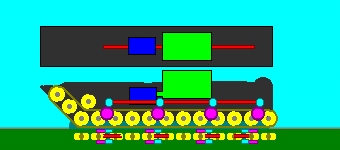
Since trailer and harvester must have at least 2 meter ground clearance,
you could use system, where each powered track has it's own engine.
You can place the engine, gear box and transmission to ground level. Engine
and gear box are in the top.
Below them goes shaft. Shaft has leads to powered wheels, with 10 meter
distance.
System divides the engine power into powered wheels evenly. With 10 meter
distance and 4 powered wheels 2 000 hp engine produces 500 hp wheel powers.
Each powered wheel reduces efficiency, so you should not use too many
powered wheels. Power axles ... shafts length is insignificant.
Wheels are powered from both sides. Engine can be 70 - 80 cm wide. Legs are
always completely covered, so that they don't hurt plants.
Besides load, system creates momentum forces to the tops of the legs.
Harvester and trailer are slow vehicles, momentum forces are marginal.
The harvester-trailer is moved with pillar car, it fits into car's box.
When trailer tilts, the most significant force hits the outmost track. If
outmost track collapses, the fully loaded trailer collapses.
When so, you must put the power to the outmost tracks. Powered leg is
stronger because of the power demands, already.
When you have strong outer tracks, demand for inner tracks is to carry the
ground load with small tilt.
Tracks without power must be suspended, so that they do not lift the powered
tracks into air. System allows you to put springs also to power tracks.
Star engine would be ideal for the legs and tracks.
- Max displacement for single leg engine is 7 * 3.14 * 5 x 5 x 5 ~ 2 500
liters.
- It burns 180 liters fuel during one firing stroke.
- This engine is only 70 cm wide, 60 cm long and around 1.2 meter
high.
These machines are not armored tanks, you cannot drive fully loaded
machine over edge, and wait until the front falls to ground. Such breaks the
body.
Sample for calculating displacement
In principle, with maximum fuel power you can estimate required displacement
for an engine.
Old pillar car's engine power was 13 000 kW, with 20 % fuel efficiency it raises to 65
000 kW.
If rpm is 1 200, one cylinder fires 600 times a minute. It means 10 fires
per second.
The fuel-energy you have to burn in one stroke is 6 500 kN.
Fuel's energy contents is 37 000 kN per kg, you need 175.68 grams fuel for
one firing stroke.
When you vaporize fuel, density falls to around 2 kg per cubic meter.
Volume grows to 87.84 liters ( 175,68 g / 2000 g = 0,08784 m3 ).
When fuel-air ratio is 1:14. The fuel liters must be multiplied with the
ratio.
It makes 1 300 liters total displacement.