Picture shows principle for dam and river basin.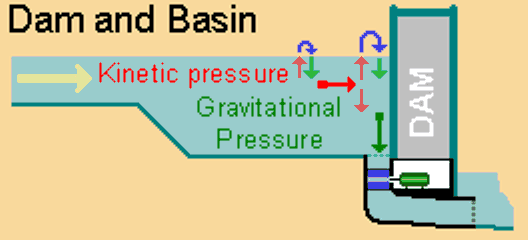
Kinetic energy from flow goes towards the dam. From the dam it spreads to
upwards and downwards. Upward movement raises the surface, and increases
potential energy. Downward movement above the inlet goes into generator.
The movement of the pressure goes upstream. This movement of pressure takes
the pressure over the bottom of the basin, away from the inlet. After that downward pressure starts
to raise the surface, too.
Surface is the easiest for the pressure to spread in. Every time basin gets
more water the raise in surface begins from the dam. Then the hike starts to
move against the flow.
In principle basin always produces as much rotating power as common dam.
Big lake and expensive dam is needed for raising the water levels, mostly.
The maximum energy you can get from dam is water height * area. In standard
dam tilted inlet reduces the maximum powers a little. Dam must be designed for
unbroken flow, before you can get benefit from titled inlet. Besides old
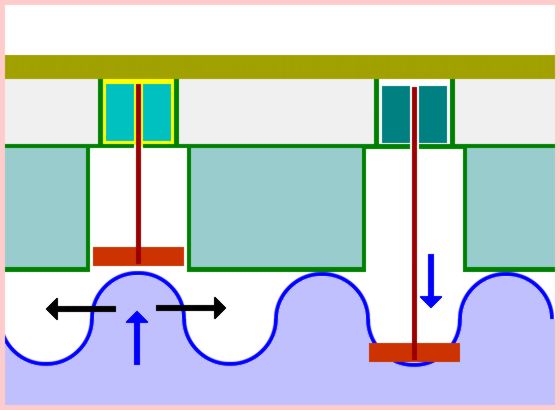
paddle wheel, there is double piston plant for collecting kinetic energy from
flows. Double piston plant can efficiently collect energy from very slow
flows. Like sea current or tidal waves. It does not need height difference,
quite a lot easier to construct than big paddle wheel system.
Sea current plant produces steady amount of energy 24 hours a day. It does
not need electromagnetic batteries, you can adjust the power production with
the number of active units. Sea current plant suits also to areas, where tidal
waves are small. In for example Asia tidal waves are small. Not possible for
Japanese, Chinese, Koreans, etc to build tidal plants. Nothing prevents you
from anchoring a big sea current plant in there. You can easily exceed Three
Gorges capacity with Sea Current plant. The constructed capacity is available
all day and year long. Cheap and simple replacement for nuclear plant suits
well also to poorer seaside countries. Double piston plant can be built to
vertical or tilted position, too. Sealed piston system can be used for
capturing winds and strong up-streams.
- - Add ons - -
Basin dam does not provide protection against flooding. The water reservoir
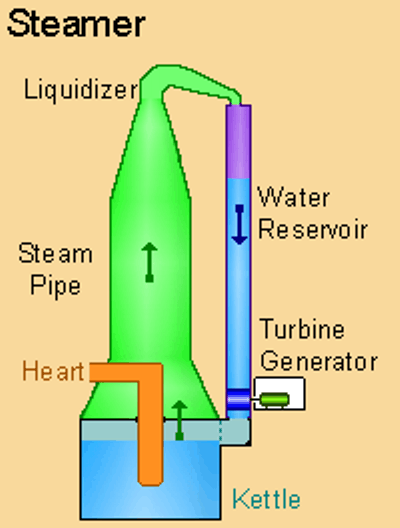
is so small. With special steamer you can evaporate flood waters to air.
Required steamers are big, but cheap to build. You can add flood
steamers into river plants. When so, you get the power for evaporation from
the plant. And when needed, you can bring more resistors for evaporating the
surplus of water.
You can also add water purification steamers into plant. You can lift the
water to tower with add-on steamer.
- - - -
In 2020 dam plant got a new generators. Crank generator improves the
efficiencies of all hydro plants. Crank generator converts over 90% from
kinetic or potential push energies to electricity. Crank generator moves
linearly in horizontal or vertical direction.
Calculating dam plants
When you calculate dam plants you have two parameters, which creates
generator and output powers.
Lets say, that you have 100 meter high waterfall. You build 100 m * 1 m2
tube to the water fall. The tubes volume is 100 m3. In easy calculations this
means, that tube consumes 100 m3 discharge per second. With 100 m3
discharge you get continuous 100 000 kg/s weight over the generator. This
weight converts into continuous 1 Mega Newton force.
This means, that your plant produces 1 MWs power with 100 m3
discharge. If river's discharge is 2 000 m3 /s, your plants push
power is 1 MWs * 2 000 m3 / 100 m3 = 20 MWs.
From this 20 MWs push power you convert 90% electricity, and the plants
power production capacity is 18 MWs. This converts into 64 GWh production
capacity.



 31st May 2019 -
Double piston river plant
31st May 2019 -
Double piston river plant