Sugar cane is farmed in poorer, tropical countries. Brazil is the biggest producer in the world.
Worldwide sugar production is around 180 million tons a year. 3/4th comes from cane, 1/4th from sugar beet.Sugarcane is tree / flower like plant. In 1.5 x 1.5 meter hectare there are 4 444 sugarcanes. When so, one cane weighs 14-18 kg.
Cane is perennial plant, it lives 4 years. During it's life time, it can be harvested four times, with 9 - 24 months interval.
Growth speed is dependent on heat and humidity. In rainforest growth takes a year, and colder areas 2.
It is said, that plant likes 32C- 36C temperatures. Watered desert is optimal growth place for sugarcane.Cane starts to grow from the planted body part or seeds. Planting depth is 15 - 50 cm.
Planting pit must be filled with water, after planting, you water the plant generously.
Recommended planting density on the field is 150 x 150 cm grid.Cane needs 60 cm rainfalls, and good harvest 100 - 150 cm rainfalls per year.
Since it needs water, it obviously needs also lots of CO2.
Plant is not very demanding with soil. It prefers dry soil from wet.
Plant needs quite a lot of heat and sunshine.Typical harvest is said to be 60-80 tons per hectare, with 12 month harvesting interval.
When you calculate things, machinery goes with higher 80 ton value and production with lower 60 tons.The maximum harvests are said to 120 tons per hectare. In India they talk about steady 100 tons per hectare, after 12 months growth.
With 60 tons per hectare, farmed area falls to 1.5 million km2 and 15 000 cells.
The big harvests are good to soil problem, but tricky with machinery.For 120 cm yearly watering, you got to build a big water pipe from ocean to fields.
Fields need 10 cm watering per month, on daily level it means 3 mm per day.
It is possible, that ocean water for sugar oil fields can be cleaned from salt with filters.
Salt particles are quite a lot bigger than water molecules.Another source says, that plant needs 60 cm rainfalls a year. And around 1 mm per day.
Cane fields do not need yearly sowing.
It doesn't need big storages. You can harvest, when needed. Close the watering system, wait a while and go to field.When you harvest canes, you should never break the skin. Sugar reacts quickly with water and liquids.
You should always pick the cane as whole. And keep the machinery and storages dry.Sugarcane looks like desert plant. Cane does not have seeds. It is storage, where cane keeps water and energy.
It collects water and energy very efficiently, just like cactus and other desert plants.
When you farm cane, without drought and bad times, it collects water and energy all the time.Quite obvious, that if you leave sugarcane without care into drought, shadows or cold, it starts to consume the cane-storage.
Machinery for sugar oil fields
- Sugar oil field needs sowing system, harvesting-transportation system, seed collection system and greenhouse system..
- Storing system must remove and keep humidity away from sugar plants. Sugar is sensitive to water and liquids.The harvester units could share the pipeline widths, 20 meters With 20m width processing of 1 km2 area needs 50 km drive.
With 6 km/h walking speed one box needs 9 working hours drive. You can build storing / storage system so, that you can sow and harvest all-day-long, in three shifts. With 24 hour day and three shifts one machine processes 2.88 km2 per day.
The harvester collects 6 000 - 8 000 tons / shift. It makes 700 - 900 tons in hour.
Three shift machine harvests 18 000 - 24 000 tons a day. When required harvesting capacity is 21 million tons a day, you need 1 130 harvesters.
5 days working week increases the need for weekday harvesting with 42 million tons. When so you need 30 million tons a day and 1 700 harvester teams.Caterpillar harvester needs a trailer. Besides harvester you need bigger storage - caterpillar car - on the field.
If you build railways from fields to refinery, you do not need big additional storages in the villages. Then you get harvests quickly to processing.Fields
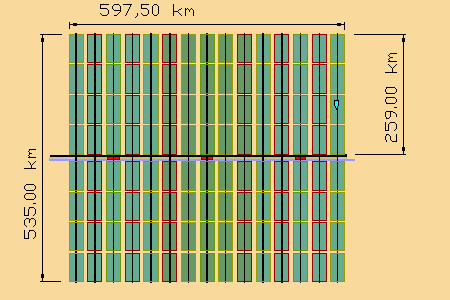
In the picture you see actual cell widths, cell is 15.4 km x 6.4 km
Field boxes ( in numbers of previous box ) Width Length Total Cell 45 km2 15 3 km Swap System 2 90 km2 15 6 km Train System 2 180 km2 30 6 km Railroad Box 2 360 km2 30 12 km Train yard 4 1 440 km2 30 48 km Team blocks Mobile Village 4 1 440 km2 30 48 66 km Worker area 4 5 760 km2 30 192 264 km Refinery 10 57 600 km2 150 384 - km Turn points at top and bottom are 150 meters. On the left, wildlife side, there is 60 meter route.
Inside cell there are 60 meter wide plant-free slices with 3 km interval.Swap point is 250 meters, in the center there is pink 50 meter "good" route for pillar cars.
In between fields and pillar car road, there are 100 meters for harvesters and trailers.
On railway side there is pink 100 meter pillar car road.With 6 km/h speed you handle two 3 km slices in hour. Swap team harvesters drives side by side on the fields.
On both sides of the swap track ( in the middle ).- Railway roads : Railroad with 2+1 double tracks is 20 + 2 meters wide, 4 track highway is 11+2+11 = 24 meters. In total these are 60 meters.
- Roads : Railroad with 2 double tracks is 20 meters wide, 2 track highway is 10 meters. In total these are 40 meters.
- Cross roads : Railroad with double tracks is 10 meters wide, 2 track highway is 10 meters. In total these are 20 meters.
Wished tilt for the fields is 0.1 degree. It makes 1.7 mm / meter.
- On 3 km field it results into 5.24 meter fall.
- On 15 km pillar-car track fall is 26.18 meters.
- It is also the standard fall for drains. "Bigger than ground" angle buries the drains very quickly. Only mining companies are interested.
In this picture there is another side from actual railway box.
Actual box is 13 050 m x 30 860 m = 403 km2 or 13 x 31 km = 403 km2.
In between cells there is 250 m reservation for pillar car route.The width of railway-highway part is fixed, it is always 60 meters.
Fixed width comes from movers, which goes over road and another double track railway.
- In 60 meter width there are always two double track railways and 2 track road.
- free 30 meter space for 3rd double track railway / 4 track road / on-ground pipe, etc.On the field-side there is 100 meter wide route for pillar cars.
- In wildlife areas these routes are 100 meter pathways.
- Underground pipes are under pillar-car routes.
- Routes at the ends of the fields are hardly ever driven with fully loaded car.
- Pillar routes are easy to open for fixing / replacing the pipes.Train yard / Mobile village Train yard is the biggest field unit. It has 4 railway boxes.
Without surrounding wildlife areas it is 31 x 60.50 km = 1 875.50 km2.
In the center there are rails for mobile village.
Max trip to work is 30 + 15 = 45 km.4 train yards forms the worker area, which is the biggest area in the field system.
Worker area is the area, you need for keeping one railway team busy all year long.
- one worker area system needs, that railway boxes are sowed on different years.Wildlife areas distances in here are recommendations for minimum.
- You should keep mobile village areas as small / short as in here.
- Distances in between villages are free.
- Idea in mobile villages is to keep distances from housing to work short.Refinery / village Refinery is an efficient collection unit. It has 2 * 5 worker areas.
In the center there is refinery, train station or harbor.
Distance in between villages is little over 200 km / 130 miles.Refinery area limits the number of trains per worker area to 2-3.
The max trip from field to refinery and back is little under 400 km.
With 100 km/h speed train has enough time to empty the load at the refinery point within 9 hours.
Without villages areas, most distant worker teams, would've needed around 20 trains.When you use rivers for watering, you can make them 15 - 20 meter deep.
Make them flow in the refinery slice. When you do so, it is possible use ships as transports.Villages have also greenhouses and other seed utililities.


Division of the fields

RAILWAY BOXES
|
Fields are divided to harvester cells, they are 3 km x 15 km. Three kilometer depth is fixed, it comes machinery.
Width is free. 15 km is maximum / optimal for machinery.
Machinery needs, that railway goes always in the middle. So that both sides forwards with same speed.
In the box railway must be straight. You can make curves and shifts in wildlife areas.These harvester cells grows to railway boxes.
Railway box has 8 cells. It is 30 km wide and 12 km long. Field area is 360 km2.
Railways boxes are surrounded by wildlife areas. 10 or 4 km from the sides and 2 or 4 km in railway direction.
Wildlife areas are needed for creating functional ecosystem to fields.When one harvester processes 0.12 km2 in an hour, it needs 375 hours or 3 weeks and 2-3 days for one cell.
- In 46 week working year there are 230 work days and 4 968 hours ( in here ).
- One harvester needs 13.25 cells or 596.16 km2 for one year harvest cycle, with 108 hour weekly use.In work-division fields enlarge to bigger boxes as follows :
- Two harvester cells forms a swap point ( harvester team ), they are 3+3 km x 15 km = 90 km2.
- Two swap points forms a train system. Train system is 6 x 15+15 km = 180 km2.- Two train systems forms a railway box. Railway box is 12 x 30 km = 360 km2.
- Railway box is surrounded by wildlife areas.- Four railways boxes forms a trainyard / mobile village. Field area is 1 440 km2. Total length is 66 km.
- within train yard distance in between railroad boxes is 3 km, then comes longer 5-6 km wildlife area.
- in between railroad lines there is 10 km wide wildlife area.
- wildlife areas cannot be very wide, they get humidity and ingredients from the field systems.With 12 harvesters railway team clears 1.44 km2 in an hour. 7 153.92 km2 in a year.
With sugarcane's 4 year lifespan, one railway team needs 6 sowing/cutting machines.
Sowing team needs one pillar car.Worker area, is the area, one railway team does in one working year. It is 4 mobile villages with 80% efficiency. Earlier numbers are with 100% usage.
- - - -
- Harvester set has 3 drivers, harvester unit and two trailers.
- Pillar car set has 3 drivers and one caterpillar car.
- Break time team has 3 drivers for 1-4 harvesters.
- Sugar train has 3 drivers, one locomotive and 3 km long car set.The harvester team needs 6 or 2,4,8 harvester sets and 2 pillar car sets.
- 12 harvesters must be accompanied with 6 sowing machines and 2 pillar cars.Railway team has 2 harvester teams and 2 sugar trains.
- 12 harvesters, 2+1 pillar cars, 6 sower/cutters, 3 trains.Swap / harvester teams on the field
The swap team has usually 3 + 3 harvesters. When so, everyone makes 7+2 hour work days.
Monday 5+6-15 15-24 free Tuesday 9-18 18-3 0-9 Wednesday 12-21 21-6 3-12 Thursday 15-24 free 6-15 Friday free 0-9 9-18+19 In this table there is field teams working times. Need the 9 hour shifts, for dividing work evenly to everyone.
- As you can see, the times floats during the week.
- First and last shift of the week spends one hour for driving the machines to the fields.Work time for the week is 36 hours. You live 11 to 12 weeks at the same train yard.
Machines run 108 hours on the fields / week. Without breaks and continuous driver changes.
- In the old stable village system you worked from Sunday evening to Saturday morning.Then you have one day off during the week.
Very long weekend, when shift moves from first to third.
Due to this, by default the shifts are changed in reversed order.
You have enough time to relax, make long visits, go far from the fields.
The circling system and work times are up to the teams.
Doesn't matter, as long as the machines run that 108 hours a week.Harvester set 2 and 3 has shifted, but otherwise the same schedule.
Sowing-cutting teams have almost the same system than harvester teams.
They have smaller trailers than harvester teams. Trailers are changed after a round.- - - -
Pillar car drivers come to work 4 hours before others.
After four hours, 2 drivers for first harvesters come to work with 2 break drivers.
After 30 minutes 2 drivers for the 2nd harvests releases men from previous shift.
Finally after 30 minutes 2 drivers for the 3rd harvesters come to work.Break drivers begins the work by releasing pillar car drivers to lunch hour.
After break drivers have a coffee break. After break they go and release 1st drivers to 30 minute coffee break.
After 1 st drivers they release 2nd and 3rd drivers. After others coffee break, Break drivers have their lunch hour.
After lunch break Break-drivers releases regular drivers to lunch breaks.
Right after one hour lunch breaks, break drivers start to release regulars into coffee breaks.
Break drivers day ends to theoretical 30 minute coffee break. Break is real, if you do overtime.
Break drivers four and half hour stint after lunch, fits into regulations. In return you get 30 minutes shorter days than others.- first coffee break swaps are made at wildlife side, so the break driver jumps from one harvester to another.
- lunch break swaps are made in the opposite ends.
- second coffee break swaps takes place at pillar car side.- instead of harvesters, both break drivers have field buggies.
Pillar car drivers do not have fixed coffee breaks.
The pillar cars are emptied after an hour.
With 40 - 80 km/h cruise speed, you spend less than 20+20 minutes to trip.
You have always at least 20 minutes at the train.
At the fields driver has 10 minutes to unload and reposition a trailer.Swap team has 6 harvesters, 2 pillar cars. 6+2+2 drivers per shift, 30 in total.
Pillar car's box is barely big enough for carrying three harvester-trailer sets.
During transportation there are 2 trailers over each other.
Harvester units are around 5 meter long. They fit into 4th "trailer space".Railway team has two swap teams, who loads the train from both sides. 60 people in total.
- sowing team shift with 6 machines, has 6 drivers, 1 pillar car driver and 2 break-time drivers. 27 for 3 shifts.
- seed team's system is unknown.
- village people, Master and Mistress.77 people plus seed teams.
The sample, with 80 million barrel daily production, needs 860 mobile villages or 215 railway teams.
3 km field depth and 6 km/h speed
After one hour work, driver is eligible to have cigarette break. Harvester's trailer should be capable of carrying 1 000 tons sugar.
Fuel consumption is kind of wanted thing on the fields. Machines provides CO2 and humidity to horny canes.Swap gives you the break, which goes by western work-laws. In nine hours you must have one 30-60 minute lunch break and two 10-15 minute coffee breaks.
You should keep the machines at work all the time. Cigarette break is 3 - 5 minutes.46 week working year
46 week work year has 230 work days, every one has 4 week summer holiday at the same time. Summer holiday is used for cleaning and checking the systems.
Weekends are also fixed to Saturday-Sunday for service and maintenance.Then there is that special Sugar carnival. Long weekend, when no one works.
The teams can have their 2 week holidays, when they want. Western-Christian team celebrates Eastern and Christmas-New Year on their western schedule.
Orthodox team follows orthodox system, Asian team celebrates Chinese New Year on holidays and so on.46 weeks with 36 hour weekly work makes 1 656 hours a year.
- Mobile villages makes it possible to use variable length work years. 7+2 hour days are fixed.
- System works as long as every one does as many days as the others.- - - -
Harvester teams, who works around swap point drives their sides always at the same place.
Railroad teams works also at the same place.Catering sets some demands to working distances. Rest-dining rooms and toilets travels with swap points and pillar cars.
The field area in between roads is coherent, there aren't ditches. Only small hills and valleys.
Part from team's wage comes from processed area / harvested sugar.
Although water pipes and drains are hidden, you cannot have plants over them. Watering system needs some free space.
With field buggy vehicle you can catch the machine where-ever it is.
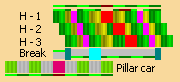
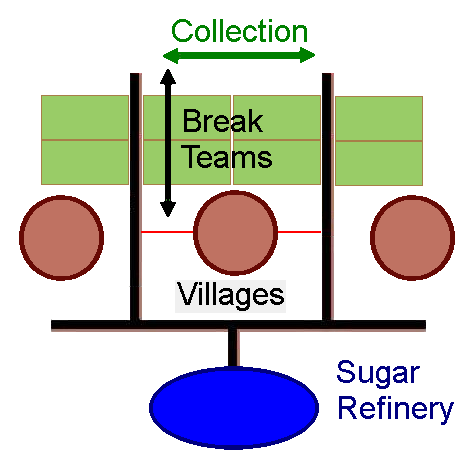 |
In the diagram you see collection and catering-break team movements. You cannot easily refine sugar to oil on fly. Oil sets into fire very easily, on field conversion would result into widespread-wildfire risk. Then the refining needs controls, catalysts, separation and who knows what. Water tower is missing from the picture. It is obviously in the same place than sugar refinery. At some hill top near refinery and common railway. You can use the watering system for killing pests with poisons and spreading liquid fertilizers to fields. |
Work on the fields
In the middle there is low friction, smoothed driveway for pillar car.
Loaded pillar car always uses it. Empty car goes to harvester's trailer & turn area.When harvester comes to swap area, it drops the trailer.
- Driver has his cigarette, possibly few words with the others, takes the empty trailer and goes back to work.Powered trailers can be operated and moved by pillar car driver.
After trailer is dropped, pillar car driver takes the trailer.
He drives the trailer directly to the mover system. ( you don't turn fully loaded trailers ).
Empties and takes it to next grab point.
After car driver has emptied all trailers, he drives the pillar car to next drop point.At the other end there is slice, which is never processed. It is used for turning the vehicle.
The turn place is 3 km from swap point. Driver turns the vehicle once in hour.
You process the slices so, that you skip 4 or more slices in the turn point. Turn takes less than minute.? Without turn point and with 6 km depth, you need 2 pillar cars and drivers per harvester. Or awful many trains and railroads.
Each swap point needs two pillar cars. One is almost always taking harvest to trains, another one waits loads from harvesters.Car's weigh put heavy demand for strength. Routes for cars are smoothed so, that they don't tilt too much.

Mobile Villages
Mobile village moves with worker teams. On the field area there are special train yards.
Yard provides connections to water, electricity and communication systems.In the railway line, there are yards after every 66th kilometer.
Each mobile village has at least car, where there is kitchen, 24 hour shop-bar-restaurant, mail office and bank.
Then is various set of workers homes. Homes are built over double-track cars. Maximum size is two floors and 320 square meters.
You can have garden or playground on the car, you can have your own car ... or two in the village.Mobile village consists from 1 railway team. It usually stays in it's place 11-12 weeks, four moves a year.
During one year mobile village has to travel at least 250 km. It would be difficult to build a village into one place.
If you do not live in the village, trains give you a lift to home for the weekends.- One railway harvester team has 60 people
- Machines need one mechanic, 3 in total.- Kitchen needs one cook. 3 in total.
- Then you need dish washer and food driver for harvesters. 3 in total.
- Shop-bar is open 24 hours. all year long, 2 people present, 6 people.
- Part from these jobs can be shared.In traditional farmhouse there was two organizers and workers. Same system here.
Master organizes field works, Mistress kitchen and village works.
Master and mistress raises total to 77 peopleOptionally there can be sowing and-or cutting team. When present, teams raise village size to 100 people.
Mobile village gets bonuses from the good cane export numbers.
Mobile village is hosted by village. The village has greenhouses, it produces seeds, maintains soil and fertilizer storages, and so on.Mobile village system
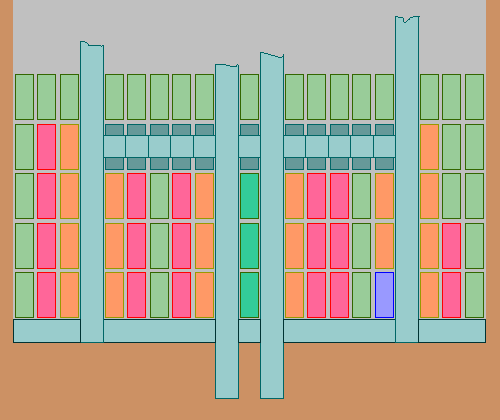
Sample village with 5 * 17 = 85 cars.Red block = house car
Orange block = car park / garage
Green block ( both ) = outdoor block
Blue block = shopLight blue areas streets
You enter village from the bottom
In sideways the lower street opens for letting trains railway cars in.
Upper street is made with railway cars.In picture cars have holes in between,
cars have folded seamless sealing systems on sides.Village grows only in railway direction.
In this village there are 18 houses, 18 * 6 = 108 flats.
Village is around 210 x 110 meters.If you want to develop your village or build a house of your own,
you get the car / cars from the house.
Cars are the same you use on fields.Train yards have streets / roads, rails are in a pit, below the surface.
Pits are covered, when village comes to train yard, it opens as many covers as village needs.
There are all kinds of cars, there cars with houses, garages / parking places, outdoors areas, road-crossings and railroad platforms.Then there is special coupling car, car provides water, electricity and communications to village.
The car is always on-line, when village settles down to train yard, car fills it's water tanks, and start to use water from pipes.
Drain water is collected with mobile system. You can go to toilet, when the village moves.When you move, the train simply takes the cars and tows the car-row into new location.
Moves are made during weekend nights, with a slow speed.
In an empty train yard there are only roads and covered pits for cars.Basic house is multifamily house with flats. Flat has kitchen, bedroom, living room and bathroom + garage for one car.
This comes from the house. One car has these 60 m2 flats in two floors, 6 per car / staircase.
Flats are for singles and people, who does not live in the village. Person, who comes with family, can get a bigger flat from the house.Then you can have custom houses. Two floors, with 8 x 20 = 640 m2 is the maximum. Max weight is 600 tons.
You can build these custom houses on your own time, if you want to. If you are building a house, the construction yard moves with the village.
Bigger than 8 x 20 houses are possible, they need special design and double walls for the move. Also possible to use non-standard 8 x 30 or 8 x 40 cars.Outdoor cars can have parks, flower benches, playgrounds, walls, gates, etc.
Crossing car connects two roads at the train yard. Railroad platform cars allows circling business cars visit the village.Main road has one car row in the middle. On the sides there are 9-10 meter roads.
The places for housing have three rails, the house in the middle, then there is one row in front of the house, one behind the house. ( see the picture above )The standard flats can have more than one houses / stairs on one plot. Plots are surrounded with outdoor cars.
After that comes another 3 rail pit for the houses on the next street. Unused plots are covered with common outdoor cars.
Mobile village have fixed 6*8 = 52 m width for blocks, length is free. Up to village people. In between blocks there is 9 meter road.- All houses are air conditioned. Villages are naturally open for everyone, not only to workers.
- You have a common fixed mailing address in the village. It comes from the village name, "street" and location of the house.
- If you get into troubles with the neighbors, you can change the location of your house in the village.
- If the local animals or people are hostile, you can have thick 8 meter walls and gates into village.
- Digital democracy works in the villages.
- All villages are themed, some will have tourist attractions, which follows the theme.
Refinery-village area and population center.
Refinery-village has 1 000 potential worker inhabitants.
You can have a home and family at refinery-village area and live weeks at the mobile village. You can buy or rent a home.
You can order things to village from refinery area. They are delivered with trains.Possible to construct double track fun and shopping trains. They can circle the villages.
Villages get their own side tracks. First it is used in the construction of the village.
Also possible to build circling pillar cars from the old machinery.Fields are so far from other places, that most obviously moves to the area.
And goes away only occasionally. Very old fashioned business from this aspect.Somewhere at the fields there is population center with school, church, big shops, hospital, love and order, cigarette and booze shops, restaurants, et cetera.
These utilities are not usually a big problem, when you come with thick wallet and good, long term job opportunities.
Ranches, roads and railways
Typical ranch in unoccupied, plain desert could have 15 railroad lines and 3 villages.
- Ranch would have 30 railway teams. 77 people per team makes 2 010.
- Ranch would have 30+30 sow and seed teams. 27 people per team makes around 1 620.- Total field area is 170 800 km2. With $100 000 / km2, fields would make $18 billions.
- then there would be 8 025 km railways on the fields. With 1 million / km, railways are $8 billions.
- 120 mobile villages have 3 km railway : $10 million each and $2 billions.
- 600 km multi-track railways to refinery area could cost $1 billion.
- then you need greenhouses and refineries. Could be $2 billions.
- Constructions would be $40 billions, interest is $2 billions a year.
- after these comes ranch's share from main water line and pumping station.Ranch needs also full sized airstrip and helipad at the refinery.
Refinery area is population center, with many independent businesses and services.
After ranch is fully expanded, it produces 14% from current oil production. Eventually share falls to 1.5 %.Ranch produces around 11 million barrels a day. 4 billion barrels a year.
- with $60 per barrel : $670 millions a day, $245 billions a year.
- with $30 per barrel : $335 millions a day, $122 billions a year.
- with $20 per barrel : $223 millions a day, $82 billions a year.
- with $10 per barrel : $112 millions a day, $41 billions a year.Before the final fall, you have enough capital to expand fields to maximum, build worldwide double track railways, and so on.
The production includes the oil, you use for production and deliveries. One or two months production goes to fields and pumping station.When you buy something, you spend certain amount of money to the purchase.
If you buy it with loan, you pay interest for the purchase. With down-payments you acquire ownership to the thing you bought.In balance sheet you estimate the current value of your assets.
When you calculate costs, you use interest for initial capital. Capital shrinks by the time, with growth of your businesses
- you spend $50 billions to ranch now with $150 billon revenues
- after 10 years your revenues could be $600 billions, and the $50 billions loses it's meaning.
- during the 10 year period, labor and other costs grow from $30 billions to $120 billions
- but the initial $50 billion investment-interest system remains unchanged.Shrink of capital comes always from the growth of your own business. National and global growths only assists the growth of your businesses.
There are awful many examples from the companies, whose revenues have fallen at the same time, wider economies grows.
- With vehicles you got get money for interests, then you have to collect money for maintenance and new vehicle.
- the big field machinery has long life span, ship-train like 20 - 50 years.
Miscellaneous about roads and others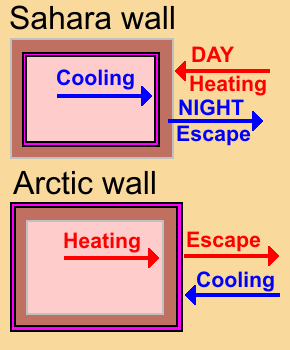
On the right there are basics for the walls and roofs to the extreme weather.
Both walls have two walls and thick, filled heat isolation hole in between Another wall is thick is thicker / better.
In Sahara wall primary wall is the inner wall. During nights thin outer wall allows the heat isolations to release the air to the outdoors.
In Arctic wall the primary wall is the outer wall. This wall releases the heat from isolations to indoors.It is difficult to cool down room with arctic walls.
When you cool the room, most from the heat in the isolation layer comes to inside and slows down the cooling.Both wall types have matching materials and heat isolation capacities.
- - - -
Highways and roads accompanies railways. Then there are water and oil pipes.
The water is clean and the pumping is cheap. You can build ponds and creeks into wildlife areas. Make water lines to locals.
Passings for wildlife areas could be a mixture from bridges and tunnels. Then you could build overpasses for wildlife.
If the whole field follows one standard, you get lost very easily. One good reason for building themed villages.If you ever build population centers to field areas, leave wildlife areas alone and some distance to them.
Fields are worthless pieces of industrial land. Wildlife areas are rich with vegetation and animals.Refinery should be at the lowest point in the area.
- Center location shortens the deliveries, but distance to population centers is long.
- When you use center location, you move crops farther from the final delivery point, oil harbor, etc.
Everything in oil consumption and sugar systems is big. Watering is not an exception.
Plants need 1-3 mm rainfalls a day. It means that one cubic meter covers 333 - 1 000 square meters.
Watering : Oceanside pumping station ( fixed 28th May 2019 )
Total area 1 237 253 km2 Watering 3,50 mm/day 1 277,50 mm/year Area with 1 m3 water 285,71 m2 from m3 Cubics for km2 / day 3 500,00 m3 / km2 - days to secs 86400 Cubics for km2 0,0405 m3 / s - total 50 120,20 m3 / s Energy Weight 50 120,20 kg / s Height 1 500 m -work 737 519 kN/sec 63 721 622 633 kN/day 23 258 392 260 863 kN/year Energy 41 MJ/kg 41 000 kN / kg 34 235 kN / liter Fuel efficiency 0,2 -needs 90 kg / s 7 770 930 kg / day 2 836 389 300 kg / year 108 l / s 9 306 503 l / day 3 396 873 413 l / year Mechanical system System with 3.5 mm daily watering needs 50 tons water in one second.
When you raise 50 tons mass into 1.5 km height, it's potential energy grows with 737 519 kN.
- When you do that once a second, the mass multiplies every second.
- For mechanical lift you need 150 million liters fuel in one year.On the left 3.5 mm rain is divided into one square meter blocks.
Then I calculated how many square meter boxes you can process with one cubic meter water.
After that daily portion is divided to seconds.
Finally per second watering need is spread to field area.Combustion engine powered water pump burns fuel with 20% efficiency.
Mechanical lift needs, that water is purified, cleaned from salt, etc.
From the table below you see how much big city consumes water in one day.
City consumption 10 000 000 citizens water / citizen 300 liters per day 0,3 m3 total consumption 3 000 000 m3 flow 35 m3 / sec 28th May 2019 : there was one prefix error in earlier complicated calculations.
- Watts were converted into kiloWatts and used as Watts. Same error in both.
31st May 2019 : fuel consumption formula missed days.
Physical lift with steamer
In principle, steamer works so, that you raise surface level temperature from 99C to 100C.
- it pre-heats the underlying water before vaporizing.
- It is possible that the steamer would work as follows, if it doesn't there is still tidal pumping station left.One cubic meter water weighs ton. One cubic meter water vapors weighs 0.6 kg. When so, one water ton needs 1 m3 and vapors needs 1 667 m3.
When you boil one cubic meter ocean water in 1 m2 pipe , the vapors raises to 1 667 meter height. In ideal, non-leaking system, the lift is free.When you cool the vapors at 1 500 m height, the amount of water you get from the pipe, is dependent on the speed and pressure, with what vapors come out from the pipe.
The speed with what vapors move is dependent on the speed, with what you vaporize water. Steamer is not like stove, it is optimized for vaporizing, not for warming.First you boil ocean water. In the pipe, need for adding heat, is dependent on tubes isolation. Heat goes always upwards.
- - Calculations for the estimated fuel consumption - -
Steamer station Enrgy for heating 4 160 J/kg per 1C Water's conductivity 0,6 Watt / meter Volume for heating 50 120 kg - energy for one second 208 500 kN - tubes efficiency 95 % 219 474 kN / sec -water's conductivity 40 % 548 684 kN / sec Energy 41 MJ/kg 41 000 kN / kg 34 235 kN / liter Fuel efficiency 0,6 -needs 22 kg / s 1 927 086 kg / day 703 386 536 kg / year 27 l / s 2 307 888 l / day 842 379 086 l / year Water needs 4 160 Joules per kilogram for raising the temperature with 1C.
Joule is power, you get or need for one second time.- If the isolation keeps 95% from the produced heat in the pipe, tubes efficiency is 95%
- For the additional heat you build a small power plant to the pumping station and use resistors in the tubes.Water's heat conductivity is 0,6 Watt / Meter. Possible that heart works with 40 % efficiency.
When so 60 % from the heat goes up and down.Steamers fuel efficiency is 60 - 80 %.
One kilogram of oil based liquid fuel has 41 MJ - 43 MJ per kg.
With steamer you get around 30 MJ per kg.
Watering
Arabia is the best place for watering. In the west there are mountains at Red Sea. Field area begins from the another side of the mountains.
In Africa there are Atlas mountains in Morocco. These 4km mountains are the only ones for Sahara.Checked that open river can output enough water for the fields.
If basin is 2 km above fields, track 1 km wide and 10 meter deep, 50 000 m3/s discharge is kids play. Many rivers peaks to 100 000 m3/s.Fully farmed Sahara needs 5 000 km base line the basin and 500 000 m3/s reservation. If you have to build it to full capacity, it will be the biggest river in the world.
Open pipeline wastes a little, but it is quite a lot cheaper and faster to build than closed pipeline. In open pipeline distilled water gets natural touch.
You can use pipes for going over hills or otherwise difficult places. Sometimes you have to pass rivers.- - - -
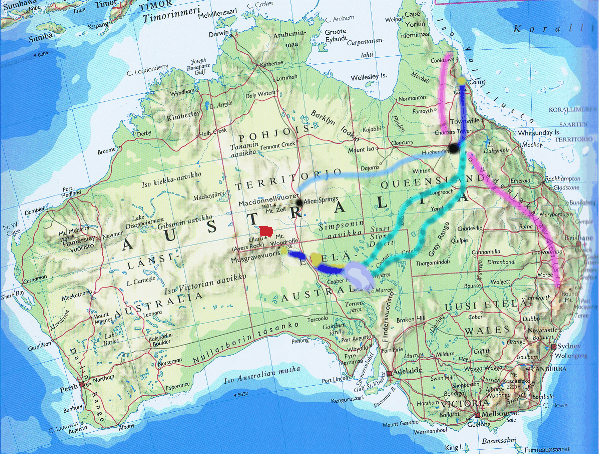
Primary target in Australia is to get the inlet and big water reservoir to Alice Springs / Ayers Rock area.
They are at the highest location in desert areas and in the center of Australia..
There are two high mountains. With mountains it is kids play to lead water into deserts.In east Australia there is water divisor near ocean. ( pink on the right )
If you build pumping station near Cairns, the distance to closest natural route to deserts - near Hughenden - is only few hundred kilometers ( blue line on the right ).
Cairns is one of the highest places in Australia, 1 622 meters above sea level. North from Townsville.From Hughenden there is long route to Lake Eyre. You get 1 000 km free-ride in first desert field areas. ( two dotted cyan lines. )
Distance from Lake Eyre to Big Red Rock ( Ayers ) is not very big.
When the lake has water, distance is around 100 km. Lake Eyre is 16 meters below ocean level. Have to climb 500 meters.
From MacDonnell and MusGrave mountains you can continue to western deserts.The light blue line is another clear water divisor in Australia.
When you build river to the divisor, you get watering system to western Australia and over 1 million km2 deserts.
Eastern Australia is full of creeks, which are dry most of the year. Australia has all-year-long rivers and lakes only at ocean sides.Australia's industrial output is currently below $1 trillion a year. Fields raises the national output to over $2 trillions.
Watering : Primary pipes
In primary pipes water could move with 4 m/s speed. 3,6*4 = 14.4 km/h.
The underground pipe in the fields has to provide water to 3 000 x 20 meter area.
The underground pipeline, which follows pillar car routes has to provide water to 30 km x 6 km area.
The pipeline which follows railroad has to provide water to multiple 360 km blocks.
The pipeline which follows sugar refinery's railway has to provide water to it's side.From these pipes, only the underground pipes can be operated with pumps. And the pipes can have pressures.
With big pipes you use water tower system.
In water tower, gravity moves the water. You can probably use 9.5 m/s speed. Speed comes from the gravitational force.
No one has benchmarked water tower effect. Very difficult to say more.
- In water tower, gravitational force has double role. It moves and brakes the water.With water tower system and preceding assumptions, 10 meter boxed pipe brings 3 mm rains to100 rain-road blocks. Blocks whose size is 360 km2.
When so, the water tower pipelines needs 350 boxed 10x10 meter pipes. In hosted tower, you should obviously use top/surface water.
In seaside or router tower, you add / pour water to top.Might be a good idea to use weather and time resistant plastics in the pipe works. Plastic also in drains.
The total length of both systems is million kilometers. As long as you use plastic, you can use as big, thick and dense tube systems as needed.Should build line and pipes so, that it is easy to increase capacity, when the farmed field grows.
Water pipes follow the oil pipe systems. The existing oil pipe system transmits more oil than these water pipes water. Oil pipes are not that big.The fields humidity and watering demand is controlled with sensors.
After field becomes fully functional and there are animals in the nearby forests, field doesn't need much watering.- - Shape of pipes - -
The internal gravitational pressure makes low and wide pipe better than boxed and round tube.
- 10 meter wide and 1 meter high water tube pushes the lowest level with 1 000 kg load.
- 10 x 10 meter pipe pushes the bottom with 10 000 kilograms. 10 overlying 10 x 1 meter pipes are quite a lot better.
- 10 square meter tube's diameter is 3.57 meters, the highest pressure at the bottom is 3 570 kg. When the pressure system changes throughout the width, these pressures creates turbulences into tube ... all the time.Rectangle has clear pressure system, which grows towards bottom.
If you want to optimize the pipeline, you widen the 10 x 1 meter pipe towards bottom.
Tilt angle at both sides could be 30 - 45 degrees. With 45 degree tilt the bottom width is 12 meters.- - Calculations - -
Total area 1 237 253 km2 Watering 0,0405 m3 / km2 Water pipe Water's speed 4,00 m/s Area for pipe 0,0101 m2 / km2 - radius 0,0320 m - diameter 0,0641 m Total area 12 530 m2 - pipes diameter 71,30 m Pipe, rectangle 10 m -area 100 m2 -count 125 pcs Primary pipe from pumping station
When water moves with 4 m/s speed,
the cross section area of the pipe is the requirement per second per 4
-: So square kilometer needs 0,0405 / 4 = 0,0101 m2.
Cell width 15 km Cell length 3 km Slice 20 m Watering - Slice size 0,06 km2 0,0024 m3/s - Cell size 45 km2 1,82 m3/s Pillar route 90 km2 3,65 m3/s Train block 180 km2 7,29 m3/s Railway block 360 km2 14,58 m3/s Mobile village 1 440 km2 58,33 m3/s In this table you see the watering demands for various areas.
Water tower's transmission system
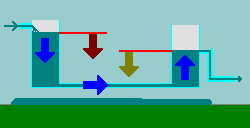
In the picture you see tower. When you add water to host, gravity drags hosts water down.
This creates pressure to bottom. From the bottom the pressure continues to client tower.
Since the client tower doesn't prevent or rise the pressure, it should remain unchanged.
The more water your pour into into host tower, the faster the pressure and water forwards.At some point the water level in the host tower and the pressure in connecting pipe starts to raise.
The tower system switches into looped system. The more water your pour to tower, the more pressure in the pipe raises.
This hike fastens the speed, with what the water in client tower raises.The system is different from the way gravity makes rivers float. It is also different from manmade water pump.
Manmade water pump works with overpressure. Water tower does not have any over pressures.Without this tower system you need 215 ten meter pipes. In tower system you can use "free" pressure in long and big pipes.
In closed system pressure should not vanish on the way. You can for example use common water-pipe network's 4k pressure.In the calculations, you can use water's viscosity for estimating the force, which goes into pipe with some water height.
In the system you adjust the water levels with pressure sensor in connector pipe. Viscosity is needed only for estimating the height of host tower.Client tower does not have to be very high, high enough to keep the connector pipe hidden and the system coherent is enough.
The last blue arrow is bit difficult to explain properly. It points to wrong direction. Almost non-exiting pressure pushes heavy mass upwards.
Piped liquid's capability to climb over mountains is another difficult thing. It shouldn't do so. Does it anyway.Cannot use the system with gases, fumes from old oil fields.
Miscellaneous
Due to watering demand, easiest places to start are Saudi Arabia, Yemen, Oman and United Arab Emirates. They have high mountains at seaside. On the other side ground goes down all the way. In Africa you need very long and big pipeline for Sahara. And enormous pumping stations at Atlantic coastline. Possible to start also from eastern side, Egypt and Sudan. Planned once a water channel / river to Sahara, for drilling oil from the beneath.
- Train deliveries allows you to combine railroad blocks from various places.
- Two track double track train is wide enough for moving slow worker pillars from one place to another.
- You can use all four tracks during Saturday-Sunday night.
- Faster, empty pillar car can be driven into new locations. Empty car goes over road without ruining it. Almost as fast as train. Can also pack field pillars to pillar car.When you sow the fields, you should use fields own seeds. By the time the plants obviously adapts themselves to the area, form their own desert subspecies. Plants are not stupid like rocks.
Sand desert at warm area does not need much basement work.
- usage of pillar cars makes the route creation almost free. Clear driveway is enough for jeeps and pillars.
- you can drop the number of roads to reasonable / marginal levels.The capital costs are devious, if you spend too much, the spending raises the production costs for an awful long time. After the money is wasted, you cannot get it back.
These calculations are sample from the way you can build the system. Also a proof, that everything is possible, with profitable sugar-oil production.
You can get roads for sugar-rally series, tourist attractions to exotic-vintage villages. Long roads, on which you can test various cars.
