Field creation
Field creation cost is heavily dependent on the tech with what you lay down the drains and water pipes.
- you need machines, which digs the hole and lays down the drains directly to correct height. Water pipe works with pressure, height is insignificant.
- drains are for the time, the ecosystem becomes functional.
- If you start from the roadside ditch, all you have to do, is to raise relative hole-depth a little all the time.
- small, long water balancer like system with electric circuit at the bottom will do / adjust the depth all the time.
Ash soil is not enough
.
Hole for field creation Diameter 0,3 m Length 0,3 m -radius 0,15 -area 0,07065 m2 0,021195 m3 27,55 kg Mixture 50 - volume 0,01060 m3 - weight 13,78 kg In this table there is spreadsheet from the holes which are made to fields. Sands and rocks density is 2 600 kg/m3.
When you create fields, you mix sand and good soil with 50/50 system.In the table below both soil for fields are the amount of soil,
which are mixed with desert's own soil / sand.Train columns tells the number of 100 000 ton sugar trains,
you need for hauling all the soil in one year.
Plants per Soil for field / m3 Soil for field / ton Area for holes km2 Trains Trains/week -train 78 000 000 826 605 1 074 587 6 11 0 -railbox 156 000 000 1 653 210 2 149 173 11 21 0 -village 624 000 000 6 612 840 8 596 692 44 86 2 -worker area 2 496 000 000 26 451 360 34 386 768 176 344 7 -optimal area 9 984 000 000 105 805 440 137 547 072 705 1 375 26 -ranch 99 840 000 000 1 058 054 400 1 375 470 720 7 054 13 755 265 -total 536 142 966 667 5 681 775 089 7 386 307 616 37 879 73 863 1 420 From one trash ton you get 10 kg ashes.
- 10 million metropolis produces 20 million kilos or 20 000 tons trashes in one day. It converts to 200 tons ashes.
- In week this city produces 140 000 tons trashes and 1 400 tons ashes. Auch. No where near tons, which are needed for creating soil.
- In total you could get 3 million tons ashes a year.There are plants, which can convert water and CO2 into soil components.
Plants, which loves to live on sand, with watering only. Then there are water plants.If you look at the area, which is covered by plants, it not very big. It is around 190 x 190 km area ( 120 x 120 miles ).
It is possible to buy the soil for fields. When you buy farmed fields with $1 000 000 per square kilometer, you pay $10 000 hectare or $4 000 acre.
Cost of purchase with this price is $35 billions. Then there are big wildfire areas and others in USA, Russia and Canada. They are cheaper, but they need more work.
95% from the harvested cane is energy. Rough estimation for the need of fertilizers is 5% from harvest. When yearly harvest is 7 423 million tons, you might need 372 million tons replacements.
Kids play ? There are around 3 billion city people in the world. Within one year this group people outputs 330 million tons shit. Still short on goal and most of this excellent fertilizer ends into oceans. The only way is to collect all leftovers from the harvested plants ... very carefully ... and return them with some enhancements into fields.
Then you can naturally use 5 - 10% from produced oil to fertilization. You can for example have a clipper in the back of the harvester. After chopping you smoothen or liquidize the cane, and let it go to ground. Soil creation would need, that you collect the chopped canes ... you use stored canes.
The amount of ash-oil fertilizer, you need for existing fields, is dependent on the efficiency, with what you collect non-sugar leftovers from the harvest.
With the estimation, 5% is the maximum. With 80% return rate you need 1% from production / 292 barrels / 50 billion liters a year to fertilizing.The seed-croppers could collect around 6 734 million tons organic material from the fields a year. But this goes to body building.
Fertilizers and deserts history
Quite obvious that recycling of shit and need for fertilizing was invented rather late state.
Best guess for the inventor is Isaac Newton or Galileo Galilei. Recycling system is easy only for a physicist, who concentrates in energies.
Newton was highly appreciated person, whose advise was asked for awful many things.Modern unnatural add-on fertilizers came to farming after World War II.
Possible that Mesopotamia, Egypt, Greek and Rome declined to the lack of fields and food.
If so, these advanced civilizations had to expand all the time for getting good ground for farming and food production.Cavemen tribes burned forest for getting new fields for farming up till 19th century.
In Asia the areas, old great khans used to rule, are nowadays worthless deserts. Deserts begin soon after Beijing, ends to Caspian sea. Just like khans kingdom.
USA has the biggest coal reserves in the world. Possible that North American Indians deserted the country. When white man came, the remainders were hunters and wanderers.
Australia used to have rivers and lakes. Nowadays filled only once a year. When you pack Indian ocean, Australia was right beside equator in Africa.Old high civilizations used to build big constructions, that needed busloads of workforce. Temples for gods or their offspring.
According to maps equatorial rainforest have small deserts inside them. Then grassland has narrow leads into rainforest area. Sometimes the grassland-desert is right beside river.
In deeper Asia and central America, Sahara-Arabia latitudes are rainforest areas.
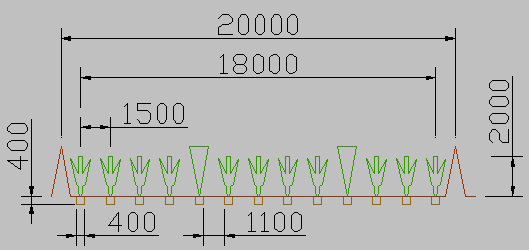
In the picture you see slice. It is 20 meters wide, it has 13 rows.
Slice is 3 km long, it has 2 000 columns, so the total plant count per slice is 13 * 2 000 = 26 000.
Slice has space for 12 tracks. Their max width is 50-60 cm.On the sides are watering systems. There isn't a way you can drive through the field.
You need 20 meter routes in the fields with 3 km interval.For driver changes you need a field buggy, which shares machinery's ground clearance.
Car has a bridge and anchoring system to harvester. You can use the car for fixing watering system.The trailer width is 18 meters. Machinery does not need steering on the slices, you can place guidance system into water lines.
At the wild life end of slice you need 150 meter space for turning the harvesters, sowers and possible seed collectors.
Harvester is around 60 meters long. You got to drive them away from the sugarcane area, before you can begin the turn.
Then you need space for actual turn and for straightening the vehicle before entering the field.At swap area you drop the loaded trailer. You turn the harvester and grab empty trailer on you way to new round..
The pillar car driver uses remote control for steering and positioning the trailer. Swap area is around 200 meters wide.
At the railroad, pillar car drives directly to train, driver goes to another end, and drives vehicle back to field.
But on the field 40 meter wide vehicles need 100 meters for passing each other on the swap route.You need 5 twenty meter routes, they need 100 meters.
At the both ends there is 100 meter route for moving from one block to another.Wildlife areas are crossed from railroad side, so they must have 100 meter pathways beside railroad.
Sowing and field creation units
Sowed / year Soil / tons Sowed / hour Soil / kg -village 156 000 000 238 797 31 401 48 067 -worker area 624 000 000 955 188 125 604 192 268 -ranch 24 960 000 000 38 207 520 5 024 155 7 690 725 -total 134 035 741 667 205 175 212 26 979 819 41 299 358 One worker area has to sow around 624 million plants every year. It makes 13 millions a week. It goes down to 35 plants per second.
When sowing takes place with 6 km/h hour, and 13 plants ( 20 meters ) at the time, you plant 13 canes in one second.
35 plants per second needs 3 sowing machines / village. If railway team with 12 harvesters needs 3, you need 1 sowing machine for 4 harvesters.If you get 100 seeds from one plant, you got to process 55 653 plants a day.
If one person checks 1 tree and gets 100 seeds / minute, village needs 133 pickers, around 150 000 in total.
Might build a machine, which cuts the plants from the area, which is going to sowing. Machine can produce short branches for green houses.The final system is dependent on how cane start to grows, and how much it makes seeds.
In sowing and field creation you use ground drills. Both drills collects the drilled ground with tube.
- In sowing you could use 5 - 10 cm drill. In field creation you use wider 30 cm drill.
- Sowing unit enhances the soil and drops the plants and fertilized soil into hole. Before drop it waters the hole.
- Drill can have spikes and watering system for the ground outside the drilled hole.
- Field creator mixes the drilled sand-soil with farm soil. Field creator doesn't sow.
- Field creator's speed is free.The sowing unit should forward with 6 km/h ( 1.666 meters / second ) speed. But it uses 2 hours for round.
With 39 meter length, you can sow 25 plants per row at the time. 19 meter width has 13 plant rows.
Unit makes 80 stops per slice. You have around 20 seconds per stop.Sowing machine has two smaller 100 - 200 ton trailers.
Trailer has boxes with plants, water, soil and fertilizers.
Trailer is changed after one round / two hours.Sowing machine, Functions
In the picture there is diagram from sowing-cutting unit.
In the front there cutting unit, it is 3 meters. then comes chopper unit.
After chopper, comes multi layered sowing table with 13 x 25 sowing units. In the back there is small trailer.
Due to continuous stops, machine is light. Only 150 - 200 tons, when fully loaded.
Machine is layered, it has decks for the functions and stuff. This version has water and plants in the top of the trailer.
Below there is storage for used boxes. At the bottom are soil storages. Table ends to drill layer.Possible seed collector and it's staff, would be in between cutting and chopping units. Around 5 meter unit.
Sowing machine has many functions.
First it must cut the sugarcane bodies.
If the seeds are checked or cut from the bodies, it happens here.
Then the machine chops the bodies into small pieces.During chopping machine uses ground drill. Ground drill makes two holes to the field.
The wide full- hole sized blade digs hole for mixing chopped old sugarcane body into soil.
During mixing, you can add fertilizers into soil.At the same time with mixing, the machine fills the smaller hole with water.
Small blade opens a hole for the plant. Plants are in the boxes, which has small 5-10 cm tubes.
After hole is watered and the soil mixed, the machine pushes the plant and mixed soil into ground.Machine moves to new position and repositions the plant boxes.
The soil which comes from small blade is collected and taken to green house.
The sugarcane bodies weighs more than canes, you cannot take them into trailer or away from the field.
When so, everything must be done at the same time, with same machine.After sowing machine is finished with slice, the watering system is activated.
- - - -
Since sowing machines spend 2 hours on the trip, you do not need two drivers for pillar cars.
Pillar car goes to railroad once a shift.
Car takes plants and fertilizers from train, water from bigger railway pipeline.
Break driver takes previous shifts car to railroad. Train drivers load the cars.Spike Sensor
You build a distance measuring system into sowing unit, so that it moves and stops automatically.
You align the vehicle after turns, with first stop. After that it forwards planted distance + 1.5 meters.You can use mechanical sensor. When machine stops, it pushes a spike into ground, to the front.
After planting, the machine moves until the spike reaches the end of it's track. Track length is planting length + 1.5 meters.
When machine stops, it grabs the spike, moves it to front and pushes spike into new position.
You build also a steering assistance to the spike sensor.Since sugarcane rows have good and bad soil, distance / spike sensor is essential.
Ground drill
Ground drill is an application from a manual foot-powered tool, with what you plant trees into chopped forests.
It is very fast. 20 second time for stop is not very demanding.
- Without need to fertilize and change the ground, you do not need blade / drill system in sowing.Field crawler
Besides 19 meter sowing machine, you need a machine for fixing the fields.
Crawler is narrow, you drive it in 1.1 meter track space. It needs to be capable of operating on both sides.
Machine needs cabin. Sugarcane has stiff, sharp knife like leaves.


Seeds from Greenhouse
At some point you must collect seeds / braches from the fields.
Trees and flowers are pre-raised before planting in greenhouses.
Sugarcane is closer to these than common corn.After sowing and emptying the tube, you move the boxes in the sowing unit together, to the next plant.
When you pre-raise the plants in greenhouse :
- the time you keep plants in house is around 8 weeks, you need greenhouses for 30 billion plants.You use 0.20 x 1.30 meter boxes for plants.
- with 1.30 meter length you can fill the sowing table efficiently.
- 20 cm width allows you to build movers for empty boxes in the sowing system.
- in greenhouse mover system for boxes can be operated in the plant row, under the boxes.
- One box has 104 plants, with plants and soil it weights around 110 kg.Boxes in machinery
In trailer there are 6 boxes per row, and 84 rows for the plants. It makes 504 boxes.
During one round sower needs 500 boxes.Box size converts into 7.80 x 16.80 meter area. Where 16.80 fits to maximum 18 meter width.
The boxes for one trailer load fits to railway cars 8 x 20 meter floor.One railway car can carry 4*150t = 600 tons. Plants for one load weighs 80 tons.
Car can carry 7 floors / trailer loads. With 1 meter height car raises to 7+1= 8 meters.With 6 floors per car, one car carries plants for 6 sowers. You need 9 per shift and 27 for one shift roll.
Pillar car is loaded once per shift. To 40 meter width you get 2 lengthwise or 5 sideways.
To 80 meter length you get 10 sideways and 4 lengthwise, 20 in total. Plant car needs floors.
Car needs space for fertilizers and returned soil.Rows in greenhouse
- lengthwise 1.8 meter corridors for staff with 6 meter interval. Width allows you transport boxes and drag boxes from the rows.
- Cannot have corridors in sideways, movable bridges over rows are possible.- With two meter path, width is 7 meters, length 1.25 meters. Area has 2 500 plants.
- The sample fits to 12 million 1.25 meter long rows. It needs 250 million boxes for greenhouses.
- Greenhouses for all needs around 100 km2.In the other end of the greenhouse you have planting facility, where you fill the tubes with soil and seeds.
In the other end you have loading system for trailers. Sowing team doesn't need pillar cars and exact timing.
Can drive "remote controlled" trailers to railway cars.Tubes in boxes
Boxes have 5x5 cm tubes. They are 30 - 40 cm long. Tubes are open from both ends. In order to keep soil and plants in them the bottom needs a disposal organic cover.
Sowing machine brakes the bottom and pushes the pants into ground. The bottom is buried into hole. Difficult to make the system otherwise.
Soil collection
You must collect soil with sowing machine. Return it to soil storage at green house.
Round 5 x 5 x 40 cm tube's volume is 0,00314 m3.
If you increase the tube size, the greenhouse size grows quickly.xxx If you keep soil for whole year in storage, storage got to have around 4 000 000 m3 soil.
xxx With 1.5 meter pile, such storage fits into 1.5 x 1.8 km2 area,
xxx Daily portion - 5 500 000 - plants need 17 500 m3, it weighs around 35 000 tons.
Harvesting
Harvesting is simpler.
- You cut the canes from the bottom of the cane.
- Then you let them fall on tilted table.
- At the lowest point in the middle you have mover.
- Each row has it's own tilted system.
- Cutting system should not harm leaves and body. At least much.
- Same not-much-harm goes to collected canes, too- You could use some kind of lasso-system for cutting the canes. Then you could bend the plants / canes.
- You must go and study the canes and the best way.Cane weighs almost 20 kg, it is in the top of the plants body, in at least 1.5 meter height. The body must be strong.