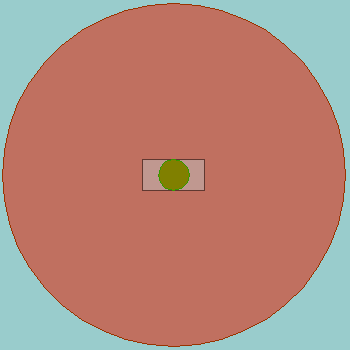
Space Lift diagram has new multiple layer system for adjusting the lift. In
vertical lift you do not talk about thrust, you talk about lift power. With
wing system, you can reduce momentum, which comes from low and wide tank
system.
Original idea was to use the same containers, trucks and trains uses. So
that space cargo follows the international standards. No need to change that.
Food, electromagnetic batteries and grain does not set new demands for
containers shape and size.
New lift has also vertical wings for steering and horizontal movement.
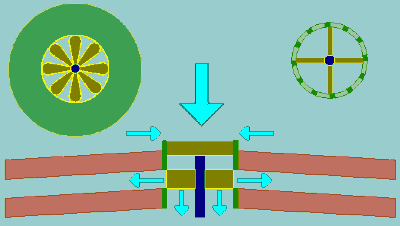
With strong inner ring, you "push" the load upwards. Ring has
also the primary pressure tube lines and their control system.
Primary engine is in the center hole. It is always in at least the
vertical wing unit. It creates vacuum over the tower, overpressure under the
primary donut. The thrust must redirected so that it never heats container /
passenger compartment at the bottom.
Might be good idea to build an independent system where the wing system -
which redirects thrust - is always in donut. When so you can add engines also
into additional donuts.
With adjustable nozzles, and two separate cell layers, you can create
overpressure towards upper / lower row. Overpressure towards lower row raises,
towards upper thrust pushes craft down. With 4 nozzles in 90 degree angles you
can steer the craft with thrust. You can never direct thrust directly towards
tank. Pressure blows the underlying tanks.
If hot layer is 1500C, steel becomes soft and melts in these temperatures.
With 100 km/h climb rate lift uses an hour in the layer. High temperature
refers to big pressure. In scheduled morning pass temperature can be normal.
Or then it's the same. Depends on the source of heat.
Due to hot layer passing, you can never set tanks' covers into fire
with the engine or fuel. Heat resistance demand for fabric is over 1000C,
engine's max temperature is around 700C. All outer parts must be covered with
the fireproof fabric. Wolfram lasts over 3000 C temperatures. Edison used
wolfram hearts in his bulbs. Carbon lasts higher temperatures than wolfram.
Wolfram weighs three times more than iron. Molybdenum weighs little more than
iron, can be used for longer stay in hot layer.
Helium tanks
You could reduce weigh of tanks with shaped fabrics. Tank is always built
from cells. Cells must be rather big, in order to reduce weigh. With shaped pieces and strong seams, the filled tank takes
it's shape without support system. When so, outside the inner ring, you have
pressure tubes and constructions, which divides the load from the
bottom.
As safety, you must always leave some spare tanks into tanks system. So
that lift can operate with one or two broken tanks. Tanks sealing system must be made so, that it is rather easy to
repair the
broken tanks. Change and fix the broken tanks after flight.
They should keep their shape for making small vacuums possible. With vacuum
you can improve the lift. Big vacuums creates a safety issues. You could
reserve bigger vacuum as an emergency against bigger tank loss.
Carbon tanks
Carbon tank system would be strong and light. Carbon does not need heat
protection. Tank's cell system can designed so, that it carries the load.
Carbon tank allows usage of vacuums. Don't know how it lasts sharp temperature
changes.
Could make connectors from molybdenum or wolfram. Pipe system from carbon.
Wires from molybdenum, covers from carbon.
Center ring, etc.
Might be good idea to build primary lines as spirals ( less than
one round ). So that one line can fill cells from all around the tank. Minimum
requirement for primary lines is two. Each line must have it's own,
independent system. Starting from compressor and pressure tanks.
Cold fusion can be used for cooling the gases. Cooling can be used as
addition to pressure balancer system. With cooling you can keep the gas size /
pressure steady.
Pressure balancer compresses gas from air tanks. Packs gases into pressure
tanks. High internal pressure increases gases density and weigh per cubic
centimeter. With the system you control climb rates and direction. You
can load / unload gas system with balancer.
If you use cooler system with balancer system, you should also add
Hot-Balloon effect to the cooling system. The system must support continuous
circling and heater. The temperature, with what you cool the gases, when
passing hot layer, can be bigger than the hot balloon effect temperature ( you
use near the ground / gravity systems ).
The compartment needs a detachment / parachute system for emergency
landings. It does not need much more for near-ground safety. Manned donut
needs oxygen system for upper atmosphere and space. Possible to use catapults
for crossing the hot layers. You always anchor the ship before entering the
hot layer, then you are slinged through the layer. Besides improved safety, it
would reduce donut's thermal demands, too. You can also change the donut
system there. Stars can be very tricky without anchoring stations, the depth
of layer is enormous.
The compartment needs a towing system for final delivery, which takes place
in space. Space Hotel is a place where you can change the tractor of the compartment.
Commercial exploration of a new planet-moon-star always starts with a space
hotel. Possible that you need interstellar hotels too. At least one outside
solar system, for scientific purposes.
When
- Everything you need for electric jet engine exists already. Engine misses
electromagnetic battery system. You can test space donut with common jet
engines. In final product you replace fuel lines with wires. Fuel tanks with
electromagnetic batteries. Temperatures and design are independent on donut's
type.
- Helium tanks need cover material. Pressure balancer is simple, everything
you need exists. All construction materials must be capable of handling very
low and high temperatures.
- In space sunbeams should not be very different from earth. In space, beams
misses all gravitational effects. Drag and resistance.
- Since radioactive radiation is actually man-made lethal scent, radiation is
not a problem in space.
- Good sealing is important. Pressures in space are obviously very low.
- Manned ships should always have enough vegetation for producing enough
oxygen to everyone on board.
Donut is safer than plane. It doesn't fall very easily. Then it doesn't
necessarily need a field for landing. Different from old airships.
With reasonable budget, first flight tests with donuts can be made within a
year from start. You take more and more altitude with test donuts, develop
them with the experience and gathered data. Altitude is taken in three states
: First comes cold, then comes hot, after that comes space and first
satellites. No-one is expected to die in the altitude tests. Most flights can
be done with unmanned RC controlled ships. In the air you collect temperatures
and pressures. Then you develop fabrics and others on earth, with the measured
data.
Test donuts should be made so, that they can later be used for scanning the
atmosphere.
With luck maiden flight, with cargo, takes place two years after start.
How much
From 1 kg sugar you get app 0.61 liter oil. One barrel needs 260 kg sugar.
One space lift can carry around 200 barrels. One trip to space and back takes
two days. One million barrel daily production needs 10 000 space lifts. After
you run out of ground oil, you got to haul at least 100 million barrels a day.
You need one million lifts with 50 ton payload. Lifts can wait the night in
the air, before they go through hot layer.
If one lift spends two hours on field, with 24 hour traffic, one strip can
handle 12 lifts a day. Lifts do not need long strips. They need around 300 m x
300 m boxed area for landing. 3 km x 3 km space field can handle 100
lifts at the time. 1 200 lifts a day. One million barrel daily production
would need nine 3 km x 3 km fields.
From 1 kg sugar you get app 0.61 liter oil. One barrel needs 260 kg sugar.
If barrel is sold with $80, max cost for 1 kg sugar is 30 cents. Rather near
current producer price of sugar.
One million daily production needs 270 000 000 kg sugar every day. If you
get 5 000 kg/ha, you need 54 000 ha or 540 km2 per day. Whole year
with one harvest needs 200 000 km2. Yearly field box is 450 km *
450 km. Possible in big countries. Easy for bigger African and Latin American
countries to earn some pocket money with farmed sugar-oil and smaller farmed
areas. With steamers it is possible to take hot central Australia and other
warm deserts into use and oil production.
100 million barrel yearly production needs 20 000 000 km2,
required box is 4 500 km x 4 500 km. With three harvests required box is
1 500 km x 1 500 km. These numbers are way too big for earthly production.
Venus should be examined before you run
out of ground oil. Possible that you have to haul elements and compounds from
Venus to the fully expanded greenhouse system.
Removed 11th Dec 2018 : If
you blend mined coal into soil you use in greenhouses, you can kind of a
convert coal to sugar and oil. With the usage of mined coal you can ensure,
that earth will not run out of coal.
- - Sustainable Oil - -
Now that we know from where ground oil came, and how easily sugar converts
into fat, it is possible that oil has a recycling system. Most plants have
sugar in them, animals have fat. Plants obviously converts CO2 into
sugar and oxygen. It is possible to for example Gulf countries
to get continuous feed to their oil reserves from the sea and dead underwater
plants and fishes. Almost dead area misses consumers of the recycled fat-oil.
Almost dead area prevents on-ground recycling.
Even if the oil has a recycling system, we spread most from oil in all over
the earth, just like we do to all mined raw materials. When so, Oil-from-sugar
allows us to create new "oil-fields" from the oil we spread into our
world.
No one has verified, that plants can use CO2 emissions, which
come from booze fuels. Although not very likely, it is possible that booze
changes CO2 compound so, that plants cannot use it. But if they do,
booze fuels lead into a brand new, almost impossible, nuclear scent-anomaly
disaster. Greenhouse guys are not very different from the nuke boys.
Everything is simple and clear ... as long as you do not pay too much
attention to details and facts : You look good and bright in the media feed,
with your stupidity and stupidities.
- - Electro magnetic battery - -
2TB hard disk weighs 88 grams. 2TB space battery could be 50 grams, the
estimated power is 50 kWh. 1 MW/h needs 20 x 2TB units. 1 GWh needs 20 000
units. 1GW/h unit weighs 200 000 grams, 200 kg. One 50t lift can carry 250 GW/h.
You need 2 lifts for each 10GW space solar plant, with daily deliveries.
Biggest nuclear plant's capacity is 8 GW, biggest dam is 20 GW.
If solar panel produces 1 kW/m2, 1MW plant needs 1 000 m2, 10 GW
plant needs 10 000 000 m2. Box of 3.2 km x 3.2 km. In earthly
plant, efficiency of solar panel is very low. 10 GW continuous daily
production is impossible, even with electromagnetic batteries.


 Nuclear
anomaly-scent door
Nuclear
anomaly-scent door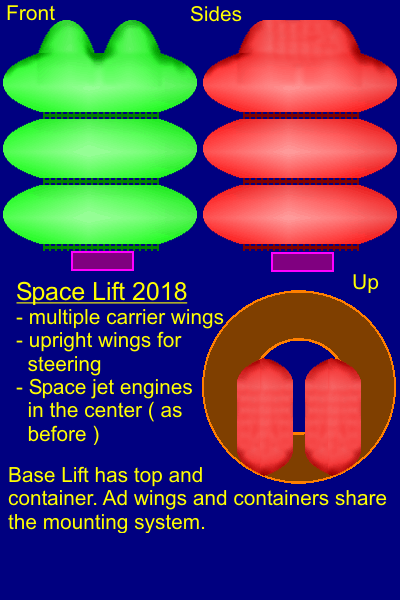
 Hot Layer research
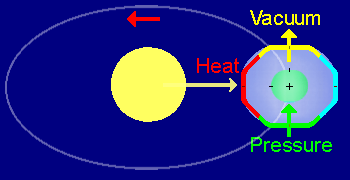
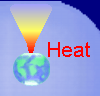 Reason why space air and upper atmosphere can have thin air and cold at the
same is in the lack of gravity. Gravity pushes air molecules closer to each
other all the time. The lack of push makes thin and cold air possible.
Reason why space air and upper atmosphere can have thin air and cold at the
same is in the lack of gravity. Gravity pushes air molecules closer to each
other all the time. The lack of push makes thin and cold air possible. Space Train-Locomotive