R&D Vehicles    Cars   Jets   Misc     FastPack   Fees   FuturePack   ATS   Jack Answers
Return R&D Vehicle - Shorts
( Jack : 2010 - 2017 )
<<   Shorts   >> .  
16th Jan 2020 - AC wiring and Skin revitalizer

AC wiring changes and simplifies cars-and-vehicles electric systems. You need power, control, feed back ground wires. With frequency range relays you can convert electric A-C signals into physical switches and other movements. All front lights and blinkers can be switched on-and-off with only one control wire. With one feedback wire, you get pulses to speed-o-meter, tachometer, fuel - cooling gauges and so on. Behind dashboard you have only few wires. 

In principle it is possible to strengthen vehicles body with skin revitalizer principle. Only required change is in grounding. During recharging the electric system must be detached from body. If you use body as ground, you must have easy-to-detach grounding points in body.

With mileage continuous bending loosens the atoms in the plates and beams. With steel-charger you can obviously feed great deal from the lost strength back to body.

In principle strength of plate has connection to electric conductivity. Cannot say which way it goes. With hi precision voltage-resitance meter, you can check the system. It is possible to build a the precision meter with revitalizers head. When you move the head on vehicles body, the electric conductivity system responses to the changes in strength.

Charger and Meter have lots of usage in all kinds of steel constructions.

Air conditioner's operating principle - 

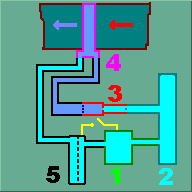
Diagram

1 Compressor
2. Condenser
3. Orifice / Expansion tube
4 Evaporator
5. Accumulator / Drier

Light = R134a gas.
Blue = R134a liquid

Yellow = Pressure cycling switch

On the left you see diagram from air conditioning system. Fridge operates with same principle.

1. The chain starts from compressor. Compressor sucks refrigerant  from the accumulator. Most of the refrigerant comes to compressor as gas. Compressor raises the pressure to around 3.5 bar or 50 PSI

2. With this pressure refrigerant goes to condenser. When refrigerant is high pressured gas, the warm air cools the hot refrigerant.  Condenser is usually placed right in front of the cooler. From the outside condenser and cooler looks the same.

3. From condenser cold refrigerant continues to oriface. It converts the gas to liquid and lowers the pressure. In orifice refrigerant 134a cools to around +6C or 40F. Oriface is a small, simple tube in the pipeline. Oriface stops the gas, with a small hole at the end of the tube.

4. From the oriface refrigerant goes to evaporator. In the evaporator the cold from R-134a is transferred to the warm outdoor air. Inside the evaporator the refrigerant flows in pipes, the air from the outside goes by ... from the outside. Evaporator looks like heater core. They are usually also placed into same place, behind the dashboard.

5. When warm air heats R-134a in the evaporator, it turns back into gas. This warm gas goes to accumulator / drier. The circle of the refrigerant ends here. 

In other words, in condenser you cool hot, high pressure refrigerant. In orifice you shift down the cooling to lower temperatures. In evaporator you unleash the cold into cabin. If accumulator is comparable to gas tank, compressor is the engine of the air conditioning system. Compressor warms and pressurizes the refrigerant. 

A capability to keep / remember changes in heat levels is very unique to refrigerants. Typical for air conditioning systems is that, when temperature raises, they start to lose their cooling capability.

- - - -

5e In the accumulator the pressure is around 1.5 bar or 20 PSI, slightly less than in tires. The accumulator always has a switch. This pressure cycling switch detects pressure inside the accumulator. The pressure cycling switch controls the compressor. It prevents overcooling of the air, and stops the compressor, when the pressure goes down. Before the pressure cycling switch [ in the same power line ] there is always a cut-off switch. With cut-off switch, you turn the air-conditioning on and off.

By default - without power - compressor always is and goes off-line.

A/C is closed system. A fully functional system does not run out of the refrigerant. If the system does not work properly, the change of the fluids hardly ever fixes the system. Usually some kind of repairs has to be done before changing the fluids. Many repairs need emptying of the system and new fluids after the work is done.

Leaks, faulty Pressure cycling switch, faulty clutch and faulty over pressure valve empties the system from refrigerant and oil. Clutch is always and over pressure valve is usually integrated to compressor unit.

? Text is based on Caprice's Service Manual and in-car examinations. Most diagrams from A/C system misses oriface / expansion tube. Theoretical part has something new.

14.7.2015 : Pressures were fixed from the conversion error. PSI was accidentally mixed with kPa and hastily converted to bars.

Saturday 11th July 2015

Thursday 2nd July 2015 : 21.30 GMT

Still studying Caprice's air conditioner. Air conditioning is new thing for me. When I was young, climate control was rare in Euro-cars, they were  small, cheap and ascetic. And I was more interest in performance, road and street racing ... Air conditioner consumes quite a lot of power, out of the question.

 I'm afraid that Caprice air-conditioning must be converted it into newer CFC free refrigerant. Refrigerant is a liquid, which performs the cooling. The conversion requires opening of the system, few new nozzles. Then you have to flush and wash the system. CFC consumes ozone. But after listening the stupidities those little, green and media sexy Martians have presented ... not forgetting how quiet they have been about the actual melting of the north ... I am not absolutely sure, if CFC can gain enough altitude for reaching the ozone layer in the atmosphere.

The new liquid is considerably poorer than the old CFC liquid. When fridges and air conditioners have unchanged cooling demands, the new liquid increases power consumption around 10 - 30 percent. Climate control in a car uses oil for the creation of coolness. If the ozone claims are not true, we are talking about stupid extremist jerks here ... and once again.


Chassis lights for park assistanceClick to view the full design

Before you can get full advantage from parking assistance you need lights in all around the car.

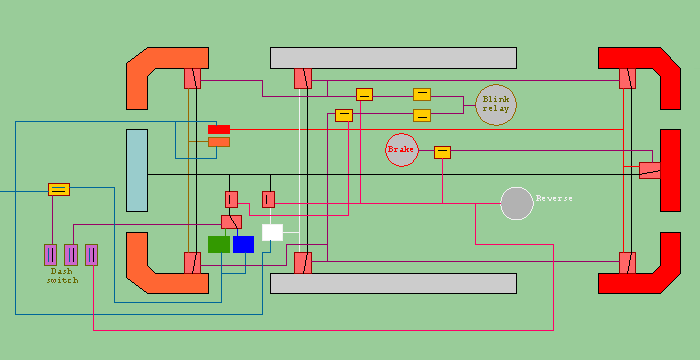
In picture you see RGB based chassis lights for Caprice. Or any car. All strips, except front strip have two light source wires. You switch the sources with 2 stage relays, which have 4 poles. You connect the strips to the relays so, that when relay is off-line, all strips takes power from main wiring ( black in the picture ). When you for example put right blinker on, you lead power from the blink relay to the right side relays. When you turn left you power the relays from left side. When you push the brakes, you activate the relay for the rear RGB strip.

There are boxes with what you can create permanent light sources for strips. Caprice has yellow blink lights in front and red in back. Then  the area / strips between wheels will have white blinks.

The main wiring can have three light sources, one random source, disco-lights and park / reverse lights. 

It is not in the picture, but reverse lights need an additional relay with what you cut power from all relays with what you control RGB strips. With this function you keep the lights white as long as park / reverse lights are on.

From shops you can find easily 4 pole relays, which have 2 stages. They cost app 5 euros / dollars. 4 pole relays with 3 or more stages are rare and around 10 times more expensive than 4P2T relays. It reason, why there are 3 relays in the main wiring. In the actual installation all relays are gathered into one box. And there are long wires from the relay box to the strips. Keeping the relays right beside the strips, made the picture and design work easier.

Added full design to the site, you check it by clicking power design. The system needs ten 4P2T relays, 6 single pole on-off relays ( SPST / 1P1T or SPDT / 1P2T ).  3 On-off switches to dashboard. 3 permanent light boxes, one music box and one random box. Then you need waterproof RGB Led strips,  4pin and 2 pin wire, electric connectors for Strips and boxes ... possibly transparent tube. Dashboard switches control relays, with small power, you can take power to them from any available 12V wire / connector. Don't remember prices, think that it goes somewhere near 100, without work. 

All relays must be 12V relays, otherwise they do not work in car. Voltage in relay refers to the current with what they work. Amps tell the maximum load you can switch or redirect with relay. With 12 Volt  5 Amp relay you can control 70 W led strip ( in car ).

- - - - -

Finished plans and purchases for the Caprice's main lightning system yesterday. Have been planning led strips to the bottom. RGB led strips can change the color on fly. Had a plan that the strips will be connected to brake, reverse and turn lights. So that when you brake, the rear lights will turn red, when you signal turns, lights will blink and change colors to white, yellow and red. When you reverse or activate parking system all strips are white. It would also be possible to create music driven disco lights from the RGB strips. Everything is possible, required parts exists, all you need is some money and time.

-----

I have continued with electric design for Caprice. Think that total price of the chassis lights falls below 100. RGB strips are bit tricky, the controllers with what you take advantage from variable are remote controlled, and the receivers are embedded into box. You must put the box somewhere where you can control the box. Light for example - including IR - never penetrates through metals and other solid materials. 

You can use the RGB strips also in home and garden. After you come back from restaurant, with a good looking chic. You put romantic music on, and change the lights into pink. And always remember to avoid too much red in the lights. Bright red refers to sex without emotional stuff. If your dame is not drunk enough, possible that she gets nervous and runs away ...  with a hurry.

Saturday 18th July 2015

Friday 31st July 2015 : 12.15 GMT

 + 12.15 GMT + +

Bought first led strips and controllers to Caprice today. According to written text 1 meter ( or 3 feet ) 3528 led strip produces as much light as traditional 21 W blink-brake-reverse bulb. With  more powerful  5050 strips you can reach 21W bulb lightning with 30 cm or 1 ft strip. Led strips spread light to only 120 degree sector. 

When you replace traditional bulbs with leds, you get the required led power by diving the bulb's power with 6. 

21Watts per 6 is 3.5 Watts. Bulbs in 1 meter 3528 strip consumes 5 Watts. 1 meter 5050 strip consumes 15 watts. Both strips must have 300 bulbs in technical data. There are also strips with 150 bulbs in tech data. 

If the numbers are right, in reverse / park mode 3528 leds produces lo-beam lighting to all around the car.