October 26th 2018


| R&D Vehicles | Fric Full Copter Star G-GPS Combustor Ethene Liquid | Cars Jets Fast Fees Futu ATS | Jack Answers |
|
Friction October 26th 2018 |
|
| Tights | . |
Better precision to gravitational friction force ( not yet finished )
Gravitational friction forces are calculated with old formulas. But with bigger precision
When I developed formulas for ATS roulette and car simulation, the current friction force system couldn't provide proper results for the 2D game.
Friction for car comes from the tires. The first thing is to divide cars mass to wheels. Calculation is based on weight center. You divide the mass to wheels with momentum from wheel to weight center. Just like you do in strength calculations. Cars longitudinal and lateral tilt must be included to calculation. Direction from wheel to weight center allows the division to boxes.
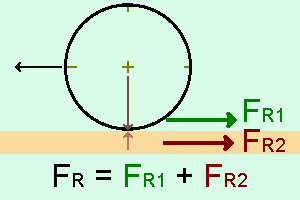
When object moves on surface, there are four primary types of forces, which resists the movement. First two forces comes from the raw friction. The wheel and road has unique friction factors. Friction factor comes from smoothness / roughness of surface : Polished, varnished wood has totally different friction than varnished, untreated wooden plank. Material is insignificant. Polished, varnished wood is as shiny and slippery as polished rock.
The second friction force set comes from the softness of object and surface. When object is soft, the area with what the object touches the surface increases. When the surface is too soft, the object falls into surface. The effect of the fall is dependent on objects shape. Fall of rectangular object resists the move. Fall of round object increases the friction force. Fall of rolling round object increases the touchdown area, then it resists the move with the depth of created pit.
The theoretical base for the system is, that ice is always slippery. It does not matter what kind of object there on the ice. So it is possible to define nominal friction factors for various materials. Calculate separate friction forces for both object and surface. Sum them together for getting the total force. Force, which is currently calculated with paired friction factor tables.
When you use nominal friction factors for roughness/ softness, you can build general friction systems. You do not build ready made tables for object surface pairs. You create tables, where surfaces and objects have roughness- softness factors for calculating friction forces. With tables you can calculate areas for touch.
With additional factors you can get more detailed / accurate calculations.
Softness
Softness is conditional factor, it needs a pressure-force system for the beginning and breaking. If object or surface are strong enough to carry the load from object, there aren't any magical, miniature deformations. Nothing ever happens. Some materials gets polished by wear, some gets rougher by wear. Immediate effect is typical for polishing, etc. tools. The effect of these goes to upper atom layers, they are insignificant for rough force calculations.
When pressure from the object is smaller than F1, softness force is zero. When pressure from object is bigger than F2 the underlying object cracks. There are objects, which never bends, there are objects-surfaces, which never cracks. F1 and F2 requires indicator for the mentioned impossibilities.
|
|
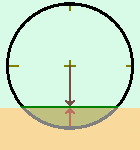
Case 1 : Object reacts, surface stable
In this case the force from object is big enough to shrink / flatten the object, but it is not big enough for surface. Flat doesn't change length of circle ( much ). There fore there
are two types of flattening. With one look to cars tire, you can verify that flattening takes place in all directions. So you need X-Y factors or graph for softness. |
|
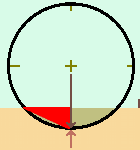
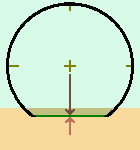
Case 2 : Object stable, surface reacts
In this case the force from object is big enough to dig a pit to surface, but it is not big enough for object. When moving object falls into pit, it has climb up from it. Use red force
triangle for getting which is used climbing. The touch area is the bottom of rectangle or area of touching circle / ball. |
|
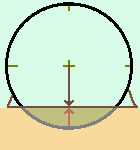
Case 3 : Object reacts, surface reacts
In this case the force from object is big enough to flatten the object and digging a pit to surface. In simple system you use Cases 1 and 2 for calculating the
forces. |
Static friction
In principle object-surface does not have static and dynamic frictions. When you think it, it looks like that static friction is air resistance force. When so it is dependent on objects size and surrounding gas / liquid. You can check how it is, with tests.
Wet / lubrication factors
In lubricated object-surface system the friction grows to the full effect. Friction begins with dry surface factor it ends to lubricants factor.
On paved road it is easy to notice how the friction vanishes with thickness of ice layer. In the beginning ice keeps the roads roughness, when layer grows thicker the roughness vanishes, it is more and more difficult to keep the car on the road.
In here partial ice cover on paved road is called black ice. It is invisible to eye, but it is not usually as slippery as visible ice. After certain weather system black ice covers all roads.
Water, snow and ice has many forms.
- ice, water on ice, snow on ice, etc
- soft ice, water on soft ice, snow on soft ice, soft ice over ice, etc
- snow, water-ice on snow, ice on snow, frozen snow
- water, puddles, streams and lakes.All possible forms exits in the nature. During spring time, when sun melts the snow and cold night freezes the melted snow, all forms are possible. During spring, all variations exist in wider scale.
Frozen snow is born, when temperature raises over zero. The topmost snow layer melts. When temperature falls below 0, the snow freezes. You can even drive car over the strongest frozen snow layers. Snow carries load like ice, but it looks like snow. Ice on snow creates thin, hard, mirroring cover over snow. Frozen snow is thicker and it misses the mirror effect. When go and play over frozen ice, there are usually undetectable places with common snow layer. You cannot see the snow pits.
Lateral factor (curve)
Tire belongs to objects, which have different xy friction factors. It needs longitudinal and lateral frictions. In order to draw arc-ellipse for the factor, you need elliptical line, with predefined cross point. With elliptical line and angle you can get correct friction factors and forces.
Shift factors (curve)
Tire which has air space needs another elliptical line for defining the longitudinal and lateral movements movements with various pressures.
Rubble factors and forces
Sand road is an example from the surface, with has loose particles, which starts to roll under wheel when you drive too fast.
Bounce factors and forces
Fully defined softness needs also bouncing factor. With bounce factor you calculate collision speeds and recovery times for bounce. When you throw soft ball towards hard wall, the ball shrinks. Then it bounces back with a force, it gets from the bounce.