October 6th 2019


| R&D Vehicles | Fric Full Copter Star G-GPS Combustor Ethene Liquid | Cars Jets Fast Fees Futu ATS | Jack Answers |
| |
Combustion Collector October 6th 2019 |
|
| Tights | Combustion Collector + machine powered tubes for ground vehicles. |
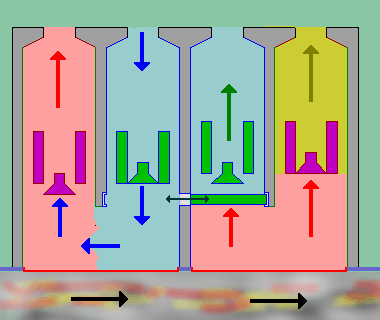
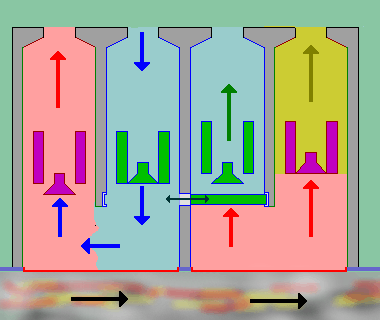 Combustion collector has 3 strokes. Straight forwarded system has to embed the 3rd stroke into 2 stroke system. In the picture 3rd stroke handler is the plate, which moves in between two operational unit. Rolling collector can handle 3 stroke system without additional arrangements.
Air and water has alternative tables for heat conductivity. In these tables air conducts around 10 W/m and water 500 to 6000 W/m. Heating column was corrected from detected fault in the usage of electricity. kJ values were divided with 3600 seconds. Not known how truthful conductivity values are. Conductivity would need forwarding speeds, for temperatures and amounts of transferred heat ( temperature differences ) - - - - Cast iron needs around 0.139 J for 1C hike per kg. Aluminum needs 0.083 J and copper 0.106 J for the same hike. Cast iron is not very efficient heat conductor. Aluminum is almost as good conductor as copper. You can calculate the mass of iron and aluminum in between the rods and cylinder. - - - - Heat energy contents is always calculated with relative values. The energy comes from the change to the randomly selected zero point. The energy contents is calculated with heating factor. Heat losses come from the radiated heat, the object spreads to surroundings. Radiated heat downgrades object's energy contents and increases surrounding content. The loss should be related to objects and surroundings heat conductivity. There is a maximum speed, object can transfer heat from the center to sides. Then there is a speed, with what the surroundings can suck the heat to itself. - - - - Humidity's - microscopic water drops - meaning to climate shows also
in the table. Water can absorb lots of heat. Combustion collector reduces the manmade heat load to the climate. It drops traffic's oil consumption quite a lot. |
This page was upgraded on 25th February 2020. The air was replaced with water and liquid-gas conversion. With water conversion you can get as much pressure as you wish. Copper rod system got better design.
Link for old page >>
With combustion collector you can collect wasted heat from combustion engine.
Collector operates with a fact, that when you need 1 J for raising water's temperature with 1C, lowering the temperature with 1C must release 1 J energy charge.
Temperature is a quality or property of an atom, compound and material. Temperature moves with the object. When so, the temperature and heat energy must be stored into object.
Since temperature is quality, temperatures always blends with each other. When ends of object are loaded with two different temperatures, they both moves in the object, and creates a singular temperature.
When two ends have continuous temperature difference, the object creates a heat system, where the mid point has the average from the ends and their heat sources. When there is a temperature difference, material conducts heat almost in the same way metals conduct electricity. Good heat conducting capability is not heavily dominated by metals as electricity. Heat doesn't move as quickly as electricity.
Heat transfers have two major things. There is a speed, with what material moves the heat. There aren't researched tables for this parameter. The material's heat transfer capacity comes from the heat energy contents. Heat energy contents is the amount heat energy 1 kg block has per 1C temperature change.
Due to blending, the temperature cannot raise above the highest input temperature. When so, engine whose mountings, lubrication and gaskets can stand 700C temperature, doesn't necessarily need cooling. Engine without cooling creates cooling system with the air in the engine room. Liquid fuel engine with water booster needs cooling and isolation to pipes, with what you lead air, liquid fuel and water into engine. In common un-cooled engine the fuel-air mixture fires on it's own. You have difficulties with compression stroke and produced heat-expansion based pressures. Liquid fuel engine's real-time vaporizing is free from these cons.
Peltier plate creates a system, which has cold and hot sides. It simulates continuous heat sources at the ends, with electric current. The electric current, it uses for unbalancing the temperature system, raises the mid-point / average temperature. The plates are used in small cold boxes.
In principle, you should be capable of creating electricity from heat with peltier plate / process. When you charge hot-side with heat or cold side with cold, the process should create electricity. Efficiency rate is not known. Reversed system, with sufficient efficiency, would have lots of usage. You could for example use the process for collecting wasted heat from engines.
Collector is an application from steamer
Collector uses heat for vaporizing liquid water into gas. This conversion makes the collector small. Vaporizing allows you to use big pressures in the system. With heat expansion, the maximum compression ratio was 1/2, maximum compression with vaporizer is 1 / 200.
Fully utilized collector uses copper rods. Rods lead the heat into collector. In collector you use isolated rods. Isolated rods have singular temperature system. When cylinder pushes 500 C to rod, combustion collector pushes 100 to 300 C temperatures into rod. When so the rods temperature varies from 300 - 400C.
With this temperature rod creates cooling system for the block. This temperature system has 300-400C at the rod, 500C at the cylinder wall. The average temperature varies in 400-450 C range.
The water space has exchange system, you cool the copper rods with collector. You lead cold water into one combustion chamber. Then you wait until the water vaporizes and piston raises. After piston have reached the top, you open the chamber. Let the warm water vapor go out and take cooler water into the chamber. After combustion chamber, you lower the pressure. The lowering liquidizes water vapors. If not, you have to use air cooling for lowering the temperatures in water tank.
With piston crankshaft system, you get kinetic energy from pressure system.
Collector is very quiet, much like steam engine. Collector misses explosion like fire, which creates noise in combustion engines. You can use steam locomotives double direction cylinders in the collector. Steam locomotive's cylinder is pushed all the time, from both directions.
Water cooling with collector
Since you use water and around 100 C temperatures, you might want to keep the old water cooling system. Cooling system is pressurized. When so, you can vaporize water by dropping the pressure and lower water's boiling point.
When you vaporize water, the pressure-boiling point system grows and you have to bring more heat to the combustion chamber. You can do that with hot copper rods.
After combustion collector you lower the pressure and lead the steam-water into radiator. Finalize the cooling and liquefaction.
In theory you can synchronize collector so, that you could use shared crank axle. In practice sync is so difficult, that you need separate axle and power transmission system for collector.
Vaporizing water
When you vaporize water, the volume grows from 1 to 1667. When you have one liter water and you vaporize it in 100 liter chamber, the vapors initial pressure is 16.67 bars. When you extend the volume with pressure to 200 liters the pressure after push is halves to 8.3 bars. For pressure force you need 1m2 logical piston.
With this 1m2 piston 0.1 m3 volume has 0.1 meter depth and 200 liter volume 0.2 meter depth. The force is 16.67 bar * 1 m2 * 9.81 m/s2 * 105 = 16 353 270 N/m2, the final and output forces are both 8 176 635 N/m2.
The actual force and volumes come from the imported heat. One liter water needs 1.16 N for one degree hike in temperature. When you raise the pressure, you must import enough heat for keeping the temperature above raising boiling point.
The maximum pressure comes from water's boiling point, and the temperature, with what you can warm the water.
At 16 bars pressure water vaporizes at 200C. 40 bar pressure needs 250C. In combustion collector maximum pressure is around 100 bar and 310 C boiling point. Engine's water booster can achieve 200 bar pressures with 360 C boiling point.
Copper cooling
Copper is efficient heat conductor. Known losses from copper conducted cooling system in laptop computers are known to be small.
When you replace the water channels in the block with copper rods, you can increase and adjust the block's temperature freely. It is not very difficult to improve head caskets capability to handle higher temperatures. You can measure the temperatures at cylinder walls and keep them at 300-400 C. The collector's operating temperature rolls around 100C.
Copper rod cooling goes so, that when you have 500 C at other end, 100 C at the other end, the temperature in the cooler rod tries to balance into 300 C. Without combustion collector, you have dry copper cooler system at the cold and cooling end.
When you design rods, you must remember, that copper sucks heat on it's way to end. In principle you make the rods so, that they come out from the block into colder air. As soon as possible.
With aluminum's, iron cast's and copper's heat conductivity factors you can calculate estimations for cooling. Unit of heat conductivity is W/m. The speed of flow is 1 m/s.
There aren't tables for the different directions. Heat and cold forwards differently in sideways, up and down. Cold goes fastest downwards, heat upwards.
Calculating thermal conductivity
Heat conductivity is amount of heat energy, that goes through 1m2 x 1m thick wall in one second. When difference in temperatures is 1C.
In cooling and heating you would need time it takes for 1C temperature change to go through 1 meter long copper wire.
The area says how much heat you can transfer with T1 and T2 temperatures.The hot head of the rod must be big enough for storing the heat. If block produces 10 J heat in one second, the hot heads volume must be big enough for storing the heat.
The rod's cross section area must be big enough for transferring enough heat energy in one second.
When you know speed for transfer, the transfer volume for one second is speed * area.Copper moves heat with around 0.43 m/s speed. With this, logical volume for copper is area * 0.43.
With 1 m2 area for the rod, the logical block weighs 3 780 kg.The 0.43 m/s speed estimation : One cubic meter copper block has 932 J energy charge. Copper transfers 399 Joules in one second. When so, after second copper has moved 399 / 932 = 43 % from heat to one meter distance. Full transfer needs 2.3 seconds. After 1 second fully heated area has forwarded 0.43 meters. Up to turbulence point, the speed should be stable. So that 100C change comes through almost as quickly as 10C change. Just like it happens with electricity.
In block, hot head's temperature is 500 C. Cool head is held at 100 C. When heads' weighs are the same, the temperature in the middle of the rod must be 300 C. Without continuous feed the copper system's temperature balances into 300 C. With continuous feed both ends keeps their temperatures. You should be capable of shifting the mid point with weighs of hot and cool heads. Typically mid point moves towards lighter head.
In order to cool the block, you need heat isolated rod, whose cool head has steady 100C temperature. After the heat isolation ends, the rod starts to mix cold with hot. The 300 C mid point is in the block. Typically the mid point goes into block without heat isolation. Heat isolation is needed for cooling hot points inside the cooled material. Isolation prevents colder hot areas, from warming the rod.
The combustion collector needs another rod, which brings 500 C out from the block. The collectors mid point is near the chamber and no where near the block and cylinder walls.
Example
When you search temperatures, you play with relative unit-free values. Eventually you move the relative results into temperatures.
Let's say that you have 0.5 cm wall in between cylinder and hot head. The cylinder wall has steady 500C temperature.
Stroke length is 6.0 cm, piston's diameter is 8.0 cm. The block's area in between hot heads and cylinder is 28.26 cm2. Volume is 169.560 cm3.
Iron's density is 7.25 grams / cm3. The weigh of iron is 1.234 kg.
One cubic meter cast iron has 7250 kg * 0.138.9 = 1007 J. Speed is 40 / 1007 = 0.04 m/s.
In order to be capable of storing heat from iron, copper head must weight 1.234 kg * 1007 / 932 = 1.333 kg.When coppers nominal heat energy contents is 942.61 J / kg, the heat current from cool head is 3780 J
When iron's nominal heat energy contents is 1006.94 J / kg, the heat current from block is 280 J.
The ratio in between block and cool goes so, that cool head's share from heat at hot head is 93%.
This ends into 128.32 C temperature at hot head.When air's nominal heat energy contents is 0.35 J / kg, with 0.07 m/s speed the heat current from cylinder is 0.09 J.
But this is not true. At 500 C air's density is 0.4567 kg / m3, heat conductivity is 0.056 W/m.
With these nominal heat energy contents is 0.13 J / kg, with 0.44 m/s speed the heat current from cylinder is 0.20 J.With irons 288 J current, hot head brings 99.93% from heat into cylinder wall and the temperature is 128.58 C.
Heat transmission
In heat transmission you calculate actual heat energy currents, the heat sources produces.
Then you calculate volumes, which are needed for transmitting the heat.In heat transmission T1 and T2 difference dictates the area for required rod-wire.
When you have 50 C temperature at hot head and 20 C at cool head, the maximum transfer capacity comes from 30 C energy contents.
1 kg copper stores 0.1 J heat energy per 1C. With 30C difference you get into 3 J / kg.
The length of logical volume is copper's speed, which is 43 cm / secondWhen you have 2 000 kWh air conditioner, the conditioner produces 0.56 Joules in one second.
With 3 J/kg this 0.56 Joules need 185 g copper. The required volume comes with coppers density, which is 8.93 g / cm3.
You need 21 cm3 copper. When length is 43 cm, the area is 0.48 cm2
Required diameter for round copper wire is 2 x 0.39 cm = 8 mm.You have cylinder with 500C, walls with 129 C. Speed for logical volume is 0.44 m/s.
When pistons diameter is 8 cm, wall area is 2*3,14*0.04*0.06= 0.015072 m2.
Logical volume is 0.06632 m3, which weighs 30.3 g.When difference in temperatures is 371 C, one kg energy load for wall is 0.2778 * 371 = 103.06 J / second.
When we skip over cast iron block, the copper cooler has 371 C difference and 37 J / kg for cooling.
103.06 Joules need 2 786 g and 311.93 cm3 copper. With 43cm length area is 7.25 cm2. As singular rod, this area converts in 3 cm rod.
When cylinder is surrounded with copper at 10.5 cm inner diameter, thickness of the plate 4 mm.Copper rod plates in block are slightly smaller the water holes. Water holes at the sides are around 1 cm.
Copper rods and plates can be placed freely. Copper rod cooling can be used in for example computer's CPU.
In principle you can use electric wire's for copper cooling and heating.Additional table for air at various temperatures
Temp Density Conductivity Temp Density Conductivity Temp Density Conductivity C kg/m3 W/m C kg/m3 W/m C kg/m3 W/m -190 7,82 15 1,2250 25,50 200 0,7451 38,25 -150 11,69 20 1,2040 25,87 225 0,7078 39,83 -100 16,20 25 1,1840 26,24 300 0,6168 44,41 -75 1,7830 18,34 30 1,1640 26,62 412 0,5238 50,92 -50 1,5820 20,41 40 1,1270 27,35 500 0,4567 55,79 -25 1,4220 22,41 50 1,0930 28,08 600 0,4043 61,14 -15 1,3670 23,20 60 1,0600 28,80 700 0,3626 66,32 -10 1,3410 23,59 80 1,0000 30,23 800 0,3289 71,35 -5 1,3160 23,97 100 0,9467 31,62 900 0,3009 76,26 0 1,2920 24,36 125 0,8868 33,33 1000 0,2773 81,08 5 1,2680 24,74 150 0,8338 35,00 1100 0,2571 85,83 10 1,2460 25,12 175 0,7868 36,64 Pressure increases density and conductivity. When pressure remains below 50 bars, effect to conductivity is small.
Mysterious table for air and water
Heating Density Energy Conductivity Speed Heat current kJ/kg J/kg kg/m3 J/m3 W/m2 m/s Q/s Air 1000 3600 0,2778 1,26 0,350 8,000 22,857143 28,8000 Air, down 1000 3600 0,2778 1,26 0,350 6,000 17,142857 21,6000 Water 4180 3600 1,1611 1 000,00 1 161,111 1 000,000 0,861244 861,2440 This table is explained as combined radiation and conductivity table. W/m2 is exactly the same than W/m.
These values are for "standing" air and water. First there is correction columns. Heat current = speed * energy.
Table hints that heat moves downwards 25% slower than upwards.
Heating Density Energy Conductivity Speed Heat current kJ/kg J-1C/kg kg/m3 J/m3 W/m2 m/s Q/s Air 1000 3600 0,2778 1,26 0,350 0,026 0,074286 0,0936 Water 4180 3600 1,1611 1 000,00 1 161,111 0,596 0,000513 0,5133 In this table you see values with given W/m conductivity.
Air and water are poor heat conductors. They carry heat, when they move. You need air and water pumps for moving heat.
Calculations
Firing stroke is the only one, that increases the heat in the block. In principle block's temperature is match is match to fire's temperature. The temperature falls with earlier continuous mid point principle.
Every horsepower you get with add-on collector and collector that doesn't disturb gas exchange is gained horsepower.
Interference to gas exchange can lead to gains and losses, both.
- It is always very easy to ruin and damage the vacuum system, that empties the cylinders.Water cooling cools the block with rod like system. In water cooling you bring 90C water into block. Then you warm it, and take it away.
- - - -
In exhaust manifold, you can place the copper-made heat transfer system in to pipe. You get almost directly into collector.
You can use small copper pipe system in the exhaust pipe for collecting the heat. Pipe system needs electric turbo, with what you create vacuum into head and it's exhaust channels.When volume of water is one, volume of the vaporized water is 1 667. It means, that max compression ratio for freely aspirated collector is around 1667 / 1. No matter how much pressure you use in collector, it is always quiet. The engine noise comes from explosion like firings in the cylinder.
Due to heat conductivity chambers should be wide and low. You bring the heat into chamber with external copper heads.
Wide-low chamber allows you to use bigger area for copper and heating the air, too.
Piston-rod system for exhaust pipe
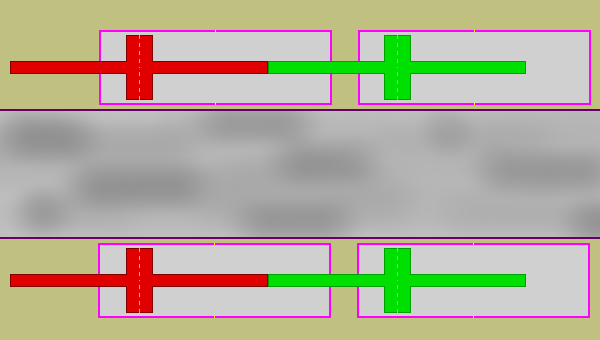
With picture like continuous piston-rod system you can collect heat from exhaust pipes.
System suits to motorcycles, tractors and others with external pipe. System silences the sounds.
Sound of the exhaust pipe comes from pressure peaks, which are born when you open outlet valve.Combustion collector is 3 stroke system.
- Suck cool water into cylinder
- Warm and vaporize the cool water.
- Push the warmed and vaporized water out from the cylinder.
- Move the water vapors into cooler tank.There are various ways to build 3 stroke system.
The best system is dependent on the way, you build copper collector system for cylinders.You should never compress the water with pistons. It always results into poorer collection efficiency.
Charged system should create vacuums and cold into cylinders.
It is possible to rotate an axle along side the exhaust pipe. Rotated axle needs push plates.
- Push plates are dragged away, when the piston plate comes.
- Without body-mounted push plates the rotator system is inefficient.
- With push plates, you can construct 3 stroke system into each cylinder.
- With 3 piston plates, you get 3 compartments to cylinder.
- You don't have to use the whole round or ring for running the system.Pressures in combustion collector are rather low, sealing is not a big problem.
Shared combustion chamber is possible. Don't know how good it is.
- Just like gravitational machine, combustion collector is brand new machine.
- Low compression ratio can cause some problems.Besides vehicles, collector suits to power plants, chimney's and others.
Rolling Block's operating principle.
Diagram for double chamber roller block. In the diagram piston has incorrect tilt.
Tilted piston should have reversed angle. So that the tilt increases roll-power.
Diagram shows how freely you can set the areas for sealing.
Goal is to develop chamber-piston-piston ring system which doesn't need lubrication.
Before that you can lubricate walls and rings via piston. Also possible to build static lubrication system to block.
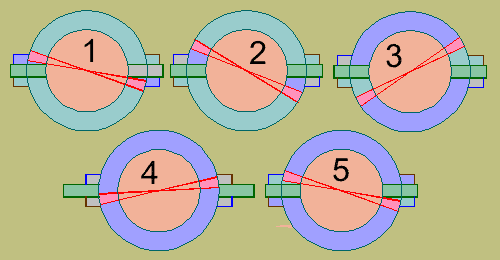
You can burn the used oil in ethane remover. It is mandatory in exhaust system.First you fill the chambers with water and keep the inlet valves open.
Then you close the inlet valves and start to vaporize water.
In picture 4 you are finished with pressure-vapor creation. You open the bypass port.In picture 5 pistons have passed bypass ports, you can close them.
Picture 5 begins second vapor-pressure creation system.
With the pressure, you get from 2nd system, you remove vapors from 1st system.- - - -
Power production begins from picture 2 and ends to picture 4.
For filling and passing system needs, like for example another rolling system.
Number of combustion chambers is insignificant for the engine.
You cannot easily avoid the power break in one unit engine.Both inlet valve and bypass port can be operated with mechanical camshafts.
It is possible to build a bypass port, whose leaks are marginal levels.
You shape the bypass port's outlet side so, that outlet hole is the last closed thing.
Then you let the piston touch gently the bypass port.In rolling engine, you use fire for creating the pressure system.
Easy compression before fire comes with external charger.
With liquid fuel and water booster you don't need pre-compression.When used as turbine, you can drop the inlet valves.
In turbine, you obviously get the best results with one chamber and one bypass port system.
Rotating system
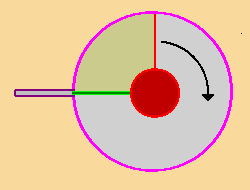
In this picture you see one way to build rotating system.
In the upper picture you perform both suck and push strokes for the cylinder. You use the other piston system for powering the suck-push stroke.
In the lower picture you continue push of the hot vapors, but you close the inlet valve and start to warm the cold water.
Picture misses lower cylinder and second piston plate.
Push plates must be dragged to their holes, for the time piston plates passes the push plates.
Outlet hole can be open all the time.
Possible that power creation needs three cylinders per roller unit. Power creation reduces the size of the expansion volume. Drop from 2.3 to 2.0 is not necessarily enough. Also possible to close the inlet valve open after the mid point. Not at the mid-point like in the picture.
Sealing of the plates is nothing like wankel, you can use as thick plates as needed.
System's efficiency is about the same than 4-strokers. Better than gas turbines and 2-strokers.
System suits also for converting gas or liquid flow into rotation.In principle you should build at least two rollers per unit. When another fills the cylinder, another expands.
If you create electricity with the system, you might want to build small generators to each unit.You can use pressure sensors for adjusting the inlet valve. Balancing a set of units, with variable heat load and power production capability.
System starts the warming and heat-transfer right after you open the inlet valve.
With plates height and rollers effective diameter, you can adjust the constructional speed.
System is one of the best ways to build a collector.
Tube-Rod system can be made with the same principle. Tube needs inlet and outlet valves at the both ends of the tube. But it doesn't need movable push plates. You need also at least 2 tubes per unit.
Copper's heat expansion factor is 16.8, cast iron's is 11.8 and aluminum's 23.8. In cast iron copper rods need solution and space for expansion. In aluminum rods to be pushed toward warmer side. When compared to solids, liquids and gases are typically very poor heat conductors. Best would be, if you had two rods and copper compounds, one for cast iron and another for aluminum.
It is possible to lead hot outlet air ( hot air in general ) to a separate copper exchanger-roller system. Lead the hot air to copper exchanger from the outside. Cool down the outer hot air with cool inner air.
Collector is environmentally safe. It only warms the enclosed water system only.
The new water collector is small. Operating principle is near combustion engine.
Collector powers
In collector you can get around 400C from block and exhaust system. Water is around 100C. Mid point temperature is 250 C.
From 4 cylinder block, you might get 40 kW heating power for 400 C temperature. With 40 000 Watts you can warm around 1 liter water from 100C to 200C.
From exhaust manifold you might get another 40kW.
After you empty the chamber, the pressure and water's boiling point falls. The outlet misses the energy you captured with combustion collector.
The bottom plate collector for exhaust system can be used for improving the strength of passenger compartment. The collector is full of small hollow beam structures. Then the collector almost automatically improves bottom's aerodynamics. So you get quite a many good things from the increased weight.
Machine powered tubes
The collector can bring very efficient machine powered tubes into vehicles. These powered tubes work in ground vehicles and city speeds, too. These tubes respond to the speed.
In ships you get a machine powered tube system for reducing air resistance.
Copter car, copter, plane and air ship with combustion collector flies with almost nothing. In planes the inlets and outlets for the machine powered tubes can be placed freely.
Collector doesn't fit into jet. Jet needs warm air behind the engine. Warm air increases the volume and gives push plate for the engine. With new propels it is possible to replace part from the jets with propel-combustion engine systems. With new propel it should be possible to reach both flying altitudes and speeds of the current jet airliners. Last 4-engine propel cruisers flew with 600 km/h speed. Jet airliner flies with 800-900 km/h speed.
|
Tube system for cars and ground vehicles
8th October
|
|
Original idea for Combustion collector
|