October 6th 2019


| R&D Vehicles | Fric Full Copter Star G-GPS Combustor Liquid Ethene | Cars Jets Fast Fees Futu ATS | Jack Answers |
| |
Combustion Collector October 6th 2019 |
|
| Tights | Combustion Collector + machine powered tubes for ground vehicles. |
 Collector operates with a fact, that when you need 1 kJ for raising air's temperature with 1C, lowering the temperature with 1C must release 1 kJ energy charge. Temperature is a quality or property of an atom, compound and material. Temperature moves with the object. When so, the temperature and heat energy must be stored into object. Collector uses heat for increasing the pressure-volume system's energy. With piston crankshaft system, you get kinetic energy from pressure system. Collector is very quiet, much like steam engine. You can use steam locomotives double direction cylinders in the collector. Steam locomotive's cylinder is pushed all the time, from both directions. - - - - In the cylinder
From the table you can see, that copper is 4 000 times better heat conductor than water and 15 000 times better than air. Copper doesn't need pumping like water and air. Heat moves in copper faster than in pumped water. - - - - Cast iron needs around 0.45 KJ for 1C hike per kg. Aluminum needs 0.90 kJ and copper 0.38 kJ for the same hike. Cast iron is not very efficient heat conductor. Aluminum is almost as good conductor as copper. You can calculate the mass of iron and aluminum in between the rods and cylinder. - - - - Heat energy contents is always calculated with relative values. The energy contents is calculated with heating factor. Heat losses come from the radiated heat, the object spreads to surroundings. Radiated heat downgrades object's energy contents and increases surrounding content. The loss should be related to objects and surroundings heat conductivity. There is a maximum speed, object can transfer heat from the center to sides. Then there is a speed, with what the surroundings can suck the heat to itself. - - - - Humidity's - microscopic water drops - meaning to climate shows also
in the table. Water can absorb lots of heat. Combustion collector reduces the manmade heat load to the climate. It drops traffic's oil consumption quite a lot. |
With combustion collector you can collect wasted heat from combustion engine. Fully utilized collector cools the block with copper rods. Rods are lead into air space above or at the sides of the engine. The air space has gas exchange system, you cool the copper rods in air space. So, that you lead cold air into one combustion chamber. Then you wait until the pressure and piston raises. After piston have reached the top, you open the chamber. Let the warm air go out and take cool air into the chamber.
The old picture on the right shows one way to build the collector into exhaust manifold. Without copper rods.
Copper is the most efficient heat conductor of all. Known losses from copper conducted cooling system in laptop computers are known to be small.
When you replace the water channels in the block with copper rods, you can increase and adjust the block's temperature freely. It is not very difficult to improve head caskets capability to handle higher temperatures. You can measure the temperatures at cylinder walls and keep them at 300-400 C.
With aluminum's, iron cast's and copper's heat conductivity factors you can calculate estimations for cooling. Unit of heat conductivity is W/m. The speed of flow is 1 m/s.
There aren't tables for the different directions. Heat and cold forwards differently in sideways, up and down. Cold goes fastest downwards, heat upwards.
Calculations
Calculations begin from cylinder. You divide heat from firing to exhaust manifold and block.
Firing stroke is the only one, that increases the heat in the block. In principle you can use general table for calculating the heat, that goes to iron block and aluminum head. Table could be rpm-area based. Walls are hit by standard temperature, volume and diameter are insignificant.
In block you move the heat from cast iron and aluminum to copper system. From copper system you go to combustion collector's chamber. In principle, you can go from cylinder directly to chamber. Ignore the transfer system, replace it with general leak factor. Table could be length based. Loss per mm or something like that.
If you have difficulties with rods, you can make them hollow and lead cool air into them.
Water cooling cools the block with rod like bi-directional system. Long rods can produce some problems.- - - -
In exhaust manifold, you can place the copper-made heat transfer system in to pipe. You get almost directly into collector.
You can use small copper pipe system in the exhaust pipe for collecting the heat. Pipe system needs electric turbo, with what you create vacuum into head and it's exhaust channels.The volume of the uncompressed air doubles, when temperature raises from 20C to 400C.
It means, that max compression ratio for freely aspirated collector is around 2:1.Uncompressed volume is reversed from the density at certain temperature.
When density falls from 1.225 to 0.5238 volume grows from 1 m3 to 2.33 m3.Due to heat conductivity chambers should be wide and low.
Wide-low chamber allows you to use bigger area for copper and heating the air, too.At combustion chamber 1 kg air needs around 0.8 kJ for raising the temp with 1C.
Theoretical maximum power for the collector is enormous, it is over 2 times bigger than measured engine power.
Every horsepower you get with add-on collector and collector that doesn't disturb gas exchange is gained horsepower.
Interference to gas exchange can lead to gains and losses, both.
- It is always very easy to ruin and damage the vacuum system, that empties the cylinders.
Piston-rod system for exhaust pipe
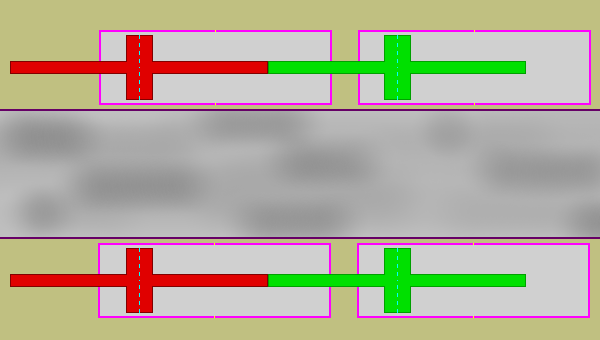
With picture like continuous piston-rod system you can collect heat from exhaust pipes.
System suits to motorcycles, tractors and others with external pipe. System silences the sounds.
Sound of the exhaust pipe comes from pressure peaks, which are born when you open outlet valve.Combustion collector is 3 stroke system.
- Suck cool air into cylinder
- Warm and expand the cool air.
- Push the warmed and expanded air out from the cylinder.There are various ways to build 3 stroke system.
The best system is dependent on the way, you build copper collector system for cylinders.You should never compress the air with pistons. It always results into poorer collection efficiency.
Charged system should create vacuums and cold into cylinders.
It is possible to rotate an axle along side the exhaust pipe. Rotated axle needs push plates.
- Push plates are dragged away, when the piston plate comes.
- Without body-mounted push plates the rotator system is inefficient.
- With push plates, you can construct 3 stroke system into each cylinder.
- With 3 piston plates, you get 3 compartments to cylinder.
- You don't have to use the whole round or ring for running the system.Pressures in combustion collector are rather low, sealing is not a big problem.
Shared combustion chamber is possible. Don't know how good it is.
- Just like gravitational machine, combustion collector is brand new machine.
- Low compression ratio can cause some problems.Besides vehicles, collector suits to power plants, chimney's and others.
Rotating system
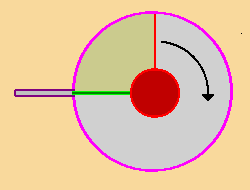
In this picture you see one way to build rotating system.
In the upper picture you perform both suck and push strokes for the cylinder.
In the lower picture you continue push of the hot air, but you close the inlet valve and start to warm the cold air.
Picture misses lower cylinder and second piston plate.
Push plates must be dragged to their holes, for the time piston plates passes the push plates.
Outlet hole is open all the time.
Possible that power creation needs three cylinders per roller unit. Power creation reduces the size of the expansion volume. Drop from 2.3 to 2.0 is not necessarily enough. Also possible to close the inlet valve open after the mid point. Not at the mid-point like in the picture.
Sealing of the plates is nothing like wankel, you can use as thick plates as needed.
System's efficiency is about the same than 4-strokers. Better than gas turbines and 2-strokers.
System suits also for converting gas or liquid flow into rotation.In principle you should build at least two rollers per unit. When another fills the cylinder, another expands.
If you create electricity with the system, you might want to build small generators to each unit.You can use pressure sensors for adjusting the inlet valve. Balancing a set of units, with variable heat load and power production capability.
System starts the warming and heat-transfer right after you open the inlet valve.
With plates height and rollers effective diameter, you can adjust the constructional speed.
System is one of the best ways to build a collector.
Tube-Rod system can be made with the same principle. Tube needs inlet and outlet valves at the both ends of the tube. But it doesn't need movable push plates. You need also at least 2 tubes per unit.
Copper's heat expansion factor is 16.8, cast iron's is 11.8 and aluminum's 23.8. In cast iron copper rods need solution and space for expansion. In aluminum rods to be pushed toward warmer side. When compared to solids, liquids and gases are typically very poor heat conductors. Best would be, if you had two rods and copper compounds, one for cast iron and another for aluminum.
It is possible to lead hot outlet air ( hot air in general ) to a separate copper exchanger-roller system. Lead the hot air to copper exchanger from the outside. Cool down the outer hot air with cool inner air.
Collector is environmentally safe. It only warms the used air. But it tends to burn the dirt, whose flashpoint is below operating temperature. Typical operating temperature is 300C - 400C.
Air spaces
The collector consumes quite a lot of air. One kiloWatt needs one cubic meter air per second. 200 kW collector power needs 200 cubic meters per second.
One round per second is 60 rpm. The rotating speed grows with engine's heat losses. If the idle rpm is 600, the required volume for the one kilo watt system is 0.1 m3 or 100 liters. If you have 1.5 x 2.0 meter area ( at the bottom plate ) for the collector, the height is 0.1 / ( 1.5 * 2.0 ) = 0.033 m or 3.3 cm.
Turbo rolls over 20 000 rpm speed. It is also the verified max rpm for the collector. In sample system the power at max rpm is around 34 kW or 50 hp.
In for example motorcycle you need high rpm system for saving the space. The rotating speed is dependent on the amount copper exchanger area at the cylinder and also the depth of cylinder. It is possible to use connected copper axles for improving the heat exchange.
Due to huge air consumption, collector can be used for cleaning city air. It is even more efficient air cleaner than properly filtered combustion engine.
The bottom plate collector can be used for improving the strength of passenger compartment. The collector is full of small hollow beam structures. Then the collector almost automatically improves bottom's aerodynamics. So you get quite a many good things from the increased weight.
Machine powered tubes
The collector brings very efficient machine powered tubes into vehicles. These powered tubes work in ground vehicles and city speeds, too. These tubes respond to the speed.
In ships you get a machine powered tube system for reducing air resistance.
Copter car, copter, plane and air ship with combustion collector flies with almost nothing. In planes the inlets and outlets for the machine powered tubes can be placed freely.
Collector doesn't fit into jet. Jet needs warm air behind the engine. Warm air increases the volume and gives push plate for the engine. With new propels it is possible to replace part from the jets with propel-combustion engine systems. With new propel it should be possible to reach both flying altitudes and speeds of the current jet airliners. Last 4-engine propel cruisers flew with 600 km/h speed. Jet airliner flies with 800-900 km/h speed.
|
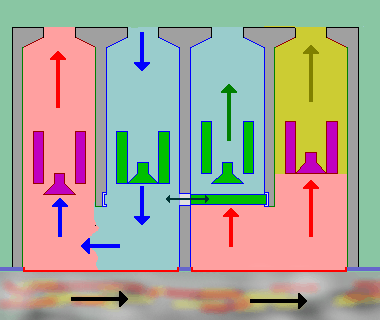
Tube system for cars and ground vehicles
8th October
|
|
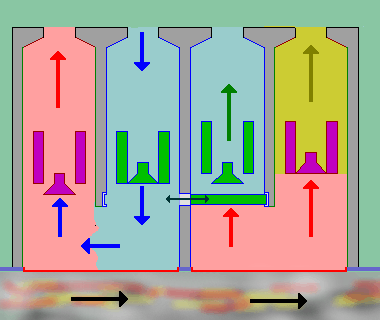
Combustion collector for exhaust gases
|