November 10th 2018


| R&D Jets | Jets Plane Lift Propels Hydro | Cars Misc Fast Fees Futu ATS | Jack Answers |
| |
Lift November 10th 2018 |
|
| Tights | How to calculate lift for gas / liquid. Wings operating principle |
Force for tube car lift - 28th March 2020
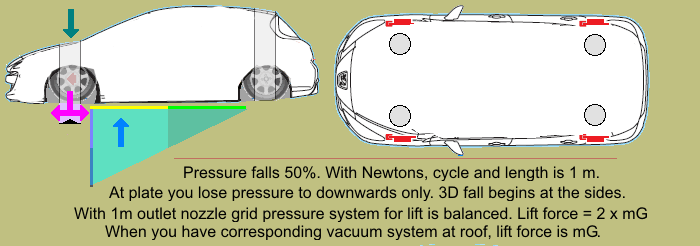
This force system is for floating object. Moving object gets 50% from the horizontal force to lift force. The creation of the lift needs that nozzles create 2 bar pressure flows, whose speed is 1 m/s. This is valid when tube's area is 1m2. When tube is smaller, you must increase compression-speed system accordingly.Nozzles must spread the pressure so, that at 0.5 meter distance plate pressure is 1.5 bars. When you have two 1 m3 cubes with 0.5 bar over pressure, and you combine the logical overpressures into 1 m3 volume, the pressures accumulates so, that resulting over pressure is 1 bar. This is what happens when the pressure flows from the nozzles collides.
IMMO . width 1.90 m weight 1 900 kg over pressure 0.93 bar height 4.90 m - G Force 18.939 N floor pressure 1.93 bar - area 9.31 m2 - G per sqm 2 503 N/m2 ve efficiency 0.80 Escape viscosity 50 % - logical area 7.45 m2 - fall force 9 320 N/s - required lift 1 251 N/m2 First you have lift pressure demand for IMMO in the air.
- the area is bottom area.
- vertical co-efficient adjusts the bottom area.
- weight and G force come from copter car's weightWithout escape, you would have to bring required over pressure under bottom only once.
Escape needs, that you refill the bottom with escaped air. All the time.
- required 20 kN lift force with 50% needs continuous 10 kN lift force creation.In tube car you create required over pressure with vertical tubes. During lift off you create required 20 kN base force for IMMO.
After that and with 50% escape, you got fill the 20 kN force system with 10 kN pressure flow.When you take air right above IMMO, and move it below the ruthlessly assassinated and molested corpse, the lift pressure demand halves to 5 kN.
But then you have to struggle with escape. Air escape increases demand for volume of the moved air back to 10 kN.
When ghost of late IMMO stands still in traffic lights, it needs 10 kW power ... for haunting it's assassinators.This force system is for floating object. Moving object gets 50% from the horizontal force to lift force.
The creation of the lift needs that nozzles create 2 bar pressure flows, whose speed is 1 m/s. This is valid, when tube's area is 1m2. When tube is smaller, you must increase compression-speed system accordingly. Nozzles must spread the pressure to 1x1 m grid so, that at 0.5 meter distance plate pressure is 1.5 bars. When you have two 1 m3 cubes with 0.5 bar over pressure, and you combine the logical overpressures into 1 m3 volume, the pressures accumulates so, that resulting over pressure is 1 bar. This is what happens when the pressure flows from the nozzles collides.
When you calculate lift forces for an object, with multiple vertical shapes, you can divide the object into pieces. Calculate supporting forces for each piece independently. Total lift is sum of independently calculated lift forces. Old fashioned round bodied plane has two very different lift force systems. Wings vertical efficiency factor is big and body's small.
Leverages and beverages for Boeing 767
Lotus - 123 .. Excel - XLS yve_lift_boeing767a.WK4 yve_lift_boeing767a.XLS Boeing 767 travels with 900 km/h speed. It carries 50 tons fuel and it's range is 7 200 km. With these it consumes around 7 kg fuel per kilometer. With 900 km/h speed one kilometer takes 4 seconds. When so, plane consumes 1.7 kg fuel per kilometer. If jets fuel efficiency is 20%, plane produces 14 000 kW power for one kilometer trip. With 50% escape the actual push power is 7 000 kW.
- 767 cruises at 12 km altitude. Air density at this altitude is 0.31. Pressure is 0.19 bars.
- 767 maximum weight is 141 tons. Plane's lift force update is steady 1 521 kN.
- Planes cross section area is around 25 m2, co-efficient factor could be 0.1. With these plane needs 6 000 kN for speed.
- From this resistance plane can get 3 000 kN for lift. Lift force filling can be ignored. It comes from air resistance.The produced and required powers are rather near each other. Close enough for this rough calculation.
Planes wing area is 275 m2. This area sets pressure for square meter. The required over-under pressure system at wing surfaces is 2.2 bars.
Engine's diameter is around 1 m. Plane has 2 engines, whose nominal thrust is 48 000 pounds. Engine's area is around 0.78 m2. 3 500 kW power creation with the engine results into 446 bar pressure system. 50-50 division to front and back results to 223 bar pressure at the outlet. Outlet pressure in current jet is dependent on turbines rotation speed. Plane's speed is insignificant. Plane's speed come from turbine's rotation and push.
In the sample calculation : Lift force is fully compensated by air resistance force after speed raises to above 450 mph or 720 km/h. At this speed power demand is 4 600 kW. In practice this means, that you must increase the planes air resistance with the height control wings at the end of main wings. With zero angle and designed air resistance plane falls slowly from sky. Flat floor spoilers at the bottom of the body has marginal meaning for horizontal air resistance. But the addition to lift force creation lowers the minimum zero angle speed. Spoilers lowers also take off speed. Flat floor body allows you to minimize horizontal air resistance, without losses in vertical resistance.
The sample calculation misses separate lift force calculation. Lift power comes from vertical wing area and pressure system on the wings.
Engines thrust in SI units is said to be 270 kN. 223 bar pressure converts onto 2 230 kN pressure system. One bar has 10 000 Newton. Shifting announced 270 kN to 2 700 kN makes some sense. Thrust is measured from the running engine's output push at sea levels. As you can see, 2 700 kN is actually 2 700 kW net power, you get from jet. It misses all losses. Including most from air escape.
Next generation jet with rolling engine can adjust turbine's rotating speed freely. Enhanced rolling engine for jet has flexible system for creating same power with various rotating speeds. And vice versa. Current jet and combustion engine suffers from almost steady power production. In order to adjust output power, you got to waste produced power or power production capacity to something or somewhere.
Rolling engine can have cylinders with multiple radiuses at same axle. Then you can variable push lengths in one cylinder. When you multiple firing cylinders the total power is sum of currently active cylinders. When you change filling ratio, the active power creation length varies accordingly. Then you can adjust produced powers with water boosters and combustion collectors. In rolling jet, you can adjust almost everything. Some adjustments come with theoretical fuel losses and some without any.
In rolling jet you have current thrust and compression. Then you have power, with what you create thrust. Engine-compressor have adjustable rpm system. When rolling engine or combustion engine is made with hydraulic valves, rpm range is practically free. Simpler spring based push-return system limits the maximum rpm.
New jet engine affects to amount of fuel you need for creating thrust. New aerodynamics affects to power, plane needs for flying with some speed and altitude. In this Boeing 767, rolling jet seems to drop fuel load to 5 tons per 7 500 km cruise at 900 km/h speed. Gain in fuel consumption raises maximum theoretical payload from 33 tons to 78 tons. In practice fuselage's strength limits the maximum payload. Wings of the plane loses over 20+20 tons from the load they must carry. In new design wings strength demands are 1/10th from current. Weight of wings falls with close connection to falling strength demand.
R&D fees for vehicles are 0.5% from production price.
Wings Lift force system - 10th November 2018
|
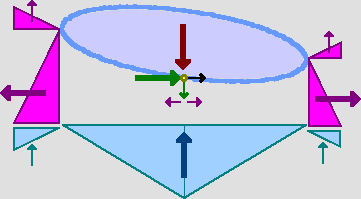
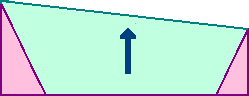
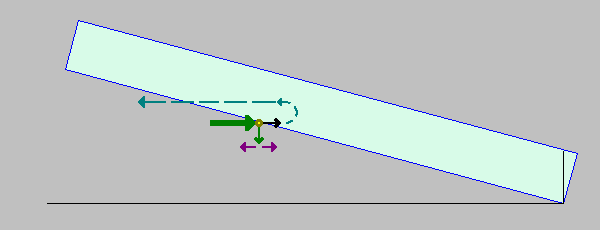
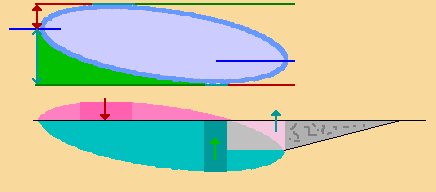
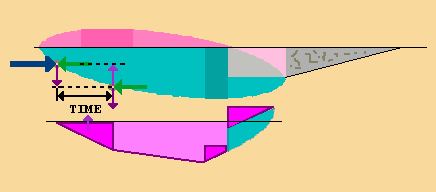
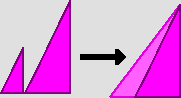
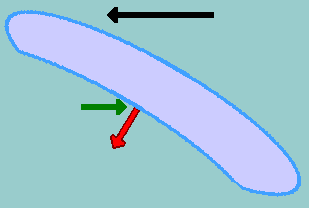
Viscosity in here is escape viscosity. It is typically around 50% from direct blow or push. Escape viscosity doesn't have researched tables ( March 2020 ). In air resistance formula escape viscosity is 50%. More detailed explanation is on hydrodynamics page. Singular leak The pressure which leaks over the wing has the same characteristics as the horizontal leak. You can always sum them with simple triangles or curves. The wing leaks also downwards. This downward leak enforces underlying air. So the total of the vertical leak is 0. You need the singular system with cars, boats and when you for example calculate take-off lift for aircraft. Bird wing Birds who are somewhat better than humans in flying, uses picture like shape in their wings. The lower rounding pushes the leak forwards. When birds flies, it leaks more air to the front than in back. In the next moment it captures the front leak back to it's wing lift. UNITS Units are actually nothing. Unit is generally accepted way to measure physical phenomena. The calculation always begins with measured values for the known phenomena. Weight, length, area and volume are the most common standardized phenomenas. In Paris, France they hold object of comparison for each measurable phenomena. There is an object, which weighs exactly one kilogram. Rod, whose length is exactly one meter and so on. Speed = m/s Pascal = N/m2 -> kgm/s2m2 -> kg/ms2
|