R&D Jets    Jets   Plane   Lift   Propels   Hydro   Cars   Misc     Fast   Fees   Futu   ATS   Jack Answers
Planes aerodynamics
16th October 2018
Tights .  

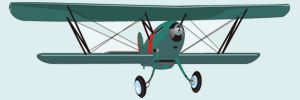
Old fashioned bi-plane with detached top wing
- - Bi-Plane - -

Plane's wing system has reasons. Big front wing makes flying easier. Main wing width and shape comes from the small adjustable flap wings in the back. With small rear wings, you keep the fuselage in horizontal position. With rear flaps, you also adjust the base angle of the main wings. With flaps you redirect flow. Flap wing with angle brakes either bottom or top flow, it creates over pressure under or over the wing. Angled flap wing creates always vacuum to back, the usage and pressure creation always slows down the plane, a little. Steep flap angle is used for braking the plane. Vertical tail wing does the same in sideways. Air after the wing does not have meaning for wing anymore.

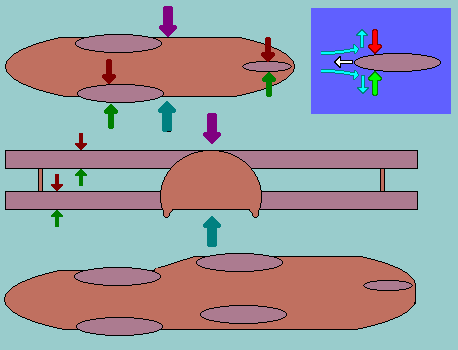
In the blue box you see how wing and body acts in the air. The action follows old Archimedes law for liquids. Plane takes it's volume from the air. Difference to liquid is that gas suspends, when object comes. This suspension effect creates the pressure system around the plane. The underlying overpressure system and over lying under pressure system keeps the plane in the air.
- The earlier power factor defines how well / long air keeps the pressure system for lift. When plane comes, the pressure system starts to leak, the underlying over pressure moves upwards and forms pressure system which pushes plane down.
- When wings purpose is to keep the plane in the air, you should round or shape wing so, that it leaks pressure from the below.
- the blue box system is true also for winds, and moving gases. When you fly or drive on-ground vehicle, most from air keeps it relative position. The movement of molecules comes from the suspension effect.
- when you look at the typical wing, it does not create major vacuums over the wing. Wing usually begins with low rounded angle. It tries to push the air over wing with marginal over pressure.
- Round upward front of the wing is needed for creating vacuum over the wing. Front spoiler captures part from the upper air and forces it to lower side. Front spoiler is one way to improve wings lift. Bi-plane can use a system which directs air towards the lowers of both wings.

Wing's lift can be improved with same tricks than jet's thrust. Ideal engine, which is mounted to wing, takes air from the above, and creates the thrust under the wing. Copter's rotor system, is near ideal. Rotor in wing could work better, if it had high rotation speed, low wing angle and it would be forced to suck part from inlet air from the sides with top shield.

In principle plane with four main wings is always lighter than with two wings. You can have one pair at the floor, another in roof. With four main wings you get as much length and power to flap wings, as with two wings. Four wing system makes it possible to build bigger commercial and military planes. Airstrips, fields and facilities for the planes limits the maximum widths of the planes. Strip length demand can be compensated with increased take off thrust.

You can connect the wings with upright tail and flap wings.  Biplane with strong tails near tips is quite a lot stronger than current wing system. You can get the required strength with lighter construction. With the system you can reduce length of wings, and overall weigh of main wing system. 

Aerodynamics of the hole in between the wings must be researched. In common airliner the height of hole is over 2 meters. Ideal hole sucks air from lower wing and boosts the top-wing pressure with sucked air. The front of lower wing directs incoming air towards top wing. After that wings convert the initial flow into a chain reaction, which continues to the end of the wings.

When you are in the air, the attachment point of the wing does not matter much. Gravitational drag makes the roof wing somewhat easier than floor wing. Roof wing creates lateral push which goes outwards, floor wing pushes inwards. To roof wing you can build underlying supports, for reducing the push and spreading the downward component to wider area.
? When plane has fuel tanks in wings, it need empty tanks / enormous lift pressure system, before the momentum force-system, with what you load body turns it's direction. And starts to favor lower wing.

When you increase the wing area, the thrust which is needed for keeping the plane in the air shrinks. The power / fuel you need for keeping the plane in air and maintaining 900 km/h cruise speed, is smaller.

In old bi-plane the upper wing was mounted to lower wing. Not to the body. 

There is minimum height distance, which is needed in between wings. You can calculate it with later viscosity - wing calculation system. When playing with gases, the required distance is not necessarily very big. With non parallel double wing system you adjust and manipulate the pressure-air system, which goes to lower wing's pressure system. In old bi-plane upper wing was often in front of the lower wing.

- - Flat floor body - -


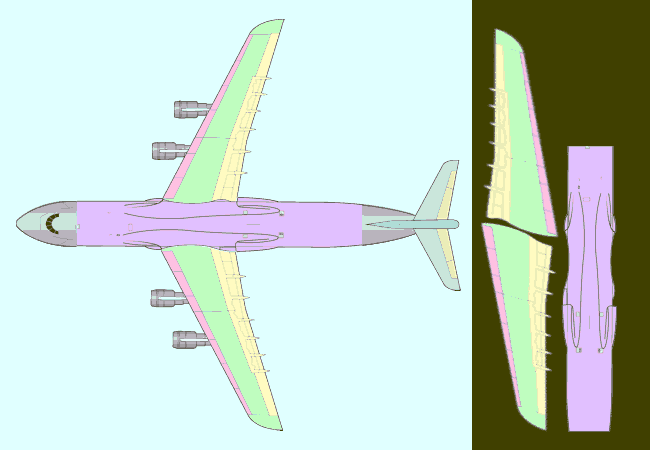
Top projection from C5AT. As you can see from right, flat floor area is over 60% from wing area.
The yellow flap wing area is app 30% from wing area. Pink area could be used for front spoilers.

Looks like that rounded bottom of the body does not have any particular reason. Flat floor plane has the same horizontal strength than plane with rounded body. Smaller sideway strength is not very important, it can be compensated with stronger roundings at the bottom. Flat floor body has more lift than rounded body. Maximum payloads raises with flat floor. Rounded floor is ideal for falling, but not for flying. Rounded bottom makes the falls aerodynamically ideal. In flat floor plane, the front is rounded for punching a hole into air, soon after you flatten the bottom. Possibly shape the flat part so, that it creates small lift to the plane. Besides rounded corners, you can use car's body kit like shapes in flat floor corners. Body kit is set of longitudinal spoilers.

From the upper diagram you can forces and benefits for flat floor system. The rounded, aerodynamic top pushes the overpressure away from the above. The flat floor has lots of more pressure below than the aerodynamic top. With vertical spoiler system you can prevent and slow down the pressure leaks from floors over pressure system.

As you can see from the diagram , flat floor planes body is not as high as round floor plane. The cargo space floor at the bottom is more practical and bigger than in round body.

Since the body is wide and high, with good design, you can get enormous overpressure system to your flat floor system.

When you have upright wings at the front, plane is not as sensible to side winds and pressure changes. Steering mechanics is better : rear follows left-right steering wings at the front. 

Problems in delta wing, which has flat floor, comes from the position of the wing area and position of the smaller wings, with what you change / correct altitudes. When the lift center is far from the front, the front sways a lot. Plane changes it's altitude and direction very quickly. Wanted thing in military plane, unwanted in civil airliners. Delta wing is sensitive to winds and changes in air pressure, too. Most newer military planes have small tail wings after big delta wing.

Flat floor plane can have air bags.
You can hide additional vertical walls into body. When they are out, they increase the lift under the floor. They prevent air from escaping from the side. You can use them in emergencies, for getting additional lift to somehow broken plane. In emergency landing they soften the crash. Air bag is kind of a parachute, which works under the body.

You are no longer interested in Concorde-Tupolev-Boeing SST replica.
No. Wings and their mountings should be redesigned, replaced with double-delta wing in the middle. Quite obvious that they were not that good. Noisy and obviously uncomfortable to travel with. Bump-bump is followed with a long scaring sway ... Plane for Space city has carbon coat, double wing in the middle. Electric jet engines.

At 10 km height gravitation is almost unchanged, but air pressure is one third from on ground pressure. At 15 km air pressure in 1 / 10 from on ground pressure. Faster-than-gravitation fall comes from the weight loss in the over lying air. It means that at high altitude mass remains almost unchanged. But lift from wings and air resistance falls a lot. With front spoilers you can collect air under the wings, boost the upper vacuum. At high altitude it does not cost much, because air resistance is so small.

Space city plane needs thick wings, heaters and spoilers for flying through the upper atmosphere. Possible that there are only various versions from Space Lift systems.

Right before hot layer air pressure is almost zero. Found one unreliable table from pressures and temperature at upper atmosphere. It says that hot layer peaks at 50 km, temperature raises to only 0 C, pressure is 0.0008 bar. Layer begins at 17 km and ends to 71 km. Reliable data from atmosphere ends to 10 km. Table says that gravitation does not vanish to the layer. There must be something wrong also in this table : air pressure and density cannot fall dramatically, when temperature raises. It conflicts against the connection between temperature and pressure.

- - Cargo-Glider - -

No one has checked thoroughly how plane with multiple longitudinal main wings would work. When primary thing is to keep the plane in the air, mountings for the latter wing row should be higher or equal than previous. So that you do not push the over pressure from previous wing towards the upper of next wing. Higher mounting guarantees, that you get enough air under the wing. Getting turbulences from the previous row under the next row gives a small boost to the lift. Resistance against fall is not an issue, gravitation drags the plane downwards all the time.

You can for example use floors inside the body for getting support to the raised mountings. You cannot use coherent wings, with small flaps in the middle. You must always cut and reload the wing after flap. Flat floor can have one adjustable part at the end of the floor.

The lowest picture shows side projection to cargo plane. In air-liner you can use additional top wing rows, without preventing the visibility. The floor can never raise with top. Such would create vacuum under the floor. With flat floor lift you can balance the heavier rear.

A cargo plane with multiple full length four wing rows and flat floor, can transport tanks and many other heavy things. Such cargo glider-plane downgrades prices of the air cargo. Fuel cost per hauled ton is low. Cannot use multiple wing rows in common windowed airliner, upper wings won't hide the most watched on-ground / on-strip sights. 

Cargo plane does not have to be that safe and carefully designed-tested. You can equip captain and crew with parachutes and ejector seats. Just like manned cargo space lifts will be equipped ... military planes and their pilots are equipped.

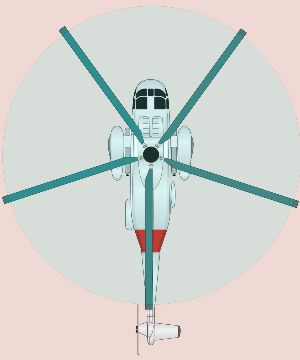
Relatively ambigious US made Sikorsky ( 5 wing copter ) Most copters have 2 or 4 wings. Some has 3.- - New copter - -

New rotor is quite a lot better in typical civil usage. In rescue operations new copter can fly to smaller places and in worse weather than the old one. In city usage it can land to much more smaller area. You can even fly on the street, in between two high houses. Save people from burning WTC towers, and so on. In military usage one carrier can transport bigger armed troops than the old. 

The new chopper has over 10 times more potential fly power per rotor than current copter. You can use it however you wish. Increase payload, top speed or downgrade rotor system's size.

Save people from burning WTC tower ?
You can fly new copter against the burning WTC tower and save people from the floors above the fire. 

You can now build choppers, whose body is the outmost part of the chopper. In old chopper rotor is always the outmost part in all directions. Huge advantage, when compared to old. Lots of useful potential. New copter, whose fly power equals to 6 meter wingspan copter, needs less than 1.5 meter wingspan. Small rotor and size allows to fly into narrow and small places which are impossible to current copter.

You can upgrade existing copter design and even existing copters with new rotor system. When you upgrade rotor system to smaller, without major increase in fly power, you do not need ring-system and stronger axles. Upgrade is an easy and cheap thing to do. 

When you upgrade your copter, you can safely increase the fly power with the savings you get from reduced momentum force. Axle's overall load remains unchanged. If your copter's wingspan is big, savings in momentum are also big. When you upgrade, you must check, that copter has enough power for bigger fly forces.

Sure that it works ?
Pretty sure. The new system follows Jet's operating principle. Jet for example sucks enormous amounts of air with dense wing system It is not known to have major problems with frontal turbulences. The area with what new rotor creates thrust is small. New copter is not necessarily as stable as the old. Possible that it needs wing systems for keeping the vertical upright position. When current copter has only two wings, there is a wing position, where the forces on the sides are missing. New rotor has almost continuous, small thrust circle, which keeps the copter in the air. Not very easy to say how it will go in practice.

Any disadvantages ?
New copter's smaller rotor needs more aerodynamic shape in the top of cabin. Possible that it has to be placed higher from the cabin than current rotor. Thrust which hits the cabin, pushes copter down.

- - Man lift - -

What is man lift ?
Man lift is an old idea. Man lift is a simple back-bag like aircraft, which lifts or transport one person. There has been all kinds of prototypes from man lifts, they have all failed. 

New rotor allows you to build small man lifts, rotors diameter at the same levels with the width of your shoulders. Rotor system, which is above your body makes the craft stable and easy to control. 

Besides theme parks and joy rides, there are all kinds of rescue and repair missions, where you can use and get benefit from man lift. Military people have traditionally been keen on small man lifts. Most prototypes were made by and to army.

Hello ... Hello ... help ... help ... my cat is in top of the tree. A day ago she climbed 60 feet to the top. Looked down. Got scared. Won't come down. Can you help ?
Calm down miss, of course we can.  Flying Fireman Fred is on his way.
How can Fred do that. Aren't branches in a way. 
Smaller branches doesn't matter. Quite obvious, that Fred is capable of finding a way to reach the cat. The rotor system and man lift increases his height and weigh, that's almost all. Fred can assist back bag lift with his feet and hands.

Hello ... Hello ... help ... help ... my cat came down on it's own. But now there is one flying fireman stuck in the tree ...
If tree is impossible, Fred can use a rescue plank. Offer the plank to cat from the distance ... before calling the small rescue copter or ladder car. With small rescue copter you can replace ladder car. In many cases rescue copter is better than ladder and lift cars. With small rescue copter you can carry and install long ladders, with what you evacuate bigger amounts of people. The crew can also take water pipes with them. Go and use the pipes from best possible place.


- - City chopper - -

Sugar oil and new rotor system makes the old idea from city copter possible. Sugar oil allows you to spend and waste oil ... for improved comfort. New rotor allows you to build sedan sized copters. City-copter fits to lanes and parking lots. City-copter expands streets to multiple levels, reduces rushes, etc. The idea is well speculated, only the vehicle is missing.

Copter is luxury vehicle, expensive to buy and drive. This doesn't suit to the primary idea for mass transport. Mass transport is supposed to be cheap. It should always be the cheapest way to travel. Ticket to jet airliner is an awful lot cheaper than the same trip with rented or owned private jet. In cities copter-bus would be in the same category than underground, buses and trams. Before gravitational shields, the only thinkable airborne mass transport for cities is derivate from space lift.

Thrust tail is a problem in copter. Thrust creation leaves a long tail after it. In the air the tail slows down the followers speed. The slow down comes from the speed of incoming air. Your own propel gives a certain speed to the air. This speed is fixed, and the difference in the speeds of incoming and outgoing air shrinks. With distracter unit, you can slow down the gas speeds in thrust tail. Unit must have some distance to the rotor, and the gas which creates the thrust. In principle you can respond to thrust tail by increasing your own rpm and thrust speed. It is possible and it does not cost much. If you do not do it, your plane is in danger to fall.

When copter's thrust is directed almost directly towards ground, thrust tail prevents nearby flights and jumps over another copters. That's almost all. You must have lots of distance to underlying and overlying copters. Alternatively you can use rpm adjuster or distracter.

City copter is not like you have seen in movies. Rotor needs open air from the above or sides. When you grab the air from the above, it creates a vacuum, which assists the lift. So. Rotor and engine are in the roof. Just like in copter. Movie like systems doesn't work. : thrust must be made over the body. So that gravity keeps the copter stable. Small rotor needs a tail wing like system, which directs thrust to  the sides of the cockpit. Part from the thrust, which hits the body, pushes the copter down. If car is 1.5 meters high, city copter is 2.5 meters. The max height comes from the bridges, tunnel and park houses. They are dimensioned to 4.2 m high vehicles. 2.5 meter copter can fly in tunnels ( at least with height control system )- Plymouth Duster can be filled from covered gas pump. It fits into common car washers and repair shops. Plymouth Duster can be equipped with electro magnetic dust collector in the bottom plate.

City copter is around 1 meter shorter than car of the same size. Copter misses the engine room, which is on the roof. Trunk-space is needed for short tail, left-right steering system. Shortness and chance to drop the copter into park, makes parking very easy. Engine and crank are in upright position, engine is dry boxer or dry V engine. It can also be a horizontal star. Star blocks were used in old propel planes, cylinders are in a circle, which surrounds the crank in the middle. All pistons rotates the crank at same position.

City copter is not very dangerous. Airborne collision does not need much strength. Copter is quite a lot lighter than car. When it comes down, it does not do awful lot of damage. Car's roof always lasts it's own maximum weight. Copter with four passengers and full tank could be around 700 kg : Fuel 50 kg, engine 100 kg, rotor 50 kg, passengers 4 x 70 = 280 kg, body 200 kg = 680 kg. Demand for small weight obviously prevents wide spread production of copter cars, with wheeled transmission.

New rotor system can respond to big changes in payload without difficulties. When trunk and passenger compartment are full, you use shaper wing angles and more fuel for the trip. Chopper will not easily run out of engine or fly power.

? Think that jet could be immune to thrust tail : Compressor-turbine system rolls freely. If speed of incoming air raises, compressor-turbine starts to rotate faster. Unfortunately jet's other qualities prevents the city usage.

In cities copter flies over the streets.
If you have for example 10 000 city copters in the air at the same time, you cannot control and give advises to each and every copter in the air. Streets have lanes for bi-directional or one directional traffic. When copters follow the streets, all they need is traffic lights ... some kind of height-tube, center and lane markers. Outside towns you can fly rather freely. At least during the early years.
Flights over houses and blocks are forbidden. What is star engine ?
Star engine is an old plane engine. According to my books standard engine has 6 cylinders, but it seems that engine had only 5. Pistons are attached to same crank curve. Cylinders forms a circle around crank. When installed vertically, the block is only around 10 centimeters or 5 inches high. The diameter is about 70 cm or 20 inch.  Crank rotates in same vertical direction than rotor. Engine is light, it fits to car's typical roof area. Star engine suits well for powering a rotator and city copter. With star engine the total height can be compressed to 2 meters or less. Private car's height ... with wheels ... is around 1.5 meters.

Copter car will kill small private planes.
Don't know. Private plane has wings, they are more economical. Manufacturing and demand are not that big. When the number of people who can fly grows, possible that private planes booms with copter car. With new engine, propel and wing system required strips and space are not very big. Max sizes and payloads grows. Top speeds raises quite a lot from current 200 km/h. Before jet engines last propel air liners cruised with 500-600 km/h speed.
Copter car kills helicopters.
By default you fly copter car on or over the roads. With roadside gas stations, cafeterias, shops and so on. Copter car replaces some copters, but not all. But then there are new kinds and better copters coming.
Copter car will kill private cars.
Copter car is a private car. New kind of car, but it is a mass produced vehicle for bigger masses. Old 4 wheel car is cheaper and simpler to drive. You cannot tow trailers and caravans with copter car. Copter car releases streets for pedestrians, bicycles, vans, trucks, trams and buses. Copter car allows you to build Star wars like park floors into sky drapers. In one millennium time Star Wars movie, park floor for flying cars was way above the street level.

Nothing prevents copter car from superseding 4 wheel cars, we'll see. Future shows. Copter car was warmly welcomed, with greater interest, in all around the world. Something very different from the small and slow electric-eco-car prototypes for future cities.

From the below you find general guide lines for first RC models and fully functional prototypes. In principle you can start the production of right away.