R&D Jets    Jets   Plane   Lift   Propels   Hydro   Cars   Misc     Fast   Fees   Futu   ATS   Jack Answers
Propels
Sunday, May 26th 2019
Tights .  

- - Propels and wings operating principle + new propel and copter- -
16th October 2018

When you capture natural forces, fall from 100% coverage is not very big thing. Most capture methods wastes "free" energy. Some more and some less. Propel of modern power-windmill wastes an awful lot. An old, native windmill - on the other hand -  has 4 wings, which covers over  50% from the diameter. They and the best bigger gas propels made so far, were used for creating flour from corn. Mayday propel for kids and traditional US wind indicator covers great deal from the circle. Small fans for computers and others has dense wings.

Coverage area of the boat's propel is often more than 100%. No one has ever tested 100% coverage propels in planes and copters. In principle they should work at least as well as traditional 2, 3 and 4 wing propels. Dense wing system creates turbulences and pressure walls behind propel. 

Dense propel plane is kind of a semi jet. The thrust is created without heat, with a small back buffer.

In propel the force and power comes from wing area and their angle. In propel the wing area is front projection area, in wings you use top projection. For real power, forces must be multiplied with surrounding gases or liquids "friction-factor". The multiplier has almost direct connection or liquids or gases current density. In the air, humidity and air pressure-temperature affects to the current density. In water, temperature affects to the current density. Liquids does not shrink and stretch under pressure like gases. In liquid depth starts affect faster than in gas. Vertical and horizontal multipliers are almost the same in both. 

Due to turbulences and others, the calculations are not accurate. You can drop insignificant small things.

When wings tilt angle is 0, propel do not have forwarding X component, wing misses lifting-lowering Y component.

Propel has also S component, which creates movement or moment in sideways. S-component comes from the thickness of the propel. Ancient water mill, old river boats / first steam boats have theoretical zero X, and the power-movement is created with S component. More efficient propel was created few decades after first steam boats. Propel was invented long before steam boats, Leonardo da Vinci is usually credited as inventor of the helicopter-propel.

Following force diagrams naturally look very simple. They were far from that during the first look ... when I assembled jet pack and checked turbine wings.

Propel and wings
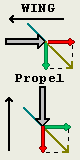
Thin black arrow is direction of movement, others are forces.You can always handle and calculate propels and wings with common X-Y-Z force systems. The over-under pressure system creates the force system for both. The gray array is incoming air. Yellow arrow is the force vector, with direction. Green-Y creates lift. In wings x-vector is kind of a unwanted, it resists the movement forwards. It is needed for creating the green Y vector. In the picture red points to against the actual direction. Effective X is counter force, which comes from the wing. X is the force, wing must last. In front projection x grows with distance from the attachment to body ( momentum ).

Wing has two sides and force systems. Vacuum over the wing, creates another force system, which lifts the plane. Overpressure pushes the wing downwards.

Propel and turbine are powered wings, this time the air forces come from the different direction. The red arrow is required strength, green is forwarding power.

The force diagram does not show the trick of maximum angle. Maximum tilt angle comes from the surrounding material. When angle is too big, the yellow force-arrow starts to spread in both directions. When tilt angle is 90 degrees, the opposite force system is equal to actual force system, nothing happens. The unwanted opposite force exists with all non-zero angles. With shape you minimize the opposite forces, amongst many other things. Max tilt angle for gas is much more smaller than for liquid.

Compressor system in dense gas propel obviously increases the power. In dense propel each wing has a air chamber. Front wall is back of the previous wing, the back is own front. When you shrink the chamber so that outlet is smaller than inlet the produced power / unit grows. The compressor allows you to get the same thrust with smaller propel. Compressor always increases the unwanted opposite force system. Compressor is not a magical trick, in closed gas turbine maximum power is always the pressure-vacuum system, which comes to the wings.

Copters
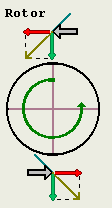
Thin black arrow is direction of movement, others are forces. Copters rotor operates like common wing. With rotor, copter can take altitude, only. With the angle of the wings you control the thrust, the rotor system produces. As you can see from the picture, the opposite wings in the rotor neutralizes each other. The number of wings in rotor must always be even, 2,4,6, and so on. The opposite forces keeps the upright rotor in place. The thrust comes always out with 90 degrees angle.

In order to make copter move, you must tilt the thrust. First you must tilt the axle of the rotor. When you tilt the axle, the body of the copter tilts with small delay. After you get the copter into move and wanted speed, you must straighten the axle tilt. If do not do so, the tilt angle grows all the time. Eventually copter falls and crashes. Body tilt depends on the way axles are made, at some point most copter's body takes part to the tilt-speed creation.

Rotation speed of rotor is another way to adjust thrust. It increases the number of times the green arrow is created in one minute or second. The sum of the green arrows, which are created in one second is the actual thrust power, the rotor creates. And the force/power, which keeps the copter in the air. Force-power system must be equal or bigger than the gravitational force of the flying object. When rotor and thrust are tilted, thrust is divided to forwarding-x and carrying-y components. When so, carrying-y component must match the gravitational force.

Propel has rotor like upright force system. Common wing has only one meaningful component, carrying-y. When y grows, plane takes altitude. When y shrinks plane loses altitude. Main wing has a base angle, which keeps the altitude unchanged with average load. Base angle is the mounting angle of the wing. The adjustment to the current payload is made with those smaller flapping wings, at the back of the main wing. Same small wings, with what the plane changes altitude. After you have changed altitude, the wing system must be re-calibrated to new altitude. Gravitational force and air pressure shrinks with altitude. You must at least check, that the old base position works, plane keeps it's altitude. There is one gauge, which shows both longitudinal and lateral position of the body. Longitudinal and lateral tilt always reduces the force, which keeps the plane in the air.

- - - -

In principle nothing prevents you from building nozzles to rotor. With adjustable nozzle you can replace the axle tilt. 

Dense rotor in copter with upgraded fly-powers, would obviously need outer ring, into which you connect the wings with two-component ball-bearings. First component allows you to adjust wings angle, second connects wings to ring. When outer ring goes slightly below the wings, it helps you to keep the air and air pressure below the wings. Such gives a small boost to the force, which keeps the copter in the air. There is limit for the length of the ring's extension. At some point thrust starts to fade.

When you build a ball bearing ring for copter's rotor, you can install more than 2 wings into the system and get much more power to the copter. A copter with two 3 meter long 30 cm wide wings covers only 6% from the circle. 4 wing copter with same thrust needs four 1.5 meter wings. Eight wing copter creates the required thrust with 75 cm wings. With 3 meter wings thrust is four times bigger with 8 wings than with 2 wings. With multi-wing copter you can get into almost impossible holes and places. Then you can fly in the weather, which is impossible for 2 wing copter.

You can also build the earlier nozzles into ring system. With out nozzle system, you must tilt the ring with rotor. With nozzle system you can mount the ring-rotor into body, drop the ball joint system from the axle. In nozzle copter the axle-rotor system never tilts. With nozzle-system you can also reduce the cruise-time tilt of the copter.

Ball bearing ring improves also copters safety. It protects the rotor's wings. Multi wing rotor reduces vibrational load in the axle. Short wings reduces momentum at axle and it's bearings. Momentum has nothing to do with thrust, it is an additional force wings and axle must last.

Also possible to build the tilt system into tail and tail rotor.

You can use the upgraded fly-power for increasing the payloads and speeds. Shrinking the size. Space lift uses ringed rotors for assisting near ground lift and steering in general. 

Samples

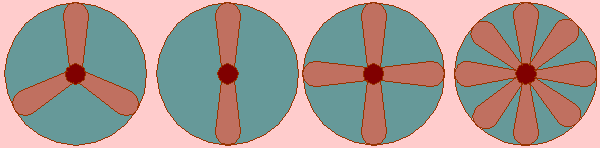
From the front-top projection you see how propels waste air. When propel creates the pressure / force, the total force is the area * pressure. 
In force creation dense propel is good, the back buffer increases the force. In fan / cooler propel, the same turbulence buffer blocks fresh, cold air.
It is possible to improve the back buffer with shape of front, top or engine cover ( in the wing ). Booster to buffer obviously needs wind tunnel testing.

2 wing propel with 1 meter diameter and 20 cm wings has 2000 cm2 thrust area, and 25.5% coverage for the diameter.
- Diameter of the dense propel with 80% coverage and 2000 cm2 thrust area is 57 cm.
3 wing propel with 1 meter diameter and 20 cm wings has 3000 cm2 thrust area, and 38% coverage for the diameter.
- Diameter of the dense propel with 80% coverage and 3000 cm2 thrust area is 69 cm.
4 wing propel with 1 meter diameter and 20 cm wings has 4000 cm2 thrust area, and 51% coverage for the diameter.
- Diameter of the dense propel with 80% coverage and 4000 cm2 thrust area is 80 cm.

2 wing propel with 2 meter diameter and 20 cm wings has 4000 cm2 thrust area, and 12.7% coverage for the diameter.
- Diameter of the dense propel with 80% coverage and 4000 cm2 thrust area is 80 cm.
3 wing propel with 2 meter diameter and 20 cm wings has 6000 cm2 thrust area, and 19% coverage for the diameter.
- Diameter of the dense propel with 80% coverage and 6000 cm2 thrust area is 98 cm.

3 wing wind mill with 70 meter diameter and 2 m wings has 2 100 000 cm2 thrust area, and 5.5% coverage for the diameter.
- Diameter of the dense propel or double piston system with 80% coverage and 2 100 000 cm2 thrust area is 18.2 meters.

As you can see from the samples, propel loses it's efficiency very quickly with diameter. Windmills and windmill farms are merely jokes. Wings and axles are heavily overloaded, when compared to produced powers. Power production is certain not to be the dominating thing in the media sexy ... expensive and inefficient ... windmills. Not a single thought for the actual issue, power production, can be found from those. They are made for money, ads and media sexy statements only. 

Must confess that a media mill, which does not produce power, is ... of course ... environmentally friendly. No one can deny that. If you are interested,  in recommended alternative, solar cell, the efficiency ratio for capturing the available light energy is around 77 %. Usually check and research things to which I give my recommendations.

- - - -

Usually when you revise old existing things there is reason for everything.  Couldn't find a reason to the small coverage areas of propels and rotors. Last propel airliners used 4 wings, first air liners used 2 and 3 wings in their propels. 

Propel plane consumes less fuel than jet plane. Jet pack improves jet's efficiency quite a lot. New propel brings back buffers and optimized wing angles to propel systems. Not possible to say, which one is better. In city copter or plane you can never use jet engine. Exhaust gases are too fast, strong and hot. They burn and messes the surroundings.


Paddle propel


Paddle propel was replaced with double piston and screw propels in 2019.

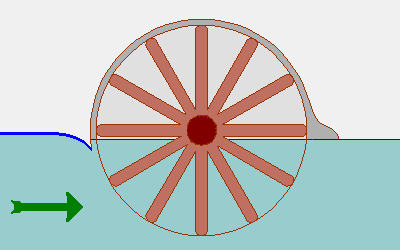
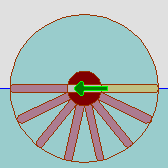
In water jet you might want to use old water mill propel. It is also known with names drum and drum propel.. The rotator of the propel is over the water, wing is supported from both ends. Water mill propel does not need much depth, the construction allows you to use big wings, powers and forces with the propel. Water mill propel has excellent braking capabilities. You can use spoiler for preventing the resistance, when the wing hits the water. In the back you need space for throwing the water away from the wings. The time single wing pushes the ship is short, but there is always new wing coming to the best push power area. Push power vector has almost 90 degree angle towards wing.

You can increase the length of wing and propel power, without increasing depth. Construction allows you to install the propel where-ever you wish. It is also relatively easy to embed steering system into propel. With rounded wings you can increase and decrease power of mill-propel. With propel you can get big boost to towers drag powers.

On ground and shallow water you can temporarily use the propel as wheel. Build boats for landing, swamps, etc.

When current propel came, wind mill propels were still about the same size they were in water mills. Development of the wind mill propel ended to that. Windmill propel has different kind of operating principle than current propel. It sort of moves and forces the ship to move. Difference is comparable to chest and free styled swimming. 

When ship has power propels in the front, it is much more stable. It keeps direction, when wave hits the ship with an angle. When you push the ship with propels, speed boosts the change of course. You cannot easily install current propels to front, into hull. Current propel has to be in the water. Jet like back buffer is also more important to current propel.

With multiple propel rows you can increase the top speed of the boat quite a lot. When you place the rows almost right after each other and increase the rotating speed of propels in each row, the speed raises. With windmill propel you get better balance to fast boat. When you drive very fast to a wave, the wave can throw the boat upside down. F1 race boats, which sails nose up, with marginal contact to water, goes often upside down.

In catarman you can install the propel systems in between two hulls, which goes to water. Build a catarman for 500 people with 200 knot top speed. Boats speed knot is 1.8 km / hour. Mph is 1.6 km / hour.

You can use drum propel with gas too. In cars heater's fan uses often drum propel ( = water mill propel ). Older electric add-on heaters used often drum propels. Drum propel does not keep as much noise as common propel. Drum propel does not suit to planes and jet engines. You have to direct gas to drum propel with tube.

Drum propel can operate under the water, too. Propel is heavier to rotate, rotating powers are smaller. Fully covered propel tends to rotate the same water around. Possible that fully covered propel needs wing system, which empties the holes before the push begins. Cannot estimate how much underwater usage would consume from propel power.

Easiest way to build underwater propel with full powers is to simply push the raising wings to another side. The propels are rotated from the ends. You can build rails to ends. Then you build a mechanical pusher, which automatically pushes raising wings - one at the time - to the other side. Possible to build counter weight system for balancing the propel. Mechanical pusher ensures that wings never collides.

In properly designed propel major load goes to rail system, not to the system with what you lock the wings. Rail system can be made so, that it is almost as strong as fixed system.

My guess is that you have tested the powers, simple or at least the mechanical underwater drum propel looks very attractive alternative for common propel.

Drum propels

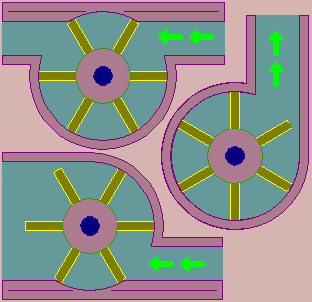
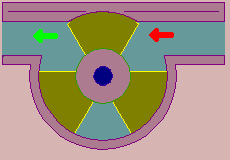
In the picture there are three drum propels. Top left is pass through propel. The picture is for horizontal propel. Vertical propel should always work below axle. So that weigh of gas, liquid or particles boosts the rotation. Bottom left propel is for collecting  energy from incoming flow. When you do not have any usage for pressure after propel, it is better to let it flow freely after propel.

The propel on the right is thrower propel. The transported thing comes to propel, propel throws or transport the thing with outlet tube. Thrower creates boosted 90 degrees angle to the flow. Thrower is sometimes also used for collecting energy from the flow. Fan  in cars heater has usually thrower propel.

In principle it is possible to create combustion engine with drum propel. First you pre-compress fuel air mixture with axle power in separate compressor. When wings form a closed space into propel, you open valve from compressor and ignite the mixture. Then you push the propel with formed pressure. System is not a match to common combustion engine. The pressure creates a strong pressures against fire chamber's back wall. This force resists the rotation. Problem exists in all pressurized drum propels. When you have a steady flow the problem is not that big. In ship the problem is near non-existing.

From this aspect double piston with crank is better. Fast double piston suffers from turbulences.