( Jack : 2010 - 2017 )


Semi Diesel is related at the bottom of the page.
| R&D Cars | Base Engine Gases Gears Tires Steer | Misc Jets Fast Fees Futu ATS | Jack Answers |
|
Cars - Engine ( Jack : 2010 - 2017 ) |
|
| Tights |
New theories, chemical reaction, operating principles and diagrams for firing. Semi Diesel is related at the bottom of the page. |
 Combustion engine smells -6th May 2018
Fire forwards with smell effect. So, as we all know, combustion engine smells, when it works. Much like nuclear plant.
- In combustion engine you should maximize smell effect.
- Fire and pressure ignores most from the turbulences. They skip from atom to atom, try to stabilize the pressure.Self ignition and knocking
It is possible that knocking comes from the random wave creation. Waves echoes around the cylinder, causes tensions towards block and head.
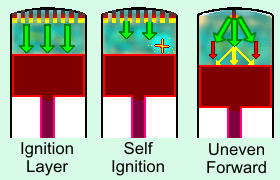
When fuel-air mixture ignites on its own, it starts to bomb the engine construction with horizontal and slanted pressures. Self ignition creates random pressure peaks. These peaks spread into all directions. Towards piston, head, valves and cylinder walls. In collisions with construction they blast. In collisions with other pressure, peaks act like uneven forwarding goes. Self ignition causes always losses in pressure creation. Especially in petrol engine.
In diesel engine, you can enrich the fuel right before you close inlet valve. When you enrich the topmost gas layer, the fire starts from the top. Takes a direction towards piston. After compression stroke, the pressure towards piston is slightly higher than pressure towards head. Fire tends to begin from the wrong end.
Picture
The ideal firing system for pressure creation is almost flat, rounded head, with sparking layer. When you ignite the mixture at once, the pressure goes down with smell effect. Besides steady push, the layer burns the mixture quickly. Difficult to install valves into a head with cylinder-wide layer system.
When you look at the uneven picture, red arrows have green arrows pressure. When tilted yellow arrow hits the piston, it starts to spread towards red arrow. The tilted yellow is taken from upright yellow. When tilted yellow adopts to the red, red obviously peaks and loses the peak from yellow quickly. The pressure change with what red pushes the piston is smaller. Pressure change is difference between tilted yellow and red. Tilted yellow is lost with red. Tilted yellow is saved only then, when the peak takes place at the piston.
And that's not all. When upright yellow hits piston, part from the pressure goes to spreading in sideways. The blasted pressure acts worse than tilted yellow. The push towards piston is marginal, most from the pressure goes sideways and upwards.
- When tilted yellow arrow adopts to red arrow, it obviously creates a short term pressure peak in to cylinder. In cases when this peak takes place in unburned mixture, the peak can result into self ignition.
- Regardless of the mixture's state, peak can always cause knocking with wave like pulses. Waves are created with fast under-over pressure repetions. When a single moving pulse collides, it seems to convert into wave.Firing methods
In order to improve firing, you can develop spark plugs, which creates sparks around the body. Can use head as ground for the sparks, too.
You can create good forwarding with head's shape too. In wedged combustion chamber small amount of fuel is sort of a used for creating good, even push for primary fire. In wedge pressure does not move much in sideways. On the other hand amount of the ignited mixture is small. With layer plugs you can use lower angles, reduce the delay in pressure creation. Delay in pressure creation costs at end of the firing stroke. The pressure, which goes to exhaust pipes is bigger.
In lab you can optimize head's shape by installing pressure sensors to flat piston. Check how the pressure comes to it. For forwarding and pressure creation, the pistons shape is insignificant.
Summary 18th May 2018
In diesel engine self ignition causes quite a many uncontrolled power peaks into cylinder. From the petrol engine we know that knocking reduces power. The knowledge is in line with this theorem. When compression ratios are the same and engines okay, diesel can never beat semi-diesel.
In knocking, temperature comes before pressure. Pressure does not set the fuel into fire. Self-ignition comes from the temperature. It means that with improved cooling you can prevent knocking, without giving up from the higher compression ratio.
When engine has fixed compression ratio ( like all engines currently have ) you should never temporarily cool the incoming mixture. It leads into power losses. Better way would be a usage of the thinner mixture.
Evenly forwarded burning reduces CO emissions. Collisions and peaks slows down the fire a little.
In ideal process, where the fire forwards evenly, the maximum temperature comes from the unburned fuel. Temperature must stay slightly below the flash point. Flash point is said to live with the pressure.
Power peak can be born without knocking. When so, peak does not convert into wave, vibrations and noise. Waves and knocking cannot be born without power peak : Self-ignition peak or uneven peak.
Power peak in burning fuel should not have as much effect as peak in unburned fuel. With fire you create the pressure, which pushes the piston. Burning fuel is either creating or it has already created the pressure. Fire begins a balancing state in burned part of the cylinder. In balancing state mixture is more stable. By default power peak in balancing state goes upwards, or alternatively to a lower pressure location. Although theoretical peak can be big, difficult for the burned mixture to create such peaks. Bouncing wave from unburned part is the only possible source for bigger peak.
Ideal / even burn does not suit well into way pistons are made. Ideal burn would need four mounting points, piston has only two. Problems with this conflict can also cause loud knocking and break the engine.
My own high compression ratio Mirafiori suffered from small vibrations in crankshaft. Vibrations opened a nut, which held generator's wheel in place. Blew the engine before I found a good solution for the problem.
 Internal
Power transmission - Sunday 10th June 2018
Internal
Power transmission - Sunday 10th June 2018
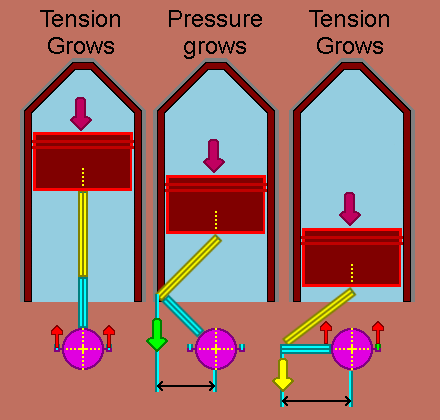
The system in the picture is the internal power transmission system. It is almost completely independent from firing and power creation. The power transmission starts from the pressure, with what the gas pressure pushes the piston. Connection to firing comes from the gas suspension. Suspension gives a small boost to firing, it comes to firing evenly from the piston. Effect to firing can be ignored. It shows in the measured pressures, with what you adjust the engine.
When I made the pressure sensor system, crank-boy insisted, that the gas suspension would make system lossless. Pressure sensors useless. And what so ever.
First picture on the right shows top position forces. When you raise the pressure above piston nothing happens. Tensions grow. When you release the pressure, tensions fall and nothing happens. All the pressure is wasted.
In the center, the pressure of the gas grows, and eventually force is used to rotate crank. Momentum-torque comes from the distance to the point, where the force changes direction.
In the third picture momentum peaks, right after that, Y component starts to create tensions into mountings. Tension is released, when piston starts move upwards. The force with what the tension stretches mountings is lost. Although the suspension system is still active, it becomes almost useless after mid-point. Most from the effect is wasted, when you open the outlet valve.
In general tension creates so small changes to size and requires so much force, that it is almost impossible to re-collect energy, which is used for creating additional tensions. You can never avoid tension, which is needed for resisting force which comes and moves piston.
Although term is the same, pressure in liquid behaves very differently from the pressure in gas. Earlier described knocking turbulence system is common to both.
Crank length and timing of the pressure creation are the things, which creates torque, from which people talk about. Third is the way loaded engine raises rpm, when you push the gas pedal and increase the filling of the cylinder. Measured torque curve is derivate from maximum engine power and rpm.
In combustion engine
- Energy comes from the difference in max pressure and the pressure with what you open outlet valve.
- Power is sum of energies you create in one minute.- Efficiency of the firing can be estimated with fuel's energy contents and the produced maximum pressure. With mixture's qualities you can calculate theoretical max pressure. The maximum produced pressure is the maximum volume adjusted pressure. Max volume adjusted pressure is forms after the mixture is burned. If the mixture is burning, when you open the valve, maximum pressure is formed a moment before the valve is opened ( cylinder is overloaded ).
- Crank system and power transmission losses come from the pressure with what you outlet valve. Opening pressure is wasted to exhaust pipe.
What goes in, comes out ? - 25th October 2018
Dry air which goes to cylinder has 78% nitrogen, 21% oxygen. Humidity reduces the amounts.
Petrol which goes in has 86% carbon, 14 % hydrogen.Base burn in cylinder
C86 H14 + 14.7 * ( 21O2 78N2 )Results into :
C + O2 → CO2
4H + O2 → 2 * H2O
2C + O2 → 2 * CO // = inefficient burn
N2 + O2 → 2 * NO // This is a claim.Fire in petrol engine is comparable to breathing and cigarette smoking. Without CAT ( second burn ) fire ends to listed elements.
- Creation of NO is claim. Nitrogen does not usually react into fire / oxygen. You cannot set air into fire with heat.
- NO is better known with a name laughing gas. NO is used as fuel in combustion engines. Temporal add-on gas system uses NO gas for giving additional kick to engine. Nitrogen and oxygen "hates" each other, it makes NO powerful fuel to for example cars. Possible that NO reaction is too fast and powerful for humans and animals : Veins, muscles and others cannot handle the pressure and heat, NO fire causes.
- Creation of NO2 is also difficult. NO2 is brown gas, it has strong unpleasant odor. In bigger amounts NO2 is hazardous, but not lethal gas.
- Cars exhaust gases are usually colorless and odorless. Sometimes they are gray or blue. Gray is water vapor, blue comes from leaked and burned lubricants.
- There is marginal amounts of single N atoms in the air. These N atoms burns in combustion engine, lungs, etc. They obviously enrich to N2 and NO2
1 dm3
Density
Box
weightUnit
weightUnit
countMixture
Unit
totalMixture
HasN 78,08 1,251 97,6781 28 3,4885 14,7 51,2801 53 * N2 O 20,95 1,429 29,9376 32 0,9355 14,7 13,7526 14 * O2 99,03 14,7 H2O 0,97 0,804 0,7799 18 0,0433 14,7 0,6369 Fuel 100 1,260 126 26 4,8462 1 4,8462 5*C2 H4 When you look at the result column on the right. The sample can never fully burn the petrol-diesel, which is fed into cylinder.
14 * O2+ 5 * C2 H4 ---> 10 * CO2 + 8 * H2O + 2 * H2
28O, 10C, 20H -> 10*CO2
8O, -, 20H - > 8*H2O
-, -, 4H -> 2*H2Volumes : CO2 = 10 * 46 = 460, H2O = 8 * 18 = 144, H2 = 2, Result = 606 >> CO2 = 76%, H2O = 24 %, H2 = 0.3 %
Exhaust gas needs that you remove Oxygen and Fuel. Add result to the rest. Exhaust gases volume can change, but atom counts in between result and fuel-oxygen mixture are the same.Water and hydrogen are obviously the primaries of the reaction. Idea comes from knocking. When you increase the amount of carbon, it reduces the knocking. When you optimize the fire, you should check that hydrogen atoms are split into water and H2 atoms. C and CO2 are insignificant for the efficiency of the fire. If water is primary product, the ideal reaction has different form :
14 * O2 + 5 * C2 H4 ---> 10 * H2O + 9 * CO2 + C
28O, 10C, 20H -> 10*H2O
18O, 10C, - - > 9*CO2
-, C,- -> CVolumes : H2O = 10 * 18 = 180, CO2 = 9 * 46 = 414, Result = 594 >> H2O = 30 % CO2 = 70% ( misses loose C )
In the sample 1 / 15.5 mixture provides enough oxygen for converting lonesome carbon atom into CO2. When so, 1 / 15.5 is optimal mixture for exhaust gases. Optimal exhaust gas has 10 water and 10 carbon dioxide. When you do not have enough oxygen in the mixture, the resulting exhaust gas sways around the optimal exhaust gas.
Optimal exhaust gas mixture is not the best for the speed of fire and pressure creation. Richer optimal mixture is for the fire and pressure, the richer optimal mixture is verified to be true countless times.
Humans who uses sugar and fat uses the same air, and the mixture has more hydrogen atoms than petrol. Humans can adjust the output, with windpipe and thoughts. With thoughts you can control your body. In this case it is possible that you give commands to the cells which burns the sugar-air. The adjustment of the output is thing you learn when you are young. The natural sugar is close match to methane ( CH4 ). Petrol is distilled product. Cleaned ground oil can be almost equal to petrol.
In principle creation of CO2 is easier than water. Carbon dioxide needs that exploding hydrogen atoms kicks the carbon atoms farther from themselves. Then the loose O2 molecules captures the loose carbon atoms. Hydrogen creation requires, that there are 4 hydrogen atoms, which breaks the oxygen molecule. Water creation requires more energy. Obviously it also releases more heat and temperature to surroundings. Thin mixture is known to produce less power than rich. When you look at the system above, rich mixture improves chances for getting water from the reaction.
When you use catalyst converter, it needs thinner mixture. If and when thin mixture increases the CO2 creation at the expense of water creation, you have a good reason for long term, phenomenal drought. Cars consumes an enormous amounts of air and provides lots of additional humidity to your climate. When you minimize the vapor creation with regulation, you downgrade the local humidity closer to natural levels. This downgrade towards natural levels looks like unnatural drought. When you burn fuel, the engine never dries the air from the humidity, which goes into engine via air filter. The water comes out as untouched hot vapor. ( You can never burn water or alter water with heat-pressure system )
Booze in petrol is also a thing which makes the mixture thinner and increases CO2 creation. Booze has oxygen, which increases the amount of oxygen in the mixture. Booze only fuel can be adjusted and mixed freely.
If big city like Los Angles would force people to use electric cars, it would result into major local climate change. The local nature would be unable provide enough food and water to people. People would have to move away in bigger amounts.
- - Catalyst Converter - -
24th Nov 2018When I made background research for this chapter, noticed that the only thing, which known from catalyst converter ( for sure ), is that it does not use flaming fire for doing what-ever it does. The released chemical reactions and resulting gases varies a lot. They are only wild guesses from the things, which might take place inside. Chemical fire can result into unnatural exhaust gases.
Catalyst converter has ( if I do not remember wrong ) platinum in it, the first converters cost a fortune. Reason was said to be platinum. Platinum is used for creating cyanides. Cyanide is well known poison. Cyanide is NxCx compound, but not all cyanide compounds are toxic. When you "burn" fuel without oxygen, NxHx and NxCx compounds are the only possible results.
If there is oxygen in the exhaust gas, the platinum converter will almost automatically form toxic cyanides. There isn't a way, you can guarantee harmless results. By default nitrogen does not react to oxygen and fire.
The most dangerous cyanide is said to be made industrially with oxygen, platinum and 1 200 C temperature. At this temperature the efficiency of the creation obviously around 100 %. In combustion engine the gas which goes to converter is 500 - 700 C. But the pressure and speed are high, these two boosts process. It is not known for sure at what temperature the creation reaches 100%, neither it is known how the efficiency of the creation grows with temperature-pressure and speed.
It is also difficult to say, what kind of compounds platinum results without oxygen. Obviously harmless to humans and life, not necessarily to climate.
Diesel engine and high compression petrol engine tends to increase the chances of the lethal exhaust gases. When converters were taken to use, V8 engines compression ratios were dropped to below 8. My Caprice and Van runs with 88 octane fuel. Modern engine with converter needs 95 or 98 octane fuel.
Saying that lambda sensor measures oxygen and the values you get from it, hints that the actual reaction is held hidden on purpose. From the unknown reason. Secrecy has obviously led into suspected widespread hazardous misuse of catalyst converter.
That laughing gas is obviously a result from wild imagination, possibly nasty fun making. Idea of creating new powerful fuel with fire or chemical fire is so distant. Far from reality and basic laws of physics.
Small amount of toxic cyanide causes headache. Bigger amount kills you with cardiac arrest ( your heart stops beating ). Like said earlier, it is possible that earlier public stupidity is intentional, and the idea of leaking oxygen into converter has it's origin in sick and twisted mind of Martian.
25th Nov 2018 : Cyanide study
- One of my college mates almost died to heart failure few years ago. He has been inspecting cars and measuring emissions over 25 years. He had been suffering from weakness for longer time. Some part from his heart turned out to be broke. Muscles were okay. If I do not remember wrong, latch was replaced with plastic spare part and he recovered. Broken latch / part hints to uncontrolled fire-pressure system.
- Heart is cylinder like compressor, which powers the blood circulation. In heart blood has lots of oxygen atoms, under pressure these atoms can react with poisonous cyanide : Self ignite the cyanide into uncontrolled nitrogen fire. Broken latch or some other leak in heart always causes low blood pressure.
- These self ignitions in heart can also cause the headache via nerve networks. Possible that poisonous cyanide self ignites in brains, cyanide is not known to cause brain damages. Vuf, vuf.
- B12 vitamin is used for curing cyanide poisonings. Body uses vitamins for building and repairing broken parts. Not known how.
- Beer has lots of B vitamins, good thing to drink in bigger cities and also after a working day in workshop / garage or after a working day on streets / street side.- - Back to common fire - -
7th Nov 2018In combustion engine, the reaction and results are secondary things. The key is to find the most efficient way to create pressure into cylinder. It is the only thing that matters. Inlet gases have been well known. But they missed connection to exhaust gases for a very long time. After an inquiry, I researched and released the connection in mid Millennium. After Greenhouse gas enthusiasts set their eyes to cars and their engines.
When you think, that you burn hydrogen, sugar oil is better than ground oil. When you for example distill oil, you enrich the sugar oil and ground oil with carbon. You downgrade their burning capabilities by removing hydrogen from the raw material.
You can never burn Carbon or Nitrogen. Chemical compound with Hydrogen is the one, which burns in common fire. Carbon monoxide is the only common fuel without hydrogen.
When you burn hydrogen in combustion engine, you use the hydrogen for raising the temperature and expanding the gas inside the cylinder. Since cylinder prevents expansion, the expansion converts into pressure.
Fire is nuclear chain reaction, just like cold fusion. Reaction of nuclear plant is quantum level chain reaction. It was obviously named and forged to nuclear chain reaction for giving proof to Albert Einstein's award winning, fake 3rd basic law of physics ( E = mc2 ). Would be very sad, if the catalyst converters turned out to be similar kind of secret society system, than nuclear chain reaction.
The reactions above are the ones for CxHx fires. Methane follows the reaction with it's own qualities / atom counts-weight systems and so on. CxHx fire is the dominating form of fire on earth. All the other forms are marginal.
In order to mathematically calculate the pressures after ignition you need the speed of fire, initial pressure-temperature.
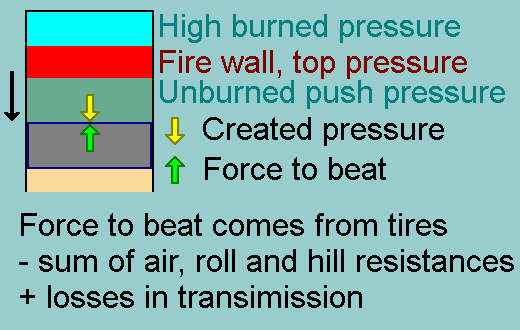
Then you need the temperature-pressure system, with what the mixture burns. It seems that the fire adds temperature-pressure system into gases initial system. Quite obvious that the addition takes place with efficiency. Efficiency gets poorer, when initial temperature-pressure system grows or is too big.In the picture you see pressure system for fire. The values of the pressure is dependent on cylinders filling ratio.
Very thin fire wall forwards in cylinder with maximum pressure.
Pressure behind-over the wall goes down with volume.
The free push pressure raises with shrinking volume.
- When piston and car moves : the pressure in push area goes always so that, it matches force to beat. If there is a mismatch, system changes the speed of piston.
- When piston and car are not moving : the pressure in push area grows, until it matches force to beat.After the mixture is burned the pressure system stabilizes. In accurate calculation both burned and unburned volumes have forwarding speeds from the wall. With computers it is possible to build complicated, more accurate calculations. Run out of paper and patience, when you use old pen and paper method.
When you design engine, your primary goal is to maximize pressure, secondary goal is to balance fire's speed and increase of volume so, that pressure remains pretty much the same during the firing stroke. You use flywheel also for balancing the pressure changes during the firing stroke. There are various pressure systems which can take place during firing, they are dependent on construction and current load. Constructional dependency comes from pistons diameter and stroke length.
With pressure sensor in piston you get the most important pressure for engine design.
Since fuel-air mixture is fixed to optimal burn, filling is adjusted with valves and pressure in inlet manifold. During filling stroke, moving piston creates vacuum into cylinder. With carburetor and fuel injector you mix the air and fuel. Then you adjust the pressure ... amount of fuel air mixture ... in inlet manifold. Inlet tubes are filled at the same time and same vacuum, cylinder sucks new mixture into it. Charger boosts both filling filling of cylinder and inlet manifold.
- - Calculation - -
25th October 2018The calculation began by defining weighs for 1 liter cube of atmospheric air. The cube is divided to boxes with the shares of Nitrogen and Oxygen in the air. Then the boxes for the elements are converted to weighs with densities. With the weight of one molecule you get the number of molecules in the box. Then the unit count per liter is shifted to with the used fuel-air mixture.
- The unit count is clamped. It refers to an enormous number of atoms. Unit counts in the table are relative to each other, far from real counts.
- In the actual spread sheet calculation there is small closing utility, with what you can shift fuels 4.846 into 5. When fuel is moved to 5.00, Oxygen raises to 14.18, Nitrogen is 52.90.
- When you play with combustion engines and air all parameters approximations. Air and fuel quality changes all the time.From the below you find general contents of the on-ground air.
Gas Atom-Mol
weightg/L Chemical Sign Share in dry air Nitrogen 28 1.251 N2 78,0800000 Oxygen 32 1.429 O2 20,9500000 Argon 40 1.784 Ar 00,9340000 Carbon dioxide* 46 1.977 CO2 00,0397800 Neon 20 0.900 Ne 00,0018180 Helium 4 0.1786 He 00,0005240 Methane* 16 0.717 CH4 00,0001810 Krypton 84 3.749 Kr 00,0001140 Hydrogen 2 0.090 H2 00,0000550 Nitrous oxide* 44 1.925 N2O 00,0000325 Carbon monoxide* 30 1.250 CO 00,0000100 Xenon 131 5.894 Xe 00,0000090 Ozone avg.* 48 2.140 O3 00,0000050 Nitrogen dioxide* 46 - NO2 00,0000020 Iodine 254 4.933 I2 00,0000010 Ammonia* 17 0.769 NH3 traces Sulfur dioxide* 64 2.926 SO2 traces Others, related Nitrogen Oxide* 30 1.249 NO Water vapor 18 0.804 H2O Petrol, vaporized 86C14H 26 1.260 C2H4 - Carbon 12 C * the way density is measured is unknown. Ozone for example seems to be calculated. So that you have divided Oxygen's mass with 2 and multiplied it with 3.
- Humidity, which varies in range 0% -100% is 0.001%–5% from the volume. 100% humidity is a point where vapor converts into water. It refers to the maximum amount of water vapors, that can exist in the air. 100% humidity means that the amount of water in the air is 0.5% at -20C, and 5% at 40C, curve is parabolic.- When you vaporize common petrol it converts to ethylene. The swap comes from difference in atom weighs, 12 hydrogen atoms weighs as much as one carbon atom. => 86 / 12 = 7 and 14 / 1 = 14. This converts into C2H4.Besides Ethylene C2H4 there is Propene (propylene) C3H6 and Butylene (butane) C4H8. All these three are possible results from vaporizing common petrol. Qualities are near each other. Possible that next in series - C5H10 - would already be a liquid. Or almost liquid.
In liquid fuel, molecules form long chained strings and rumps. When you warm the petrol, it stretches and chains get broke. Conversion from liquid to gas begins at 25C. Fly petrol begins the conversion at 40C. Fly petrol has different formula / reaction than common petrol.
The formula / calculation is not new. Someone obviously has ( long time ago ) calculated 14.7 theoretical optimum for petrol. Cannot find the reaction and the calculation very easily. With sample you should be capable of calculating ratios for methanol, diesel, fly petrol, etc. You find the vaporized forms for liquid fuels from books and tables.
Fuel mixture is often calculated with mass. The optimal ratio is said to be 14kg : 1 kg, when air's density is 1,29 and fuels around 0,75 in optimized German oriented engine uses around 14.5 : 1 volumes in fuel-air mixture. Mass and liquid oriented calculation is primitive and inaccurate. Sensors work with volumes. The mass oriented optimal mixture varies with temperature, density, and what so ever. Distilled petrol and diesel on the other hand have excellent chemical quality, untreated distilled petrol is used in for example cosmetics. The variance in weight comes from length of earlier mentioned CxHx strings. When petrol is vaporized, most from the liquid's weight variance vanishes.
PARTIAL LOAD - Nov 15th 2018
 Burning and transmission volumes 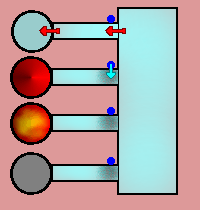
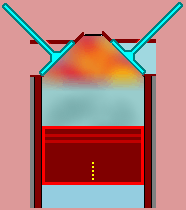
Inlet gas sequence in 4 stroke engine from Top-Bottom : |
When engine is partially loaded you have two theoretical mixture volumes in cylinder. Another one is burning volume, another is filler-pressure transmission volume. You can use the two-volume principle for calculating rough values for partial load.When you optimize the fire, you build the mixtures to inlet pipe. The first part which goes to cylinder misses fuel, at the end of the pipe you have mixture, which is burned in cylinder.
For the system you need separate inlet tubes, whose volume equals total volume of the cylinder ( displacement * compression ratio ). When you open inlet valve, the gas in the tube is replaced with new. Right before or after you have closed the valve, you spray fuel to the end of tube. New mixture has two strokes to stabilize before next stroke. With loosely timed mixing you get optimum mixtures and best powers for partially loaded engine. System is essential for boosted vapor creation. Vapor creation needs rich mixture, and by default partially loaded engine runs with thin mixture.
Partial load is controlled with the amount of fuel-air mixture you lead into cylinder. In practice you begin the spraying and mixing after or soon after inlet valve is opened. With pressure sensors, gas pedal positions, etc. you can adjust-optimize the mixing.
When you estimate vapor creation, you can start with fuel consumption. One liter fuel takes 15 liters air. From this air 20% is oxygen, so one liter fuel consumes 2.5 liters oxygen. Firing splits this 3.5 liter volume to vapors and carbon dioxide. For the calculation you need idle ... traffic light ... consumption. In cities you spend often over 50% from total drive time in traffic lights. Thing that gave me great faith in the future of copter cars. Traffic light consumption is always measured with fuel consumption per hour.
Possible to measure vapors from exhaust gases, with reasonable precision. You can even have a gauge on dashboard for exhaust gases vapors. And vapor creation. Standard equipment for real-life eco cars and environmentally conscious Californians. City people in general.
Copter cars thrust creation system is slightly different from vapor creation. In thrust creation you play with total volumes. The significant amount of inlet air is dependent on rpm and displacement. Small pressure change does not have much meaning.
- - - -
Possible that smog was only water vapors ?
I do not think so. Smog is approbation from Smoke Fog. Smoke's grayness obviously comes from the number of free carbon atoms. Carbon comes from excessive water creation. The powerful V8 of 1970 used 10.5 and 10.8 compression ratio. Amongst many other things, high compression ration and rich, powerful mixture explodes dirt in the air to atoms. Another possible source for carbon and gray scaled exhaust gas.In order to get rid of smoke, you must enrich and convert loose carbon atoms to carbon dioxide with oxygen ... or to some other chemical compound. In order to get some oxygen into catalyst converter you got to use very thin fuel-air mixture. Oxygen levels in exhaust gases remains almost unchanged, until you exceed the optimal for exhaust gas mixture. When you use thinner than 15.5 mixture, you have difficulties in getting and keeping the engine running.
When so, catalyst converter could use N2 atoms for binding the loose carbon atoms from exhaust gases. No idea what kind of compounds Nitrogen and Carbon can form. Without oxygen catalyst converter has to create nitrogen compounds from unburned fuel too. No idea what kind of compounds Nitrogen and Hydrogen can form. These Nitrogen compounds are not necessarily natural. Possible that catalyst converter does not do a thing.
Thin mixture and oil crisis cleared the skies from smog and common clouds.
Brought drought to Californians.
With sugar oil and retuned engines you can restore the humidity.What made thin mixture more economical.
Nothing. Thin mixture reduces the engine powers. Usually it increases fuel consumption per produced horse power. Thin mixture reduces the request for the power. It slows down the accelerations from traffic lights and so on. Pressure sensor tech brings a big boost to average traffic light acceleration times. New engine tech brings L.A. enough water and food for living. Sugar oil and sensors gives room for expansion in population and local wild life.How do you think that LA wild life will take the philosophy ?
Wild animals and plants always suffer more from drought than humans. When there is a drought, humans share from the water consumption grows. Human oriented consumption dries the rivers and lakes. There aren't any official water posts for the thirsty wild animals and plants. They have to suffer and die.Do plants suffer ?
They fight and struggle for their lives just like humans and animals. Quite a many goes to sleep before the natural death. Death in sleep is also a natural, painless dying method for animals and humans. It is the way we die.- - 15th Nov 2018 - -
What was the conflict in between midgets opinion and real life ?
Midgets said that, people will envy those, who can afford to drive with copter car. In real life, most who sees the copter car, wants to own and drive a vehicle like that. Common behavior is well known from example stories, which introduces dream cars and other expensive luxury cars.Knew in forehand, that when Saudi's get money from high oil prices, midgets cannot handle it. Each and everyone started to publish stories about poor Saudi-Arabian editor, who was ruthlessly killed in Turkey. Not a word about the lack of sugar oil was published. Very negative and pitiful individual often mistakenly thinks, that the thing that makes him angry and jealous, makes everyone angry and jealous.
You published biggest beneficiaries from high oil prices on purpose.
Yes, of course. Tried to make power keepers to do the right thing, unlock sugar oil. With sugar oil you do not have to get angry with Saudi's, oil prices stay low, every one happy. Locally farmed oil gives all the benefits to national economies.Unfortunately welfare of the fellow citizens is another thing, which seems to make some others very or overwhelmingly angry and jealous. When so, you can never actually do anything good for the local, national welfare. The good things always stay at the talk-cheat-lie levels.
Pressure Sensors and Semi diesel / 16-Apr2018
| Fuel | Flash | % | Components |
| Drilled Oil | 220C | 100.0 | C80-83+H10-13 |
| Diesel | 250C | 104.8 | C87+H13 |
| Petrol 95 | 300C | 103.6 | C86+H14 |
| Petrol 98 | 400C | 103.6 | C86+H14 |
| Ethanol | 420 C | C52+H13+O35 | |
| Methanol | 480C | C38+H12+O50 | |
| Air Petrol 102 | 500C | 102.4 | C85+H15 |
Diesel engine, which does not have adjustable ignition point, can be optimized for one efficient rpm and load ( fuel-air mixture ) only. In heavy vehicles, ships and generators it does not matter much, they run with steady rpm and steady load almost all the time. Semi diesel will improve diesel engines quite a lot. Sedans, Vans ... Trucks, Buses and smaller boats are the biggest beneficiaries. Possible that some day semi diesel replaces both diesel and petrol engines. For that it needs better air filtering system. The inlet air should be almost 100% clean from dirt, small particles.
Later there has been quite many, who thinks, that semi diesel will never come true. Air pollution is the reason for that.
Semi diesel is not necessarily very far from reality. Semi diesel is an engine, which uses diesel engines compression ratio and petrol engine's ignition and fuel injection systems.
Knocking prevents the construction of high compression petrol engine. Knocking breaks heads and blocks. Without knocking you could use common petrol with diesel engine's compression ratios. Diesel engine's compression ratio is around 20:1, the highest for petrol engine is considered to be around 10:1, with 98/99 octane petrol.
The latest version from Ferrari V12 engine uses 13.6:1 compression ratio. It works with 98 octane petrol. Both block and head are made from aluminum. With good design and proper materials you can get closer to the required 20:1 ratios. In principle, it should be easier to raise the structural knock resistance in common engines.
Not known how much you could raise the compression ratio with aviation gas. Air petrol's octane number is around 102. The higher octane allows higher compression ratios.
From the table on the right you see, how octane number raises, when you decrease carbon and increase hydrogen. You can also see, that flash point and octane number have a direct connection. And that diesel flashes into fire easier than petrol. Difference in between 95 and 98 octane is made with chemicals. Have a hunch, that although flash points are near, diesel will not run with 95 octane petrol.
In Ferrari FF, the previous version from this praised 6.2 liter V12 engine won an award from being the most uneconomical car and engine in the world. In Ferrari 812 Superfast V12 produces 800 hp at 8500 rpm. In Ferrari GTC4 Lusso engine produces 690 hp at 8000 rpm ( compression ratio in this version is 13.5:1 ). All three consumes less fuel than my Chevy Van from the year 1991.
The initial origin of Ferrari V12 seems to be Dino V6 engine from the mid 1960's. The base design of this V12 engine have been used in Ferrari Formula-1 cars. When I checked, Ferrari V12 was the only one, which uses over 10:1 compression ratio. Thought first, that there is an error in GTC4 specifications.
Since it is possible to exceed the rule of thumb, it looks like, that knocking comes from pressure changes and vibrations in block / head. Not from the uncontrolled burning. If old claims about uncontrolled burning were true, this V12 would not need spark plugs for igniting the fuel-air mixture. In principle, the higher pressure / ratio increases the temperature, it does not lower the flash point. Pressure obviously raises the flash point, just like it does to boiling point.
- - -
The percent column in the table shows how many ground oil barrels you need for distilling one barrel per quality. Production of diesel costs slightly more than petrol. Oil distiller tower is not booze distilling tower. It is more like steamer-thinner system. Oil fumes takes their places in the tower with density / weigh. If diesel dies, you do not collect oil from diesel's level. You collect more from the petrol output. And that's almost all. If you increase the temperature, you must recalibrate the tower. All newer towers have calibration systems and output adjusters.
When two qualities have as many carbon and hydrogen atoms, tower always outputs the qualities from the same pipe. Separation must be made afterwards.
 Heavy
duty engine - Saturday 9th June 2018
Heavy
duty engine - Saturday 9th June 2018
What kind of a thing semi-diesel is ?
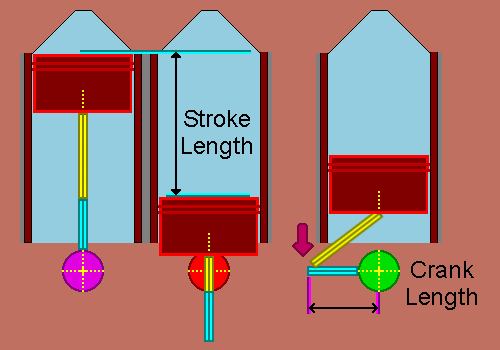
Disadvantage of heavy duty petrol is short stroke length. Long stroke creates the torque to crankshaft. But when you look at the picture on right, the actual torque-momentum comes from crank length. Not from stroke length.
This gives you a chance to create diesel engine's torque to heavy duty petrol's crank system. You can do that by reducing the number of cylinders in your engine.
If you have eight liter 8 cylinder diesel, with six cylinders and bigger piston diameter you can get the same momentum to the crank system, than with diesel engine. With six cylinders and bigger pistons, you can use the same crank system and crank length than with 8 cylinder diesel.
With 6 pistons, you can obviously increase the crank length of your engine. Wider pistons increases space for crank system. In actual engine you can never cut the cylinder walls for the crank system, like in the picture. Cylinder must always cover the whole piston.
Bigger piston-cylinder diameter and relatively shorter stroke is needed for eliminating knocking.
Since heavy duty petrol do not knock, the engine does not have to be as strong as diesel. It is lighter and cheaper than diesel.
Think that there will be 3 and 5 cylinder semi diesels ?
Don't know. There has been 3 cylinder four stroke engines. 5 cylinder layout was first used in heavy duty engines, Fiat tractors were the first, which had 5 cylinder diesel engines. They were used in mid-sized models. Father sold Fiat tractors, when they came. Saw and read all background information from 5 cylinder system at home.1, 2 and 3 cylinder light-medium duty engine needs at least big flywheel. All or part of the compression is made with flywheel. 4 cylinder engine is the first, where mixture is always compressed with engine power.
When you increase the size of 4 cylinder medium duty engine, you can use sensor tech for optimizing power production. Keeping the engine economical.
AC Spark Plug
With alternate current spark plug it would be possible to create directional electric waves into cylinder. A/C plug allows you to set the top of mixture into fire almost at the same time. A/C wave spreads into all directions. With resistor cap at the bottom of the plug you can block vertical waves. Engine explodes, if you set all of the mixture into fire at once.
AC wave can move in the air, over the valve system. But AC wave will lead the current into ground. It does not vanish like DC current. It makes AC plug difficult in cars. In big ship-industrial engines AC plug is possible.
In short stroke, wide piston car-boat engine you should at least use DC plug, which ignites the mixture into fire from the sides.