( Jack : 2010 - 2017 )


| R&D Cars | Base Engine Gases Gears Tires Steer | Misc Jets Fast Fees Futu ATS | Jack Answers |
|
Cars - Steering and rods ( Jack : 2010 - 2017 ) |
|
| Tights | .. |
4 wheel steering - 10th October 2019
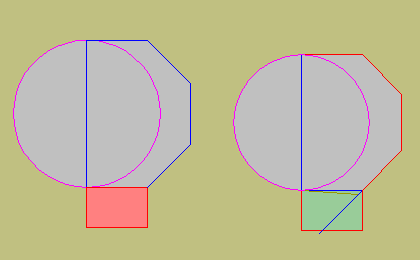
In the picture you see system, which could be somewhere near steering and 4 wheel steering. Steering belongs to chained physics.
- When you turn car and put wheels into 45 degrees angle, car's front moves sideways with 45 degree angle all the time.
- Wheelbase is well known to affect to turning radius.In the picture the chain is simplified into three 45 degree turns. The length of simplified line is car's wheelbase.
In the picture wheelbase is 3 meters. Angle of the front wheels is 45 degrees.In the left car's inner turning diameter is 7.24 meters. And with pictures 2 meter width outer circle is 11.24.
In the right rear wheels are turned 5 degrees. The rear wheel turn is used for reducing the wheelbase.
With 5 degrees angle wheelbase falls to 2.76 meters. With this wheelbase inner circle is 6.64 meter, outer 10.64.Results should be rather near reality.
In reality rear wheels pushes rear farther from the front all the time. This push makes the 4 wheel steering fast and efficient.
|
|
Turn theory Turn in sideways creates momentum, that prevent movement of the front sideways. At rear wheels the momentum tries to move wheels side ways. When so, tires' steering in sideways increases the turning diameter. If tire has theoretical 0% stiffness in sideways, the car doesn't turn. It moves in sideways, and keeps the direction. Same sideway movement happens, when you have only one wheel steering system. Turn needs always two mounting points. The turning center comes from the momentum. The momentum changes
direction at the longitudinal weight center. Rear follows the front wheels with momentum and body based connection
to front wheels. Detailed calculations are possible with momentum, wheelbase, weigh
center and front wheels angle. 4 wheel steering moves rear wheels farther from front wheels, with
rear wheels steering angle. When you move the
rear farther from front, you make the car act like a car with short
wheelbase. When car is in 4 wheel steering mode, the weight center should lose it's meaning for the momentum. Weight affects to the grip and tires own sideway movement in it's air space. Never seen tracks from 4 wheel steered car. Have a hunch, that tracks and shortcutting would match car with shorter wheelbase and 2 wheel steering. In theory it might be possible to build a good full-time fixed 4-wheel steering. Build a system where front and rear wheel angles are optimized for the steering angles. Switch into park mode after angle grows enough. Such system would reduce uncontrolled sideway movements at rear wheels. System could optimize also outer and inner wheel angles. Computer controlled steering for a car with softer suspension is obviously rather ambiguous. Possible that you end into continuous addition of sensors and subroutines, that handles various tilts and suspension events. A bigger rock in the curve, under only one wheel is an example from the thing, that can mess up your routines. The rock and it's movements are nothing for fixed steering. When you take control over steering, you must handle the rock's disturbance in your program. In principle you give up from the control only then, when some emergency sensor goes on. Designing steering When you build electric
steering, first you design default steering. After this you can build more sophisticated electrically assisted hydraulic or electric system. All electrics for at least the brakes should also have documented override switch ( if not in dash ). Override systems must be made so good, that 3rd, 4th, 5th, 6th, ... owner can use the car and take the car to inspections with override switches on. In order to keep the sales of the new cars running, you must ensure, that the car does not become unwanted during it's lifetime. Bad reputation is easy to gain with poor electrics. Bad reputation drops the resale value. Low resale value has strong effect to the sales of the new cars. Nobody wants a car, whose value falls twice as quickly as others. If all cars have a bad reputation, the overall car sales falls. Politics are very familiar with the effect of the overall bad reputation. In all countries there has been a time, when electoral activity was 80-90%.
|
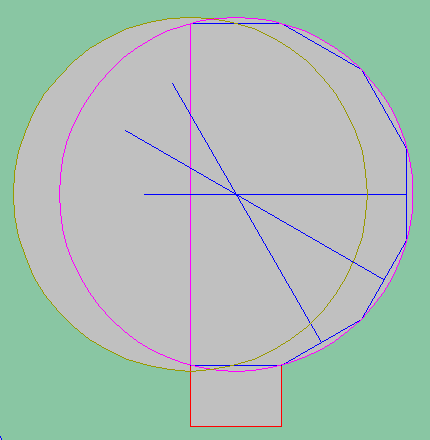
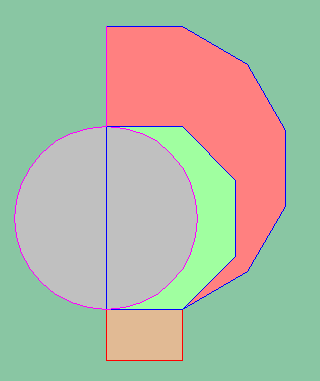 Front wheel turns with 45 and 30 degree angles. Front wheel turns with 45 and 30 degree angles.When you simplify the turn, you make as many segments as it is needed for 180 degrees turn. Formula and system has a built in logics. - In chained physics you can usually simplify the system. Credit demands applies also to super smarts, who knows everything,
without knowing anything ... |
Where do you need new theory and explanation about steering ?
Only the super smart ad-sellers, Google and midgets can steer car with computer, without proper mathematical presentation from the steering. They are not bound to reality.You need explanation and calculations for the intended parking aid and for optimizing steering. When you optimize the steering angles, wheels have better grip in curves. You either take curves faster or alternatively get better safety in curves. Theory, which belongs to chained physics, is brand new, there aren't any other vehicle level theories about steering.
And with gas spring flywheel you collect braking energy from the traffic light stops, and use the collected energy in the next traffic light start.
Gas spring flywheel is based on new definition of pressure. Pressure is potential kinetic energy. Hydraulic power transmission has many advantages when compared to mechanical system. With combustion collectors and other alternative power sources robust integration you can convert the hydraulics poorer efficiency into a huge advantage.Brakes are powered with hydraulics. With discs and drums it is not possible to collect the energy, they convert kinetic energy into heat and dust. You need a propel or turbine, whose power creation slows down the wheel. Hydraulic brake needs overhauling after 200 000 - 300 000 km. In between the unit is care and fault free. Closed unit doesn't get stuck like mechanical brakes. Unit can be designed so, that you can also power the wheel with it.
Dust creation ?
Dust creation, removal of the small particles from the pads and discs, needs lots of energy. If you have million cars, whose average mileage 10 km a day, daily mileage grows to 10 000 000 km. If brake pad last around 100 000 km, city consumes 4 x 100 pads per day. Around 100 kg per day is not very big amount in big city. Pads are nowadays asbestos-free, their dust's hazardous effect is not that big anymore. Asbestos endangers your health and ruins your lungs.Hydraulic brake unit should be lighter than mechanical. Same lightness goes to hydraulic crank, gas spring flywheel and hydraulic transmission, too. Combustion collector has many steel tubes and steel axles, they raise the weigh.
Longitudinal control bars, with weight distribution system 27th October 2018
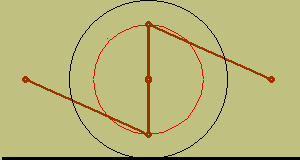
Side projection for weight distribution rod system.In the picture you see weight distribution bars for dragster. In the system you have two longitudinal rods. Another is in front and another in back of the wheel. They are connected together with third rod. Third rod or rods are connected to wheel / axle. When you have stiff axle, you can weld the third rod into it.
With the system you can reverse or boost the acceleration forces, which raises or lowers the body. Schematics for front and rear wheel driven car are opposite.
It is also possible to use the same side for both body-to-axle mounting rods. When you do so, you play with rod lengths and mounting points. Most old rear wheel driven cars with stiff axle has the system in it's rods. Lower rod is below the axle, upper and shorter rod is over the axle.
In independent suspension longitudinal rod system is the best. During suspension event, the movement of wheel goes to rolling and speed. Not to lateral movement. With longitudinal rods you can use softer springs and longer suspension ranges for your car. Without making a total mess from the safety in curves.
The presented three rod system does not prevent movement of the wheel during suspension event. You can only reduce the suspension time movement.
You can naturally use more the one rod set per wheel. Like for example first set before and second after the mounting for the spring.
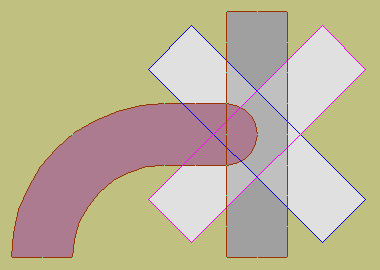
Top projection for longitudinal rod for steered wheel.
When wheel turns into both directions, straight longitudinal rod is the only possible rod.Front wheel driven car uses almost always lateral or heavily tilted rod systems. It is needed for providing space for steering the car with front wheels. Quite often axle has only one mounting point. Lateral slide is one possible reason for push feature in the curves.
Longitudinal rod system in front wheel needs a short axle, axle can be included to rods. Orientation of wheels suspension-time move comes from the orientation of the mounting. There has been some Mc Pherson suspensions, with small tilt angle. Mc Pherson is the most common front suspension in private cars.
Bar in the picture suits well to Mc Pherson, where the top mounting allows moves to all directions.
Front wheel driven powerful car would need distribution systems. Traction system releases the gas pedal and prevents the usage of full power. Weight distribution system keeps the traction control quiet. Weight distribution usually needs redesign to outmost bottom beam. It is usually too low ( near ground ) for getting height to the distribution system. Might want to enforce or build a beam in between the left and right mountings. Enforce the car sideways, improve the strength of passenger compartment.
Ends of the steering rods moves with wheel-rod system.